
PPF Self-Healing: What Temperature Does It Actually Need?
Quick answer: None of the six paint protection film makers we read publishes a temperature the film must reach to self-heal. We read the published care documents for six films and found two water temperatures and not one activation threshold. The widely quoted 49°C, or 120°F, is real — but in both documents printing it, it describes warm water you pour on the panel.
Key Takeaways
- None of the six paint protection film makers we read publishes a temperature the film must reach to self-heal. We read the published care documents for six films and found two water temperatures and not one activation threshold. The widely quoted 49°C, or 120°F, is real — but in both documents printing it, it describes warm water you pour on the panel.
- The only published baseline is room temperature. XPEL, a film we do not install, is alone in stating one: light scratches "will self-heal in 20-30 minutes at room temperature", with warm water offered only "in colder conditions, or to accelerate the process". Two further films outside our set, Avery Dennison and Hexis, likewise describe healing at room or ambient temperature in words.
- Three of the six describe self-healing in words and publish no temperature for it, and a fourth claims it needs no heat at all. Where 3M and STEK do print figures, those belong to installation, washing or material limits. 3M names self-healing and heat in its Pro Series 200 gloss data sheet and quantifies neither; its matte bulletin does not mention heat at all; and its Installation Guidelines, Revision D, July 2026, contains zero occurrences of self-healing. 3M is the only one of the six brands that puts a revision letter and a date on anything: the care pages of the other five carry neither. SunTek and STEK publish no healing temperature either.
- The one temperature STEK does publish is a melting point, not a healing point: "The melting point of TPU (PPF) is 175 degrees Celsius or 347 degrees Fahrenheit." It is the ceiling, not the target, and it is the only figure in the set that answers how hot is too hot.
- The only heat-gun temperature any of these documents gives belongs to installation, not to healing. 3M instructs installers to "heat set all film edges with a heat gun at approximately 180°F (82°C) after completing the installation" — a professional step performed at the edges of freshly fitted film, which is a different job from warming a scratch in your driveway.
- One film in the set claims the question does not apply to it. KAVACA Instant Healing, published by the company behind Ceramic Pro, states it will "recover small and medium scratches in a matter of seconds without heating". That is marketing copy rather than a specification, and it is a film we do not install.
- Our own pages were part of the problem and we have corrected them in the same update that published this. Across this site we had published three incompatible activation figures — around 22°C, around 49°C, and 50 to 60°C — and three incompatible temperatures at which healing supposedly pauses. Several of those figures were attributed to 3M or STEK, neither of which publishes them.
- For Calgary the useful comparison is against room temperature, not against 49°C, because 49°C was never a description of ambient air at all — it is a water temperature. Calgary air reaches 20°C on about 87 days a year, and on about 59 days a year it does not get above freezing at all, which makes a heated garage the practical answer for most of the year rather than sunlight.
- Air temperature is not panel temperature, and the difference cuts both ways. A dark panel in direct September sun runs well above the air around it, and the same panel overnight in January runs below it. Every climate figure here is an air temperature measured at the airport, not a reading off your paint.
- A depth test predicts whether a mark will heal better than any thermometer. STEK publishes the useful sentence: if a scratch penetrates the topcoat, it will not self-heal. If a fingernail catches in the mark, heat is unlikely to be the answer, and more heat is a way to damage film rather than recover it.

Somewhere in the last few years the paint protection film industry decided that self-healing begins at 49°C. The figure appears on manufacturer resellers, on detailing blogs, in forum answers given with complete confidence, and — until this week — in three mutually incompatible forms on this website. So we went and read the documents.
The number is real. It is just not what everybody thinks it is. And the thing it actually describes changes the answer for anyone trying to work out whether their film will do its job in a Calgary February.
What temperature does PPF self-healing need? The short answer
None of the six film makers we read publishes a temperature the film must reach. We read the care documents for six films and found two water temperatures and not one activation threshold. The 49°C figure in circulation is 120°F, and in both documents that print it, it is the temperature of warm water you pour on the panel — a remedy, not a condition. The only baseline anyone states is room temperature: XPEL says light scratches self-heal in 20 to 30 minutes there, with warm water offered only for cold conditions or to hurry it along. We install 3M, STEK, SunTek, GSWF; we do not install XPEL or KAVACA.
What the six films actually publish
Four of the six films below are ones we fit every week. Two are not, and those two are quoted hardest for exactly that reason. Read the sentences rather than the summaries — in this subject the summaries are where the damage happens.
Six films, two water temperatures and not one activation threshold
Select a position to read the sentence it comes from. Four of these six are films we install. The two we do not install are quoted hardest, which is deliberate — we have no commercial reason to soften them.
The only document that gives a baseline and a clock
"Light scratches in the film will self-heal in 20-30 minutes at room temperature. In colder conditions, or to accelerate the process, pour warm water (120°F) over the affected area."
What it means. Read that sentence pair slowly, because almost every article on this subject has read it backwards. The baseline condition is room temperature and the film is expected to do the job on its own in twenty to thirty minutes. The 120°F figure is not the point at which healing begins. It is the temperature of water you pour on the panel when the car is cold or when you are impatient, and the sentence says so in as many words: in colder conditions, or to accelerate the process. That is a remedy, not a threshold. It is also the only place in any of the six where an owner is given a time to wait, which matters more than it sounds, because the commonest way this goes wrong is an owner deciding after five minutes that the scratch is permanent. And note what is absent even here: no minimum temperature, no statement of what happens below room temperature beyond the suggestion to pour water, and no upper limit on anything.
Do this: Give it half an hour somewhere warm before you conclude a mark is permanent. That is the manufacturer's own window and it is longer than most people wait.
The same number, and again it describes the water
"Self-Healing: If you see light swirl marks, park the car in the sun or pour warm water (approx. 120-F) over the area. The TPU will “flow” and self-level." … "Heat (sun/warm water) heals minor scratches."
What it means. Our own supplier publishes the same figure as XPEL and attaches it to the same object: a jug of water, not the film. Two alternatives are offered as equals — park the car in the sun, or pour warm water at roughly 120°F — which tells you the document is describing two ways of delivering heat rather than naming a temperature the film must reach. Sunlight has no stated temperature at all. Two further details are worth having. The self-healing bullet sits under the gloss and colour-infused heading, and the satin, matte and stealth subheading that follows it contains no self-healing line whatsoever, which is a gap in the document rather than a prohibition. And the guide states the instruction a second time on its summary checklist, where the number disappears entirely and it becomes simply heat, from sun or warm water. When a document states its own rule twice and drops the figure the second time, the figure was never carrying the weight.
Do this: If your film is GSWF and the finish is satin or matte, the guide does not cover self-healing for your finish. Ask us rather than assuming the gloss instruction carries over.
Named in two documents, absent from the third, quantified in none
"Self-healing technology to remove minor scratches or marks with heat applied to the film surface." (Pro Series 200 Gloss technical data sheet) … "Self-healing technology allows minor scratches to disappear." (Pro Series 200 Matte product bulletin, which does not mention heat)
What it means. 3M is the most heavily documented film in the set and it is the one that quantifies this least. The gloss data sheet names the mechanism and names heat, and stops. The matte bulletin names the mechanism and does not even name heat. And the installation bulletin, which behaves like a controlled engineering document, does not raise self-healing at all: a machine search of it returns the letter string only inside the word Health. 3M is the only one of the six brands that revision-controls and dates anything, which is what makes that silence carry weight. That absence is worth more than a number would be. This is a company that will tell you the maximum pressure of a washer in bar, the permitted water temperature, the nozzle angle to within ten degrees and the optimal ambient range for fitting film to a car. If a healing threshold existed as a specification, this is the document it would be in, and it is not there.
Do this: Treat the silence as informative. The most rigorously specified film in the set declines to give this number, which is a reason to distrust anyone who quotes one confidently.
A fourth sets the lowest bar in the set, in words only
"This top coat protects the urethane against surface damage, while the self-healing surface repairs the majority of scratches utilizing the heat of the sun, a warm body panel, engine heat or warm water."
What it means. Four heat sources, no figures, and the bar set lower than anywhere else in the set. A warm body panel qualifies. Engine heat qualifies. Neither of those is 49°C on a February morning in this city, and SunTek plainly does not think it needs to be. Notice also the honest hedge that most summaries of this sentence quietly drop: the majority of scratches, not all of them. That single qualifier is doing real work, and it is the difference between an accurate expectation and a disappointed owner. Notice too what SunTek does not do: it never names a temperature, never names a season, and never treats cold as a case requiring separate instructions. Whether that is confidence or omission we cannot tell you, because the document does not say.
Do this: A short drive is a heat source the manufacturer itself names. Warming the panel by using the car is a legitimate first move before you reach for anything hotter.
A fifth publishes a temperature — for the wrong thing
"STEK top coated paint protection film (PPF) has a self-healing ability so light scratches can be removed by hot water or the use of a heat gun over the affected area. Note that if a scratch penetrates the topcoat, it will not self heal." … "The melting point of TPU (PPF) is 175 degrees Celsius or 347 degrees Fahrenheit."
What it means. STEK licenses the most aggressive method of the six — a heat gun, named explicitly and without qualification — and then declines to say how hot. What it does publish is a melting point, which is the temperature at which the material is destroyed rather than the temperature at which it recovers. Those two numbers get conflated in the wild, and the conflation is dangerous in exactly one direction, because an owner who reads 347°F as permission is holding a tool that reaches it easily. The second sentence is the useful one and it is the closest thing in the entire set to a diagnostic an owner can run: if the scratch has gone through the topcoat, no amount of heat will bring it back. That is a depth test, not a temperature test, and it is a better predictor of whether a given mark will disappear than any thermometer.
Do this: Use the depth test before the heat. If a fingernail catches in the mark, you are probably past what heat can recover, and more heat is the wrong answer.
A sixth says the whole question does not apply
"Kavaca Instant Healing Paint Protection Film is a high-tech PPF with self-healing and nonyellowing properties. Kavaca Instant Healing will recover small and medium scratches in a matter of seconds without heating." … "Instant scratch healing without heating."
What it means. One film in the set markets itself on not needing the thing every other document treats as essential, and it is worth taking seriously rather than dismissing, because it demonstrates that the heat requirement is a property of particular topcoat chemistries rather than a law that governs all paint protection film. That is the honest version of the point. Here is the limit of what this establishes. It is marketing copy on a product page, not a specification: no time under laboratory conditions, no temperature range over which the claim holds, no test standard cited for the healing claim itself, and no independent measurement we could find. The page does cite a named testing institute, but for non-yellowing rather than for healing. So the correct reading is that a manufacturer asserts a capability, not that a capability has been demonstrated. We do not fit this film and we are not in a position to tell you it works.
Do this: If a shop sells you a film on an instant-healing claim, ask which document the claim comes from and what it was tested against. Marketing copy and a specification are different objects.
How a jug of water became a material property
Here is the whole error in one move. Two manufacturers tell you to pour warm water at about 120°F over a scratch. Strip away the sentence those words live in and you are left with a bare number next to the phrase self-healing. Convert it to metric and it becomes 49°C, which sounds like a physical constant rather than the temperature of a kettle left to stand. From there it only has to be quoted once by somebody authoritative before it is a fact that everybody knows and nobody sourced.
The tell is that no document in the set ever says the film must reach any temperature. They describe things you can do — park it in the sun, pour warm water, drive it, apply heat — which is the language of a remedy. And the makers who describe the passive case put the bar startlingly low. XPEL says room temperature, unassisted, in twenty to thirty minutes. SunTek says the sun, a warm body panel or engine heat will do it, and GSWF offers parking in the sun as an equal alternative to the jug. None of those is 49°C and neither is meant to be.
Two films outside our six say the same thing in their own words, which is worth knowing because it means the room-temperature finding is not one brand being unusual. Avery Dennison describes scratches disappearing at room temperature on its gloss and matt finishes, needing heat only on gloss black — a finish-dependent distinction none of the six draws. Hexis writes that its clear film is self-healing at ambient temperature, full stop.
Finish-dependence is worth pausing on, because it is the one place a manufacturer has drawn a line that our industry ignores. GSWF puts its self-healing instruction under gloss and colour-infused film and writes nothing about self-healing under satin, matte and stealth. Avery Dennison makes heat necessary only on its gloss black. If your car wears a satin finish, the guidance you have been reading was probably written for gloss, which is the same pattern we found running through the makers' conflicting instructions on caring for satin film.
Where the invented numbers come from
We watched the mechanism operate during this research, which was more instructive than finding the documents. A search turned up a precise, technical-sounding claim attributed to one European film maker: self-healing within one minute at 72°F, instant at 85°F. Specific, plausible, exactly the kind of detail that gets cited. It is not that manufacturer's text. It is a reseller's product description, and the manufacturer's own published guide contains no Fahrenheit healing figure at all.
That is how this works. Retailer copy acquires the authority of a specification simply by sitting next to a brand name, gets quoted by an article, and the article becomes the source for the next one. By the fourth generation there is a number with no document under it and a chain of citations that looks like evidence. We are not innocent bystanders here — our own site had picked up three different versions of this figure, and in several places had attributed them to 3M or to STEK, neither of which publishes any such thing.
What room temperature means in a Calgary year
Now the comparison that actually matters. It is tempting to set 49°C against a Calgary winter and declare self-healing dead for half the year, and that reasoning is wrong in the same way as the claim it is attacking. Calgary's warmest month averages a daily high of 23.2°C, less than half that figure — but the gap rules out nothing, because 49°C was never a description of the air at all. It is the temperature of water in a jug. Set the real baseline against the real climate instead.
Those are Environment and Climate Change Canada normals for the airport, and they say something more useful than a winter verdict. For roughly 87 days a year the air outside reaches what a manufacturer would call room temperature, and for roughly 59 it never gets above freezing. In between sits most of the year, when the answer is neither yes nor no but depends entirely on where the car spends its time.
One caveat that cuts both ways, and it is why we will not turn these figures into a rule. Air temperature is not panel temperature. A dark bonnet in direct September sun runs well above the air around it, which is why September behaves better than its numbers suggest. The same panel at three in the morning in January runs colder than the air. Nothing here is a reading off your paint. What it does establish is that for most of a Calgary year, the reliable way to get a panel to room temperature is a heated garage rather than the sky — and that is a mundane conclusion, which is usually a sign it is the right one. If you are weighing up whether film earns its keep in this climate at all, our guide to how PPF behaves through a Calgary winter covers the durability side of that question.
How hot is too hot? The only ceiling anyone publishes
This is the question the whole subject is missing, and it is the one that can actually cost you a panel. Every article lists sun, warm water and a heat gun as interchangeable options. They are not interchangeable, and the documents are quietly clear about that even though none of them says so directly.
| Figure | What it is | Who publishes it |
|---|---|---|
| Room temperature, 20-30 min | The only stated passive baseline and the only stated timeframe | XPEL (we do not install it) |
| Approx. 120°F (48.9°C) | The temperature of warm water you pour on the panel — the figure that circulates as 49°C | XPEL (as 120°F, and as 48°C in its UK edition) and GSWF (as 120-F) |
| Approx. 180°F / 82°C | A heat gun setting for heat-setting film EDGES during installation | 3M — an installer step, not a healing instruction |
| 175°C / 347°F | The melting point of the film. A destruction threshold | STEK — the only ceiling in the set |
Lay those out and the gap is obvious. The only two figures written for an owner describe water. The two higher figures were written for someone else entirely: one is a professional installation step performed at film edges by somebody who does it daily, and the other is the temperature at which the material stops existing. That is the trap the table above exists to break.
One number, two opposite jobs: do not confuse 140°F with 120°F
This trap caught us, so it is worth flagging plainly. 3M publishes a maximum washing water temperature — if a pressure-washing system is heated, the water is limited to 140°F (60°C) or less. That is a ceiling you must not exceed. Separately, XPEL and GSWF suggest pouring water at about 120°F over a scratch, which is a remedy you may choose to apply. Until this update two of our own pages published a healing range written as 50 to 60°C, or 120 to 140°F, which collided the two: it presented 3M's washing ceiling as a healing target on the same site where we correctly quoted it as a limit. Both figures are now stated only in their own context. The washing limit and the rest of 3M's pressure specification are set out in our breakdown of what each film maker publishes about pressure washing.
Owners on enthusiast forums describe outcomes in both directions — near-boiling water achieving nothing where a heat gun later worked, and film permanently marked by somebody who assumed more heat was better. We would treat all of that as anecdote rather than evidence, and it is anecdote that points the same way our own bay experience does: warm water is slow, forgiving and hard to get wrong, and a heat gun is fast, unforgiving and easy to get wrong. If warmth and time have not worked, the problem is usually depth rather than temperature, which is where what polishing can and cannot safely do to film becomes the relevant question instead.
The test that beats a thermometer
Buried in STEK's FAQ is the most useful sentence we found across all six films, and it has nothing to do with heat: if a scratch penetrates the topcoat, it will not self-heal. That converts an unanswerable question into a five-second check anybody can run.
Run a fingernail lightly across the mark. If it glides over and the line shifts as you move your head, that is marring in the topcoat and it is precisely what the layer exists to recover — give it a warm panel and half an hour. If the nail catches, the damage is through the layer that heals, and the decision is no longer thermal. It is whether to live with it or replace that piece of film. Applying more heat at that point does not recover anything and does put the film at risk.
It is also worth being clear about what none of this touches. Self-healing is a cosmetic property of the topcoat. It is not the reason the film is on the car. The reason is the impact layer underneath it, which is doing its job on a gravelled Deerfoot in March whether or not the surface above it is warm enough to erase a wash mark. If you are choosing between films or coverage levels, that is the property to weigh — our comparison of full-front against full-body coverage is the more useful read there, and current Calgary PPF pricing sets out what each level costs.
What we corrected on our own pages
We would rather publish this than quietly fix it. Before this update, this site stated that self-healing activates at around 22°C, at around 49°C, and at 50 to 60°C, depending which page you landed on. It also gave three different temperatures at which healing supposedly pauses. Worse, several of those figures carried a brand name — 3M and STEK were both credited with numbers that appear in nothing either company publishes.
All of it has been corrected in the same commit that published this article, and the corrections point in an uncomfortable direction: our lowest figure was closer to the manufacturers' own position than our confident middle one. Every page that previously implied a Calgary winter sun is enough to heal a panel now says what the documents support instead. If you find a page of ours that still carries an unsourced activation figure, tell us and we will fix it.
Two of those corrections are worth naming because they were the most confident and the most wrong. Our guide to how the self-healing topcoat works on coloured film carried the figure in several places and attributed it to a named film maker. Our comparison of the film brands we fit credited another with a temperature below which healing pauses. Neither company publishes either number. Both pages now describe what their makers actually say.
What we do about it in our own bay
Labelled as our practice, because no manufacturer publishes cold-weather healing guidance and we are not going to dress our habits up as somebody else's instruction. We bring the car into a warm space and leave it properly warm rather than briefly warmed — a panel that has been at temperature for half an hour behaves differently from one that has had a hot rinse. We use warm water rather than a heat gun on anything a customer could reasonably have done themselves. We run the fingernail test before promising anybody that a mark will disappear, and we say so when it will not. And on satin and matte finishes we check the film maker's own guidance for that finish rather than carrying the gloss instruction across, because at least one of our suppliers simply does not address self-healing under its satin heading.
If a mark on your film has not moved after genuine warmth and genuine patience, that is worth a look rather than another attempt with something hotter. Talk to us on (587) 323-3222 and we will tell you honestly whether it is a heat problem or a depth problem.
Ready to Protect Your Vehicle from Rock Chips?
Join 705+ Calgary drivers who trust Obsidian Auto for PPF installation
Serving Calgary and surrounding areas • Free Uber shuttle with every service
Frequently Asked Questions
Sources
External references used in this guide
- XPEL — product care instructions. The only document in the set publishing both a baseline condition and a timeframe: "Light scratches in the film will self-heal in 20-30 minutes at room temperature. In colder conditions, or to accelerate the process, pour warm water (120°F) over the affected area." SCOPE NOTE: the sentence pair appears three times on the page, once each under ULTIMATE PLUS, ULTIMATE FUSION and STEALTH, so it is the mainstream instruction for its flagship films. The page is undated. IMPORTANT: we do not install XPEL film, which is why it is quoted here at full strength
- XPEL UK — film care. Cited only to record that the UK edition carries the same instruction in metric, "pour warm water (48°C) over the affected area", alongside the identical room-temperature sentence. 120°F is 48.9°C, so this is a difference of units rather than of substance and no regional split is claimed here
- GSWF — Official Maintenance Guide (PDF). Source of the second water temperature, from section 4, Maintenance by Finish Type, under the subheading Clear Gloss & Color Infused (Gloss): "Self-Healing: If you see light swirl marks, park the car in the sun or pour warm water (approx. 120-F) over the area. The TPU will 'flow' and self-level." Also the source of the same rule restated without a figure on the page-2 summary checklist, "Heat (sun/warm water) heals minor scratches", and of the capacity warning that brush washes cause micro-scratches which may exceed the film's self-healing capacity. SCOPE NOTE: a two-page image-only PDF with no text layer, no revision code and no printed date, so these were read from the rendered pages; the figure is printed as "120-F". The satin, matte and stealth subheading contains no self-healing line. GSWF is a film we install
- 3M — Scotchgard Paint Protection Film Pro Series 200 Gloss, Technical Data Sheet, Revision B, March 2024 (PDF). Source of 3M's self-healing sentence: "Self-healing technology to remove minor scratches or marks with heat applied to the film surface." Heat is named; no temperature is given. The same sheet publishes application temperatures of 60°F to 85°F (16°C to 30°C) with 70°F to 79°F (21°C to 26°C) as optimal — figures for fitting film to a car, not for healing it. 3M is a film we install
- 3M — Scotchgard Paint Protection Film Pro Series 200 Matte, product bulletin, November 2023 (PDF). Cited for a narrower claim than the gloss sheet makes: "Self-healing technology allows minor scratches to disappear", with no mention of heat at all. Read as the second of three separate 3M documents consulted for this article
- 3M — Paint Protection Film Installation Guidelines, Instruction Bulletin, Revision D, July 2026 (PDF). Cited as a verified absence and for one installation figure. A machine search of this bulletin returns zero occurrences of self-healing — the only hits for the letter string are inside the word Health. 3M is the only one of the six brands that revision-controls and dates its published documents; the care material from the other five films carries neither. (Avery Dennison, cited below as corroboration and deliberately outside the six, also dates and revisions its data sheet.) SCOPE NOTE ON THIS URL: the hosted filename ends -rc- while the revision printed inside the PDF is D, July 2026, which is the revision cited here and was read from the document itself. Source of the heat-gun figure quoted here, which belongs to installation rather than to healing: "Heat set all film edges with a heat gun at approximately 180°F (82°C) after completing the installation." Also the source of the application-temperature range restated in this article, and of the three washing and pressure figures cited here to show how densely this bulletin specifies everything except self-healing: "If the system is heated, limit the water temperature to 140°F (60°C) or less", "Use a maximum pressure of 80 bar", and the instruction to hold the nozzle "perpendicular (90 degrees +/- 10) to the paint protection film"
- STEK — published frequently asked questions. Source of the heat-gun licence, of the depth test used throughout this article, and of the only ceiling figure in the set: "STEK top coated paint protection film (PPF) has a self-healing ability so light scratches can be removed by hot water or the use of a heat gun over the affected area. Note that if a scratch penetrates the topcoat, it will not self heal", and "The melting point of TPU (PPF) is 175 degrees Celsius or 347 degrees Fahrenheit." SCOPE NOTE: a machine search of the page returns zero occurrences of the word temperature, and the melting point is a destruction threshold rather than a working or healing temperature. The page carries no revision code and no printed date. STEK is a film we install
- SunTek — manufacturer-owned paint protection film frequently asked questions. Source of the lowest bar in the set, stated without any figure: "This top coat protects the urethane against surface damage, while the self-healing surface repairs the majority of scratches utilizing the heat of the sun, a warm body panel, engine heat or warm water." SCOPE NOTE: a machine search of the page returns zero occurrences of the word temperature, and the qualifier "the majority of scratches" is SunTek's own. The page is undated. SunTek is a film we install
- KAVACA Instant Healing — product page published by Nanoshine Group Corp, the company behind Ceramic Pro. Cited for the one position in the set that dispenses with heat: "Kavaca Instant Healing will recover small and medium scratches in a matter of seconds without heating", and the feature line "Instant scratch healing without heating." SCOPE NOTE: this is marketing copy on a product page rather than a technical specification — no timeframe under stated conditions, no temperature range and no test standard is cited for the healing claim, though the page does cite a named testing institute for non-yellowing. The page is undated and carries no revision code. We use Ceramic Pro coatings; we do not install KAVACA film
- Avery Dennison — Supreme Protection Film, technical data sheet, Revision 4, dated 15 June 2020 (PDF). Cited as corroboration from outside the six for the room-temperature finding, and deliberately not counted in the tally: the film "helps small scratches in the film disappear at room temperature with gloss and matt finishes and when film is exposed to heat with gloss black finish". Note that it makes the requirement finish-dependent, which is a distinction none of the six draws. Not a film we install
- Hexis — BODYFENCE application guide (PDF, undated). Cited as the second corroboration from outside the six, again not counted in the tally: "BODYFENCEX: This transparent film is self-healing at ambient temperature." SCOPE NOTE: this document contains no Fahrenheit self-healing figure. A precise-sounding claim of healing within one minute at 72°F and instantly at 85°F circulates attributed to this brand; that text is a reseller's product description and is not the manufacturer's. It is the laundering mechanism described in this article. Not a film we install
- Environment and Climate Change Canada — Canadian Climate Normals, read via the departmental climate-normals API on 9 September 2026. Station CALGARY INT'L A, climate identifier 3031093, normals period 1981-2010. Source of every climate figure in this article: mean daily maximum temperature by month, from -0.9°C in January and -0.8°C in December to 23.2°C in July, with an annual mean daily maximum of 10.8°C; 87 days per year with a daily maximum above 20°C; and 59 days per year with a daily maximum at or below 0°C. SCOPE NOTE: these are air temperatures recorded at the airport and they are not film surface temperatures, a distinction this article states rather than glosses over

Ready to Protect Your Vehicle?
Get a quote from Calgary's most trusted detailing studio. We use only the best materials and back our work with industry-leading warranties.
Get A QuoteRelated Intelligence
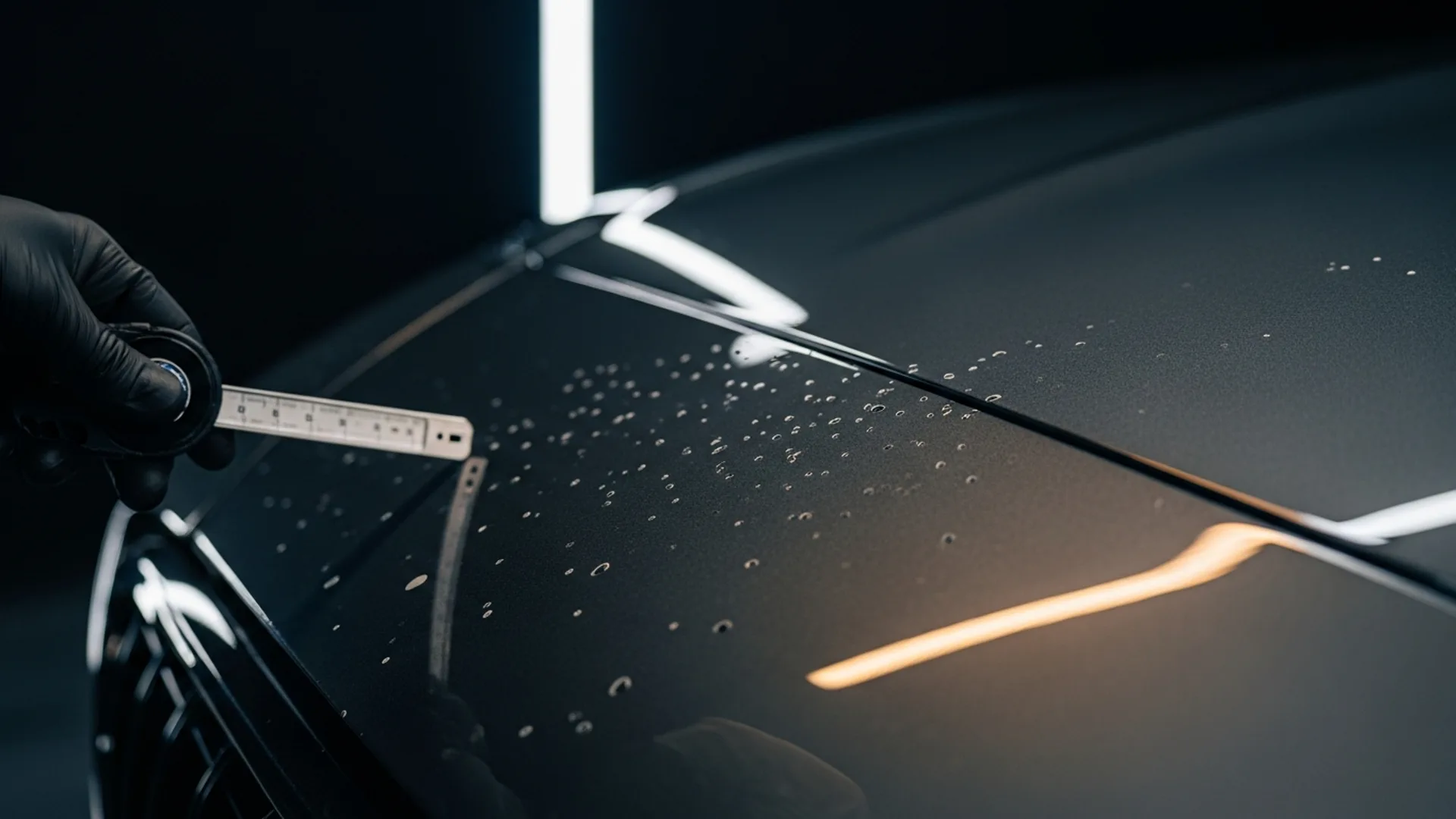
Can You Put PPF Over Existing Rock Chips? A Calgary Guide
Every PPF guide assumes a car that came off the truck last week. Most Calgary film work goes on a three-year-old car with a chipped nose. The depth rule that decides whether a chip gets filmed or filled, why no manufacturer publishes the touch-up cure time everyone quotes, the 8 microns of clear coat that limit what correction is even possible, and why film can make a chip look worse.
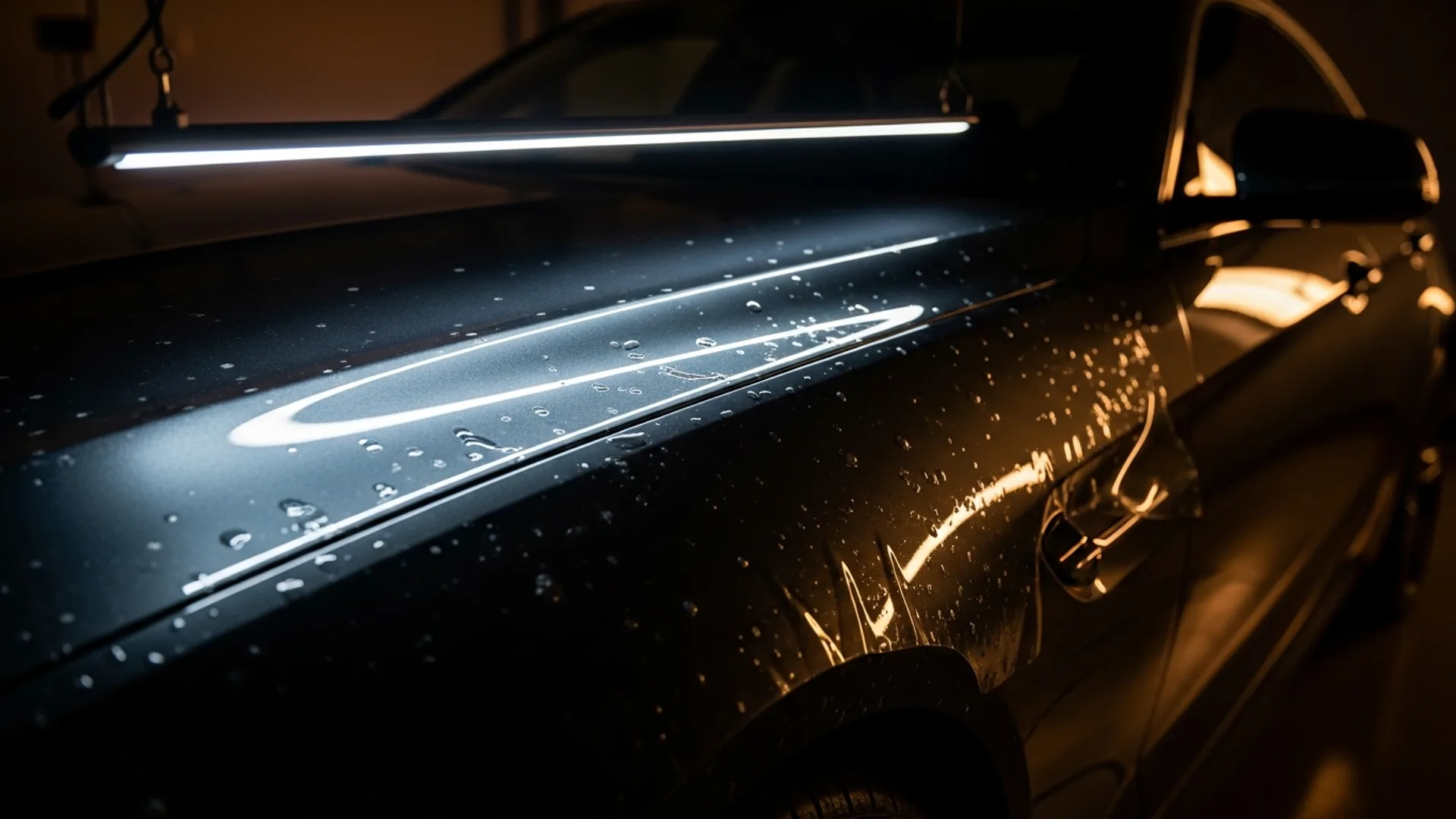
Hail Dents Under PPF: Does the Film Come Off for PDR?
The question no page answers properly: on a wrapped car, does the film have to come off before the dents get pushed out? It depends on the PDR method, not the film — rod work from behind leaves film untouched, while glue-pull tabs grip clear coat far more predictably than film. Plus why film can never be re-laid once removed, and the line item that should be its own line on the estimate.
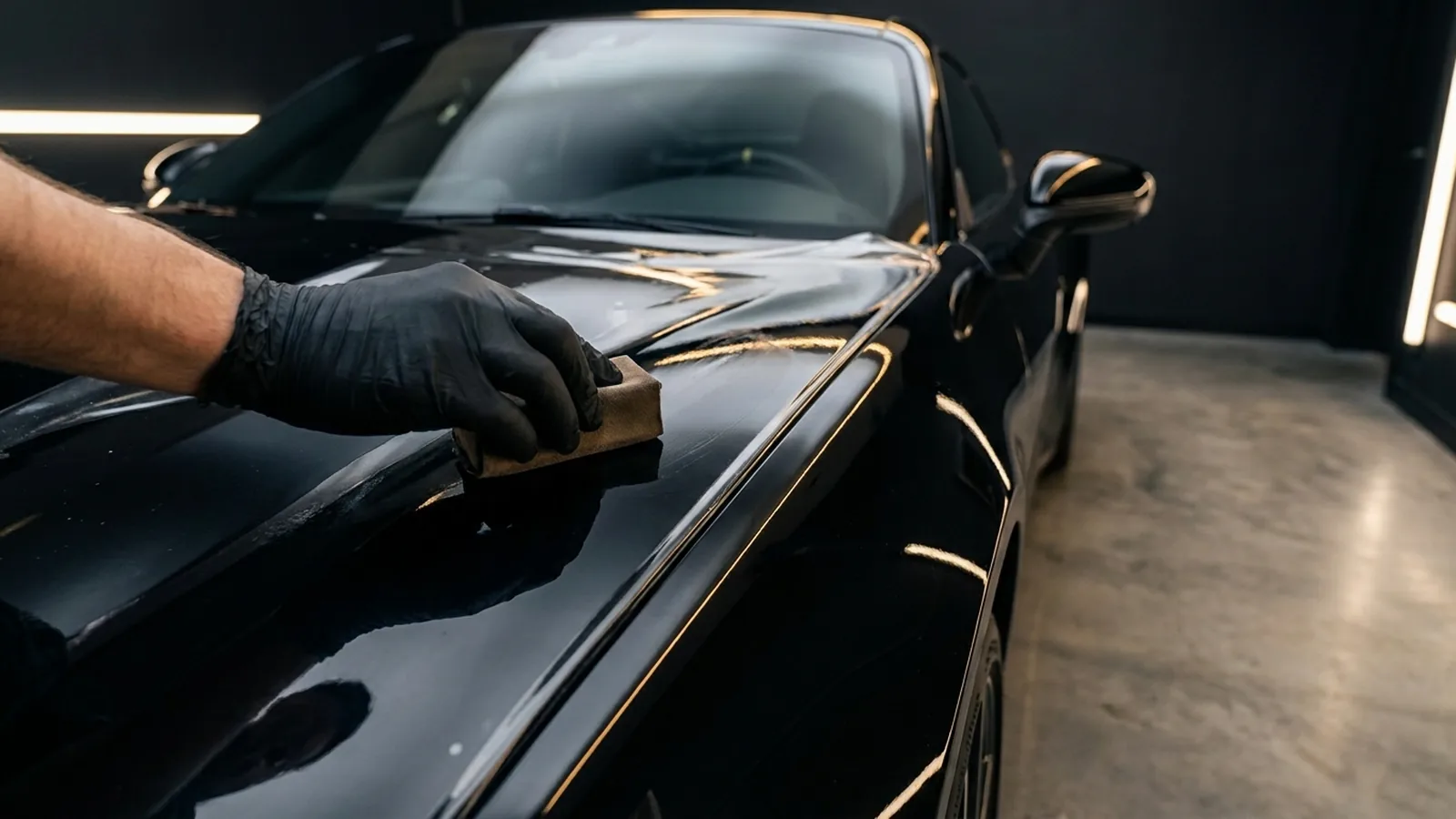
Ceramic Coating Over PPF: Does It Void Your Film Warranty?
Every page says the same thing: coating over film is fine as long as it is film-safe. We read the published warranty documents for five paint protection films and found four different positions. Two exclude coatings by brand, one excepts ceramic from its exclusions by name, and two never mention the subject at all — and one of the brand-locked films is our own supplier.