
Pressure Washing PPF: How Far Back Do You Hold It?
Quick answer: There is no single safe distance for pressure washing paint protection film, because the film makers publish different ones. We read six care documents and found three distances and two refusals: 3M says at least 12 inches, GSWF at least 24, STEK at least 36, while SunTek and Ceramic Pro tell owners not to use a pressure washer on film at all.
Key Takeaways
- There is no single safe distance for pressure washing paint protection film, because the film makers publish different ones. We read six care documents and found three distances and two refusals: 3M says at least 12 inches, GSWF at least 24, STEK at least 36, while SunTek and Ceramic Pro tell owners not to use a pressure washer on film at all.
- Only one of the six publishes a pressure limit at all. 3M sets "a maximum pressure of 80 bar" — about 1,160 PSI — along with a minimum 40-degree fan, water no hotter than 140°F if heated, and the nozzle held "perpendicular (90 degrees +/- 10) to the paint protection film". GSWF, STEK, SunTek, XPEL and Ceramic Pro publish no pressure figure of any kind.
- The threefold spread sits inside the films we actually install, which is why we cannot resolve it with a house rule. 3M, STEK, SunTek and GSWF are all films we fit, and their published standoff instructions disagree by a factor of three on the same car in the same wash bay.
- 3M publishes two separate angle rules with different reference surfaces and they are commonly merged into one. The nozzle is to be held within ten degrees of perpendicular to the film, and separately the water stream is not to be directed "at between 0° to 60° relative to the edge of the paint protection film". Those are different instructions about different things.
- XPEL, a brand we do not install, publishes three positions on one page: a three-foot figure for its colour film, a 36-inch figure with a 40-degree tip for its windshield film, and no distance at all for its flagship clear paint films. Which number you leave with depends on which heading you happened to read.
- Ceramic Pro publishes two documents that disagree with each other, and one of them disagrees with itself. Its coating aftercare calls a high-pressure washer "a great way to wash your Ceramic Pro coated vehicle every few weeks". Its PPF document says "Never use a pressure washer while washing your vehicle with PPF" — while its own supply list on an earlier page calls a high-pressure washer "optimal". We use Ceramic Pro coatings; we do not install its KAVACA film.
- The one published ceiling sits below the machines people own. Every consumer machine we could verify on sale in Canada is rated above it: Kärcher lists its K 5 Power Control at a maximum of 135 bar against 3M's 80, and a widely sold Ryobi electric is rated 1,900 PSI, about 131 bar. A rating is maximum output at the pump rather than pressure at the paint, so this is not a claim that your machine will damage film. It is why the standoff distance, and the fan pattern where you own the machine rather than rent it by the minute, carry the safety margin.
- The 40-degree tip two makers require is not universal equipment. One widely sold 1,900 PSI machine ships with a 15-degree tip, a turbo nozzle and a soap nozzle and no wide-angle tip at all. The turbo or rotary nozzle is the one to keep off a filmed panel — Kärcher, which sells them, tells car owners to use the flat jet rather than the rotor nozzle.
- None of the six films and neither coating document publishes any guidance for pressure washing below freezing, and we could not find a Calgary self-serve operator publishing the pressure or water temperature at its wand. Everything in this article's winter section is our own shop practice and we label it as ours.
- Where you do not know which film is on your car, work to the most conservative published figure and keep the stream off every edge and seam. Edge lifting is the failure mode five of the six documents name explicitly — SunTek names film lifting without locating it at an edge — and it is the one that cannot be undone by holding the wand better next time.
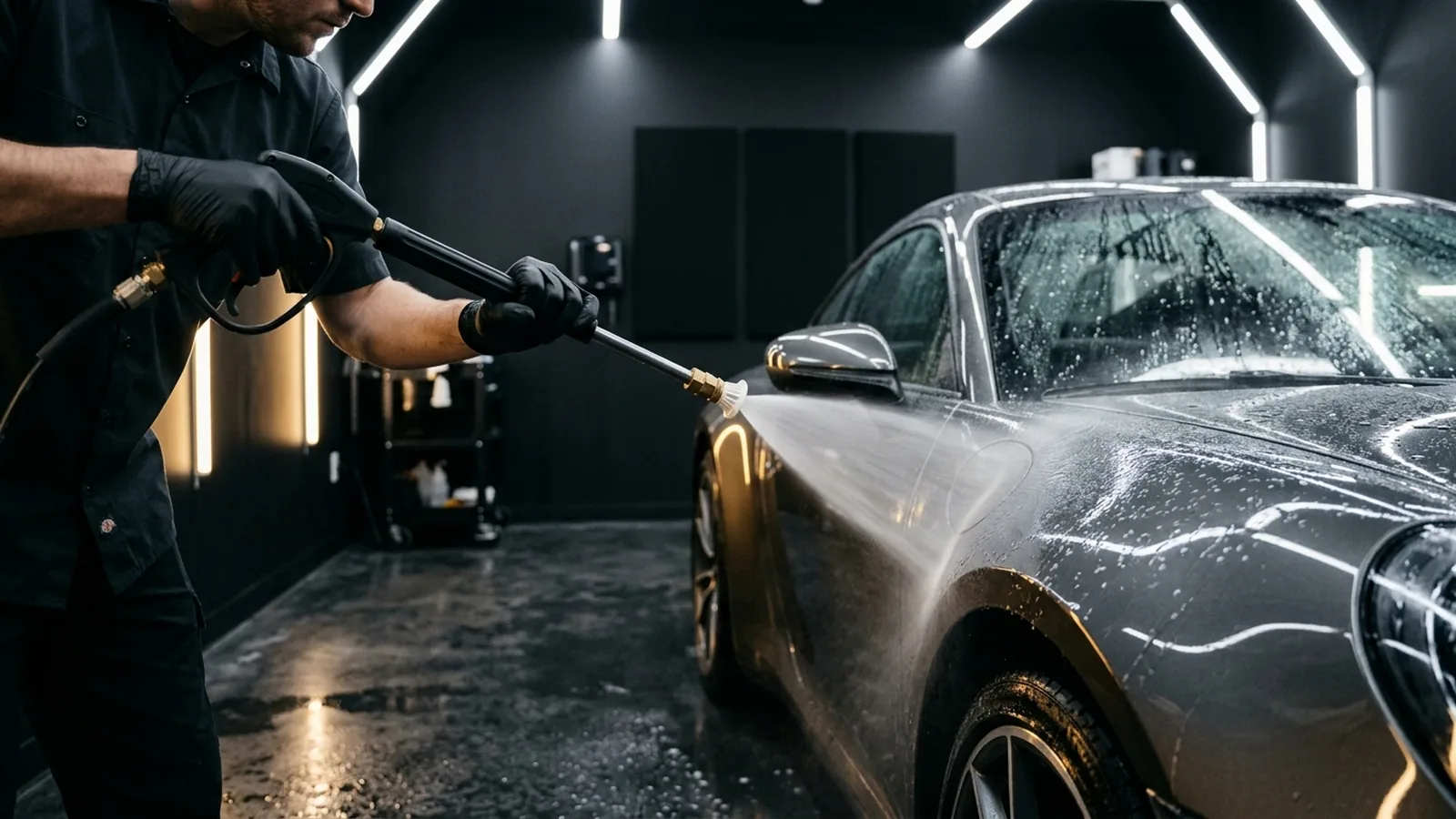
Ask how far back to hold a pressure washer from paint protection film and you will get a number. Ask for the source of the number and the conversation usually stops. We went looking for the documents behind it, because the advice circulating online — including, until this week, on some of our own pages — ranged from six inches to three feet. That is a sixfold spread on a question with a physical answer, and a spread that wide is the signature of paraphrase rather than disagreement.
What we found is more interesting than a single correct figure. The film makers do disagree, in writing, by a factor of three. And the disagreement sits entirely inside the set of films we install.
How far back should you hold a pressure washer from PPF? The short answer
There is no universal safe distance, because the film makers publish different ones. 3M says hold the nozzle at least 12 inches from the film; GSWF says at least 24 inches; STEK says at least 36 inches; SunTek says avoid power washes altogether, and Ceramic Pro says never use one on film — in a document that also calls a pressure washer optimal two pages earlier. Only 3M publishes a pressure ceiling — a maximum of 80 bar, about 1,160 PSI — along with a minimum 40-degree fan and a nozzle held within ten degrees of perpendicular. We install 3M, STEK, SunTek, GSWF; we do not install XPEL or KAVACA film. If you know which film is on your car, use its own number. If you do not, work to the most conservative one and keep the stream off every edge and seam.
What the six documents actually say
The reason a single figure circulates so confidently is that almost nobody quotes a source. Across the pages currently answering this question we could not find one that cites a film maker's care document by name, and somewhere upstream one brand's house figure got promoted into a general rule. Below is what the documents themselves say, in their own words.
Six films, three distances and two refusals
Select a position to read the sentence it comes from. Four of these six films are ones we install, and the entire threefold spread in standoff distance sits inside that set. The other two are films we do not install, which is exactly why they are safe to quote at full strength — though Ceramic Pro is a coating line we do use, and we say so where it matters.
The only document that specifies the whole job
"Use a spray nozzle with a minimum 40-degree wide spray pattern." … "Use a maximum pressure of 80 bar." … "If the system is heated, limit the water temperature to 140°F (60°C) or less." … "Hold the nozzle at least 12 in. (30 cm) away from and perpendicular (90 degrees +/- 10) to the paint protection film."
What it means. Four variables, not one, and 3M is alone in publishing more than a distance. It sets the fan pattern, the pressure ceiling, the water temperature and the standoff, and it adds a fifth instruction that almost nobody repeats: the nozzle is to be held square to the film, within ten degrees of perpendicular. Two details are worth noticing because they change how usable this is. The pressure ceiling is published in bar, and a keyword search of this bulletin returns no occurrence of PSI anywhere in it — so an owner in North America, where machines are marketed in PSI, has to convert before the figure governing their own film means anything. Eighty bar is about 1,160 PSI. And the reason for all of it is stated plainly rather than left to inference: excessive pressure forces water underneath the film and weakens the adhesion to the paint, which is what makes an edge lift or curl. This is also the shortest of the three published distances, which is worth sitting with, because it comes attached to the tightest set of conditions.
Do this: If your film is 3M, the 12 inches is not a standalone permission — it comes with a 40-degree tip, a pressure ceiling and a perpendicular nozzle. Take the set or take the more conservative distance.
Twice the distance, and no pressure limit at all
"Keep the nozzle at least 24 inches away from the film." … "Never spray directly at the edges or seams; the high pressure can lift the film." … "Use a wide-fan spray pattern (40-degree tip)."
What it means. This is our own supplier asking for double the standoff that 3M asks for, and the two documents cannot both be describing the same safety margin. GSWF agrees with 3M on the fan pattern, at a 40-degree tip, and it agrees that edges and seams are the vulnerable geometry. Where it diverges is instructive: it doubles the distance and then publishes no pressure ceiling, no water temperature and no nozzle attitude. Distance is carrying the entire safety margin on its own. That is a defensible way to write a consumer instruction — one number an owner can actually judge by eye beats four numbers they cannot read off a coin-op machine — but it means the 24 inches is not directly comparable to 3M's 12, because the two figures are doing different amounts of work. Worth knowing too that the same guide calls hand washing the gold standard for its films before it says any of this, and that its cure window appears twice in two forms: at least 48 to 72 hours and ideally 7 days in the body, then a flat 7 days on the summary checklist.
Do this: If your film is GSWF, treat 24 inches as the floor rather than the target, because there is no published pressure ceiling underneath it to catch you.
Three times the distance, and hand washing preferred first
"STEK recommends hand-washing cars protected with PPF. If using a high-pressure washer keep the nozzle at least 36″ away and avoid spraying the edges of the PPF directly."
What it means. The strictest published distance of the three, and note the sentence order, because it is doing work. The recommendation to hand wash comes first and the pressure-washer instruction is framed as a concession to owners who are going to use one anyway. There is no fan-pattern requirement, no pressure ceiling and no water temperature — the distance and the edge rule are the whole specification. Set this beside the 3M figure and the gap is the finding: on the same car, on the same wet Calgary afternoon, one film maker considers a foot sufficient and another asks for a yard. Both are films we fit. Neither is being careless. They have simply drawn the line in different places and neither of them tells you the other exists, which is exactly the situation an owner is left to resolve on their own in a wash bay with the meter running.
Do this: If your film is STEK, 36 inches is roughly an outstretched forearm plus the wand — pace it once in daylight so you are not estimating it in the dark in February.
A fourth declines to give a number, because its answer is no
"Avoid the use of automatic car washers and power washes as they could cause film lifting." … "Hand wash with soap, water and a soft cloth when needed."
What it means. The absence of a distance here is not an oversight, it is the position. SunTek names the same failure mode as everybody else — film lifting — and responds by putting the tool outside its recommended method rather than by specifying how to use it safely. That is a different kind of instruction from the other three, and it is the one that is hardest to follow in a Calgary winter, when the whole reason people reach for a wand is to get salt out of places a mitt cannot reach. We should be straight about the limit of what this text supports: it is advice about method, published on a care page, and it is not a warranty exclusion. SunTek publishes no warranty document of its own on its site, so nobody should tell you that a pressure washer voids your SunTek warranty — that claim cannot be sourced to a SunTek document, and we are not going to make it.
Do this: If your film is SunTek, the honest reading is that a pressure washer is outside the maker's recommended method. Use a touchless rinse or a hand wash where you can, and if you do use a wand, keep it well back and off the edges.
A fifth splits its answer three ways by product
"While using a pressure washer, stay 3ft away from the paintwork." (COLOR PPF) … "Avoid using a pressure washer or high-pressure water source near the edges of the film, it can cause the film to lift and/or become damaged." (ULTIMATE PLUS, ULTIMATE FUSION and STEALTH — no distance given) … "Keep the nozzle at least 36 inches (1 meter) away from the film when using a pressure washer… We recommend using a 40-degree nozzle." (windshield film)
What it means. One manufacturer, one page, three positions, sorted by product rather than by risk. The colour film gets a figure. The windshield film — which is glass, not paint — gets the most complete specification on the page, distance and tip angle both. And the flagship clear paint films, the ones most likely to be on an expensive car, get no number whatsoever, only an instruction to keep high pressure away from edges. An owner scanning that page for their own film can leave with a precise number, a vague caution or nothing at all depending on which heading they happen to land under. One small precision point since we are counting: the page glosses 36 inches as one metre, and 36 inches is 91.4 cm. It is a rounding rather than an error, but if you are going to publish a specification it is the kind of thing worth getting right.
Do this: Read the heading, not the page. On brands that split their guidance by product, the paragraph above yours may be written for something that is not on your car.
A sixth says all three things in one document
"A water hose with a spray nozzle. If you have a high-pressure washer – this is optimal." (supply list) … "DO NOT USE A HIGH-PRESSURE HOSE. Spray off with a standard spray nozzle – as high-pressure water can damage the PPF." (step 2) … "Never use a pressure washer while washing your vehicle with PPF. A pressure washer can create too much pressure and lift the edges of the film off the paint." (what to avoid)
What it means. Three positions, one document, and they cannot be reconciled by careful reading — the supply list calls a pressure washer optimal, the wash procedure forbids a high-pressure hose outright, and the avoid list says never. This is the clearest illustration of the argument this whole article is making. If a manufacturer writing its own care document cannot hold a single position across nine pages, an owner assembling one from blog posts has no chance. It is worth being precise about what this does not establish. A machine search of the document returns no occurrence of PSI or bar, so there is no pressure figure here to obey or exceed. And nothing in it makes a pressure washer a warranty exclusion — we looked for that clause specifically and it is not there, so no warranty consequence should be read into any of this. What the document does establish is the disagreement, which happens to be internal rather than between brands. We should also declare our interest: Ceramic Pro is a coating line we use, and its coating aftercare document, separately, recommends a high-pressure washer as a good way to wash a coated car every few weeks.
Do this: Where a document contradicts itself, take its most restrictive sentence as the operative one and ask the installer to confirm in writing. It is the only reading that cannot come back on you.
What PSI is safe for PPF? Only one document sets a limit
This is the finding that surprised us most, and it reframes the whole question. Five of the six film makers publish no pressure figure at all. Not a high one, not a cautious one — none. The number that everybody argues about exists in exactly one document, and it is published in a unit that North American owners cannot read off their own machine.
The consequence is practical rather than academic. If your film is 3M, the manufacturer has told you what the ceiling is, and you have to convert bar to PSI yourself before you can compare it to anything you own or rent. If your film is GSWF, STEK or SunTek — or XPEL or KAVACA, which we do not install — there is no manufacturer pressure ceiling to comply with, which means the distance instruction is carrying the entire safety margin. Those two situations look the same from the outside and are not the same at all — and it is why the 12-inch figure and the 24-inch figure cannot simply be averaged into eighteen.
It also means that any page telling you the safe pressure for PPF is a specific PSI number is telling you something no film maker except one has published. We are not exempt from that criticism. Several of our own older articles carried unsourced PSI thresholds, and we corrected them in the same update that published this page — details at the end.
The ceiling sits below the machine
We went looking for what consumer machines are actually rated at, and the ones we could verify on sale in Canada are all rated above the only published film-industry ceiling — a rating being maximum output at the pump rather than pressure arriving on paint. Kärcher's Canadian site happens to be the one place we found that publishes machine pressure in bar rather than PSI, so the comparison needs no conversion at all: it lists the K 5 Power Control at a maximum of 135 bar, against 3M's maximum of 80. A widely sold Ryobi electric is rated 1,900 PSI, about 131 bar. Gas machines sold for driveway work run several times higher again.
Distance, tip angle and how far you squeeze the trigger all sit between the pump and the panel, so none of that says your machine will damage film. The real point is narrower and more useful. The ceiling is not something your equipment enforces for you. If you own a pressure washer, you almost certainly own one capable of exceeding the only limit any film maker has published, which is precisely why the standoff distance and the fan pattern do the work — they are the parts of the specification an owner can actually control. What tip is in your hand matters as much as the rating on the machine, and that turns out not to be a given either.
The angle rule almost nobody repeats
3M publishes two instructions about angle, they have different reference surfaces, and they are routinely collapsed into one. The first concerns the panel: hold the nozzle perpendicular (90 degrees +/- 10) to the paint protection film — square on, within ten degrees. The second concerns the seam: do not direct the water stream at between 0 and 60 degrees relative to the edge of the film. One is about how you address the middle of a door. The other is about what you must not do to the line where the film stops.
The distinction matters because the popular advice is to spray at a sweeping angle, and that is sound instinct applied to the wrong reference. Raking a stream across a panel at forty-five degrees is exactly how you end up delivering it into an edge from the side, which is the geometry every one of these documents warns about. 3M is unusually explicit about why: excessive pressure forces water underneath the film and weakens the adhesion strength to the paint surface, causing the film to lift or curl — and it notes the effect is magnified by wind, which in this city is not a footnote.
| Film | Standoff distance | Pressure ceiling | Fan pattern | What else it specifies |
|---|---|---|---|---|
| 3M | At least 12 in (30 cm) | Maximum 80 bar (~1,160 PSI) | Minimum 40-degree | Tip guard; water max 140°F if heated; nozzle within 10° of perpendicular; no stream at 0–60° to an edge |
| GSWF | At least 24 in | None published | 40-degree tip | Never at edges or seams; hand washing called the gold standard |
| STEK | At least 36 in | None published | None published | Hand washing recommended first; avoid spraying edges directly |
| SunTek | None — advises avoiding power washes | None published | None published | Hand wash with soap, water and a soft cloth |
| XPEL (we do not install) | 3 ft for colour film; none for its clear films; 36 in for windshield film | None published | 40-degree, windshield film only | Keep high pressure away from film edges |
| Ceramic Pro / KAVACA (film we do not install) | None — one page calls a pressure washer optimal, another says never use one | None published | None published | Three positions in one document; no PSI or bar figure anywhere in it |
The coating on top says something different
Most protected cars in this city carry two layers with two separate documents behind them, and the clearest example of the whole problem comes from a single manufacturer that publishes both. Ceramic Pro's coating aftercare document lists touchless washing with a high-pressure hose among the things owners should be doing, and describes a high-pressure washer with a foam cannon as a great way to wash a coated car every few weeks. Its complete equipment specification is a medium-grade pressure nozzle: no PSI figure, no bar figure, no distance. System X's published terms do not raise the subject at all.
Then read the same company's film document. Its supply list tells you that if you have a high-pressure washer, this is optimal. Its wash procedure, two pages later, says in capitals not to use a high-pressure hose, because high-pressure water can damage the film. Its list of things to avoid says never to use a pressure washer on a car with film at all, because it can lift the edges off the paint. Three positions, one PDF. We should declare our interest plainly: Ceramic Pro is a coating line we use, and KAVACA is a film we do not install — but the point stands regardless of who sells what. If a manufacturer writing its own care instructions cannot hold one position across nine pages, an owner assembling a rule from search results has no chance at all.
So on the coating side the tool is recommended and never quantified, and on the film side it is quantified three different ways — four makers publish a distance and their figures land on three distinct numbers — and forbidden outright by two more. On a car with film under a coating there is no real conflict to resolve, because only one of those layers can lift: the film document governs. But it does explain how an owner who has read their paperwork carefully can arrive at a wash bay with perfectly good instructions that say nothing about the thing most likely to go wrong. The neighbouring question of whether a coating over the film touches your PPF warranty is a separate set of clauses with its own answers, and the care rules for satin and matte film diverge again from everything above.
What this means at a Calgary wand bay
The coin-op bay is where this stops being theoretical. From roughly November to April it is how a large number of Calgary cars get salt and grit off, and it is the one setting where you are personally holding the pressure rather than letting fixed equipment decide it. It is also the setting where the manufacturer specifications are least usable, for a reason worth stating plainly. We checked the published pages of four Calgary self-serve operators and not one of them publishes the pressure at the wand. None publishes a water temperature either — several advertise hot, warm or soft water, and none of them attaches a number to it. Two of the four variables 3M specifies are simply not available to you at the bay, and there is no way to find them out while standing in it.
That is an argument for leaning on what you do control. Three of the four figures 3M sets belong to the operator — the pressure, the water temperature and the fan pattern of the tip on the wand. The standoff distance is yours, and so is the attitude of the nozzle. Where the machine is unknown, the conservative published distance is the sensible working rule rather than the shortest one, and keeping the fan square to the panel and off the seams costs nothing. What follows is our own shop practice rather than a manufacturer instruction, and we would rather label it that way than borrow authority we do not have: none of the six film makers, and neither coating document, publishes any guidance for washing below freezing.
We wash on the warmer end of a winter day rather than at dusk, so that what is left in shuts and behind trim has a chance to leave before it freezes. We blow water out of panel gaps, mirror housings and film edges rather than letting it stand. We do not put a wand near an edge that already has ice on it, because you cannot see what the ice is attached to. And we rinse before we touch anything, since below about -15°C the City is putting down a mixture of roughly 3% salt to 97% gravel — so a good part of what is on your lower panels in deep winter is abrasive grit, and dragging a mitt through it does more damage than the salt would have. The wider winter routine for a film-protected car covers the rest of that season, and the choice between a touchless tunnel, a wand bay and a hand wash is a decision worth making before you are standing in one.
What we corrected on our own pages
It would be easy to publish this and leave our own back catalogue alone. We would rather say what was wrong, because the whole argument of this article is that unsourced numbers propagate, and ours had. Alongside this post we changed five things. An older winter guide asserted a 1,500 PSI figure that traces to no document and instructed a 45-degree spray angle that contradicts the only published angle rule there is; both are gone. A car-wash article set a water limit of 80°C where 3M publishes 140°F, which is 60°C — it was looser than the source it should have been following. A colour-film care guide carried a 2,000 PSI danger threshold with no source behind it. And our satin-film article said that two of the five makers it covers publish real numbers for this, which was wrong: STEK publishes 36 inches, so the count is three. And an older winter-care piece told readers to hold the wand a foot back regardless of film, to angle the stream along the panel — against the only published angle rule there is — and named magnesium chloride as a Calgary road treatment, which the City does not use.
One thing we have not finished. The six-inch and three-foot rules named at the top of this article live on our sister site rather than this one, and they are queued for the same treatment rather than already fixed. We would rather say that than let the correction read as more complete than it is.
None of those errors would have hurt a car on its own. Collectively they are how a six-inch rule and a three-foot rule end up coexisting on the internet with equal confidence. The self-healing temperature everyone quotes reached us the same way, and we have since traced it: the 49°C figure is printed by no film maker.
The practical version
Find out which film is on your car and use its own figure — that single piece of information resolves everything above, and the rest of the routine it sits inside is covered in our full PPF cleaning and maintenance guide. If you cannot find out, work to the most conservative published distance, fit the widest fan tip you have, keep the nozzle square to the panel, and never point it along a seam. Treat the first week after an install as a separate regime with no pressure near an edge at all. And accept that the wand bay is a compromise: it is frequently the right call in a Calgary winter, but it is the one place where you are guessing at half the specification. If you would rather not guess, our paint protection film packages and coverage options include telling you exactly which document governs your car, or you can simply bring it in and let us identify the film.
A note on what this article is
Every quotation above was read from the document it is attributed to rather than from another article about it, and the keyword counts — no occurrence of PSI in the 3M bulletin, none in the Ceramic Pro aftercare document, none in the System X terms — were run against the source files rather than estimated.
The limits are worth stating as plainly as the findings. The GSWF guide is a two-page, image-only PDF with no text layer, so it was read from the rendered pages. Five of the six film documents carry no printed date, and only the 3M bulletin carries both a revision letter and a date, so they can change without notice — these were read on 7 September 2026, and your film's current document outranks this page if the two ever disagree. No claim is made here about what any warranty says: SunTek publishes no warranty document of its own, and the care instructions quoted above are care instructions, not exclusions. None of these brands is being criticised. Their positions are quotable precisely because they publish them, and a manufacturer is entitled to specify a margin more cautious than its competitor's. We are a protection studio, not your warranty administrator.
If you do not know which film is on your car and would like us to look, call (587) 323-3222. We hold a 4.9-star rating across 705+ Google reviews, and identifying a film takes a few minutes and costs nothing.
Ready to Protect Your Vehicle from Rock Chips?
Join 705+ Calgary drivers who trust Obsidian Auto for PPF installation
Serving Calgary and surrounding areas • Free Uber shuttle with every service
Frequently Asked Questions
Sources
External references used in this guide
- 3M — Paint Protection Film Installation Guidelines, Instruction Bulletin, Revision D, July 2026 (PDF). The only one of the six film documents carrying a revision letter and a date, and the only one publishing a pressure ceiling: "Use a maximum pressure of 80 bar", together with "Use a spray nozzle with a minimum 40-degree wide spray pattern", a tip-guard requirement, "If the system is heated, limit the water temperature to 140°F (60°C) or less", and "Hold the nozzle at least 12 in. (30 cm) away from and perpendicular (90 degrees +/- 10) to the paint protection film". Also the source of the post-installation wait quoted here — owners are asked to wait at least 72 hours after installation before washing the vehicle — and of the edge rule, "Do NOT direct the water stream at between 0° to 60° relative to the edge of the paint protection film", and of the stated mechanism of failure. SCOPE NOTE: a keyword search of this document returns no occurrence of PSI; the films it covers are Scotchgard Pro Series 200 and Series 150, 100 and 50. 3M is a film we install
- GSWF — Official Maintenance Guide (PDF). Source of the 24-inch figure, in section 2 under the subheading Pressure Washing: "Keep the nozzle at least 24 inches away from the film", "Never spray directly at the edges or seams; the high pressure can lift the film" and "Use a wide-fan spray pattern (40-degree tip)." SCOPE NOTE: this is a two-page, image-only PDF with no text layer, carrying no revision code and no printed date, so the quotations here were read from the rendered pages. It publishes no pressure ceiling and no water temperature. Also the source of the two cure-window statements quoted here. GSWF is a film we install
- STEK — published FAQ and maintenance material. Source of the strictest published distance: "STEK recommends hand-washing cars protected with PPF. If using a high-pressure washer keep the nozzle at least 36″ away and avoid spraying the edges of the PPF directly." A keyword search returns no occurrence of PSI or bar. The page carries no revision code and no printed date and was read as published on 7 September 2026. STEK is a film we install
- SunTek — manufacturer-owned paint protection film frequently asked questions. Source of the refusal rather than a figure: "Avoid the use of automatic car washers and power washes as they could cause film lifting", alongside "Hand wash with soap, water and a soft cloth when needed." SCOPE NOTE: this is care guidance on a care page and it is not a warranty exclusion — suntekfilms.com publishes no warranty document of its own, so no claim is made here about what a SunTek warranty says. The page is undated. SunTek is a film we install
- XPEL — product care instructions. Cited for the product-split within a single manufacturer page: "While using a pressure washer, stay 3ft away from the paintwork" under COLOR PPF; "Avoid using a pressure washer or high-pressure water source near the edges of the film" with no distance given under ULTIMATE PLUS, ULTIMATE FUSION and STEALTH; and "Keep the nozzle at least 36 inches (1 meter) away from the film when using a pressure washer… We recommend using a 40-degree nozzle" under windshield film. The page is undated. IMPORTANT: we do not install XPEL film, which is why it is quoted here at full strength
- Ceramic Pro — Coating Aftercare and Warranty document (PDF), the current published version. Cited as the counterweight from the coating side: high-pressure washing appears among the recommended methods rather than the hazards — "Touch-less washing – such as a high-pressure hose, foam cannon, or foam gun" — and "A great way to wash your Ceramic Pro coated vehicle every few weeks is by using a high-pressure washer, with a medium-grade pressure nozzle and foam cannon attachment." SCOPE NOTE: a keyword search of this document returns no occurrence of PSI, bar or inches; "medium-grade pressure nozzle" is the entire equipment specification it gives
- Ceramic Pro / KAVACA — PPF Aftercare and Warranty Instructions (PDF). Cited for the internal contradiction, all three sentences read from the same document: the supply list states "A water hose with a spray nozzle. If you have a high-pressure washer – this is optimal"; the wash procedure states "DO NOT USE A HIGH-PRESSURE HOSE. Spray off with a standard spray nozzle – as high-pressure water can damage the PPF"; and the list of things to avoid states "Never use a pressure washer while washing your vehicle with PPF. A pressure washer can create too much pressure and lift the edges of the film off the paint." SCOPE NOTE: a keyword search of this document returns no occurrence of PSI or bar, and no warranty consequence for pressure washing is asserted here — we searched the warranty section for such a clause and did not find one. We use Ceramic Pro coatings; we do not install KAVACA film
- System X — published automotive warranty terms. Cited as a verified absence on the coating side: a keyword search returns no occurrence of pressure, PSI, bar or nozzle anywhere in the terms, though they do exclude damage to the coated surface from incorrect manual wash techniques, automatic car washes, brushes and contaminated wash tools. Read as published on 7 September 2026
- Kärcher Canada — K 5 Power Control specification. Cited as the one place we found that publishes consumer machine pressure in bar rather than PSI, which allows a direct comparison with 3M's ceiling without conversion: the machine is listed at a maximum of 135 bar against 3M's maximum of 80. The same page lists a maximum inlet water temperature of 40°C, which suggests 3M's 140°F heated-water clause is written for commercial and bay equipment rather than for a home machine — our reading, not something either manufacturer states
- Kärcher — car washing guidance. Cited for the rotary-nozzle instruction from a manufacturer that sells them: owners are told to wash a car with the flat jet and not with the rotor nozzle. Cited for that instruction only; the article makes no other use of this page
- Ryobi Canada — 1,900 PSI electric pressure washer, model RY1419MTVNM. Cited for the equipment gap behind the 40-degree tip requirement: this machine's published accessory list is a 15-degree nozzle, a turbo nozzle and a soap nozzle, with no wide-angle tip included. Verified against the manufacturer's own product page
- NozzlePro — pressure washing nozzle reference. Cited only for the qualitative relationship between standoff and impact, stated there as impact force falling rapidly with increasing standoff distance as the spray expands and velocity drops, and for the consumer nozzle colour convention, in which red is 0 degrees, yellow is 15 and white is the 40-degree wide fan. SCOPE NOTE: no manufacturer or engineering source we fetched publishes a formula for this, so no inverse-square relationship is asserted anywhere in this article
- City of Calgary — snow, ice and salt on city roads. Source for what is actually applied to Calgary streets, which is the basis for separating an abrasive-grit rinse from a brine rinse in this article: sodium chloride and calcium chloride, with a mixture of roughly 3% salt to 97% gravel used below about -15°C. Cited because the magnesium chloride commonly named in detailing content is not what the City puts down

Ready to Protect Your Vehicle?
Get a quote from Calgary's most trusted detailing studio. We use only the best materials and back our work with industry-leading warranties.
Get A QuoteRelated Intelligence
Ceramic Coating Over PPF: Does It Void Your Film Warranty?
Every page says the same thing: coating over film is fine as long as it is film-safe. We read the published warranty documents for five paint protection films and found four different positions. Two exclude coatings by brand, one excepts ceramic from its exclusions by name, and two never mention the subject at all — and one of the brand-locked films is our own supplier.
Satin PPF Care: What the Film Makers Actually Instruct
Every page says the same thing about satin paint protection film: never wax it, never seal it. We read the published care documents for five films and found four different instructions and one silence. One forbids it outright, one instructs an annual wax, one requires sealing every six months, one hands the decision back to you, and one never raises the subject.
Can You PPF a Factory Matte or Satin Car in Calgary?
Bought a car in a factory matte or satin colour — Porsche Chalk, BMW Individual Frozen, AMG magno? You can protect it with paint protection film, but only the right one. How matte PPF preserves the flat finish without adding gloss, why matte paint can never be polished, and how to care for it in Calgary.