
Satin PPF Care: What the Film Makers Actually Instruct
Quick answer: Never wax satin paint protection film is one manufacturer's house rule, not a property of the finish. We read the published care documents for five films and found four different instructions and one silence, so the absolute answer repeated across the web matches only one of the four films we install.
Key Takeaways
- Never wax satin paint protection film is one manufacturer's house rule, not a property of the finish. We read the published care documents for five films and found four different instructions and one silence, so the absolute answer repeated across the web matches only one of the four films we install.
- GSWF states it as a "Strict Rule: Never polish or wax a matte/satin film", and its guide is the only one of the five that sorts its instructions by finish at all — though a summary checklist on the same page separately advises a ceramic topper every few months without scoping that line to a finish.
- SunTek says the opposite on its Ultra Matte page: "Wax once or twice a year with non-abrasive wax formulated for matte finishes." That is a condition on the product's composition rather than a prohibition, though SunTek publishes no warranty document of its own and the warranty text that does circulate carries no matte guidance at all.
- XPEL goes further again and makes sealing a scheduled duty rather than an option — "Seal with XPEL Ceramic Boost at least once every 6 months to preserve and maintain satin finish" — with no prohibition on wax or coating in that section. We do not install XPEL, which is why we can quote it plainly.
- 3M uses a third kind of rule: no waxes containing "dyes, abrasive polishes, and/or rubbing compounds", its own named products for the films it covers, and everything else "on a user test-and-approve basis only". Its wax interval is conditioned on the film series, not stated once. That bulletin covers Pro Series 200 and Series 150, 100 and 50 and contains no occurrence of matte or satin — those are not matte films, so the absence is one of scope rather than a permission.
- STEK publishes no matte or satin carve-out we could find. The nearest sentence is a note that a very hydrophobic factory topcoat "may interfere with application of wax or other coatings" — an adhesion observation, not an appearance rule.
- None of the five publishes any guidance on road salt, brine, de-icer, ice scrapers or snow brushes for satin film. Everything in this article's Calgary section is our own shop practice, and we label it as ours rather than dressing it up as a manufacturer instruction.
- Satin film and factory matte paint are not the same problem. The film self-heals with heat and the paint does not, which is why a panicked polishing decision has a different answer depending on which one you actually have.
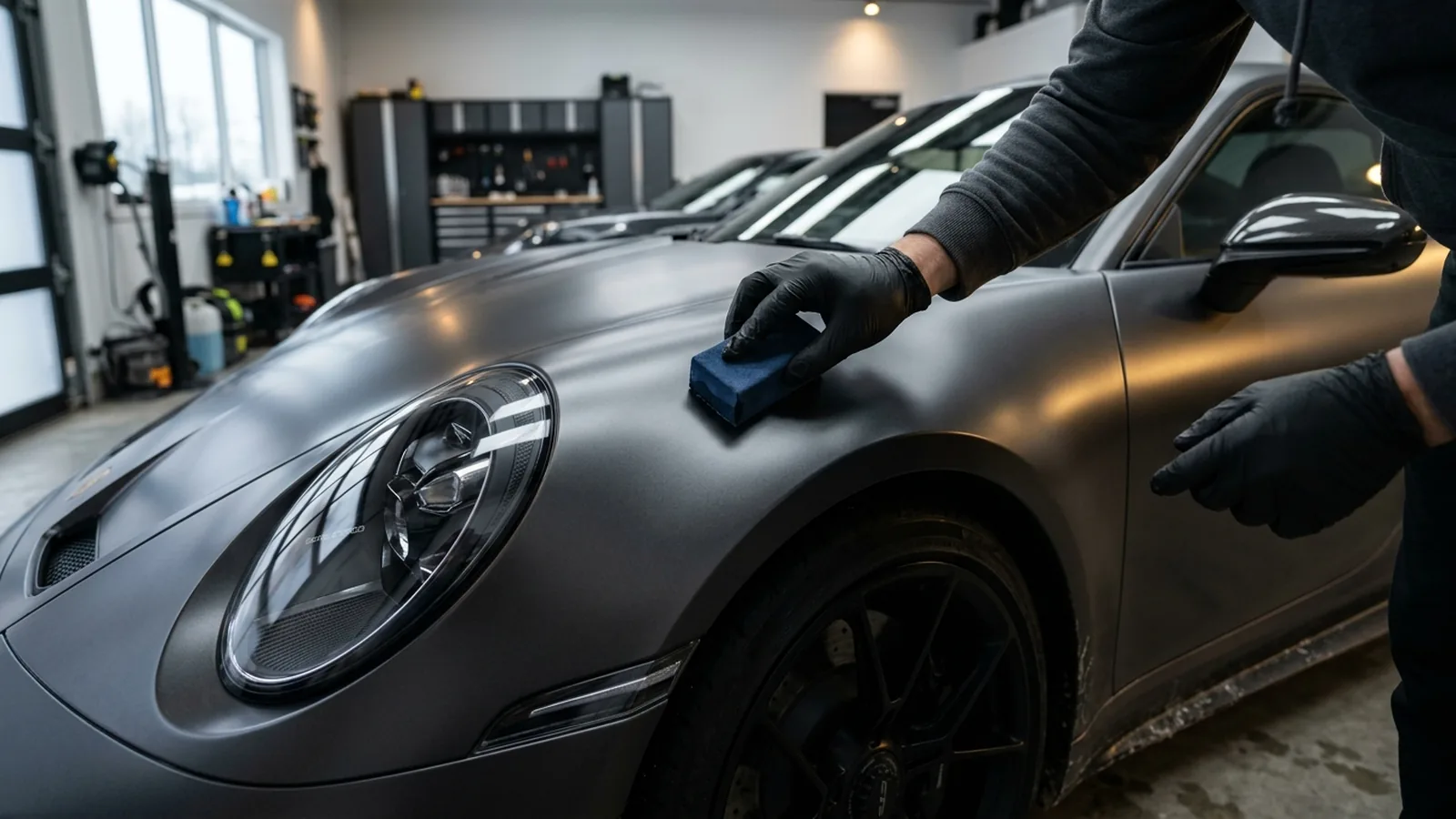
Ask whether you can wax or seal satin paint protection film and the internet answers with one word. Never. It is on installer blogs, in forum replies, and in the summaries answer engines assemble from them, always stated as though it were a property of the finish itself. We went and read the published care documents for five paint protection films, including the four we install. They give four different instructions and one silence — the strictest of them forbids wax and polish on satin outright, while another puts sealing the same kind of finish on a six-month clock.
The short answer
Whether you may wax, seal or coat satin PPF is decided by the film brand, not by the finish. GSWF states a strict rule against polishing or waxing matte and satin film. SunTek instructs owners of its matte film to wax once or twice a year with a matte-formulated product. The XPEL care page for North America requires sealing at least every six months, though its UK guidance for the same film sets no interval at all. 3M restricts what may be in the product and puts everything else on the owner to test — though the bulletin covering its Series films never mentions matte or satin, because those are not matte products. STEK publishes no satin carve-out we could find. We install 3M, STEK, SunTek and GSWF; we do not install XPEL. Read your film's own document — the finish does not decide.
Five documents, four rules and a silence
The reason the blanket answer survives is that almost nobody quotes a source. Across the pages currently ranking for these questions we could not find one that cites a film maker's care document by name. Everything is paraphrase of paraphrase, and somewhere upstream a rule that belongs to one brand got promoted into a law of physics. Below is what the documents themselves say, in their own words.
Five films, four instructions and a silence
Select a position to read the sentence it comes from. Five films, four instructions and a silence: the last panel is an absence rather than a rule, and it is listed because an absence changes what you can rely on. Four of these five films are ones we install; the scheduled-duty example is a brand we do not carry, which is exactly why it is safe to quote at full strength.
One document bans it outright, and organises itself around the finish
"Strict Rule: Never polish or wax a matte/satin film. Doing so will permanently create \"shiny\" spots and ruin the factory look." … "Matte-Specific Products: Use only detail sprays and soaps specifically labeled \"Matte Safe.\""
What it means. This is the internet answer, except that here it is sourced. GSWF is the only one of the five documents we read that sorts its instructions by finish at all: it carries a heading for gloss and a separate heading for satin, matte and stealth, and it tells the second group plainly not to wax or polish. We install GSWF, so this is our own supplier taking the strictest position of the five, and it deserves credit for being the only maker that wrote a satin section in the first place. One nuance is worth stating precisely rather than smoothing away: wax and polish are what the strict rule names, and the summary checklist on the same page separately advises using a ceramic topper every few months without tying that line to a finish. A ceramic topper is not a wax, which is the reading that reconciles the two — but the checklist line is genuinely unscoped, so a satin owner reading only the checklist could take away the opposite of the rule.
Do this: If your film is GSWF, take the finish-specific section as the operative instruction — we read the unscoped checklist line as written for the gloss owner, but ask your installer to confirm that in writing before anything goes on the film.
Another tells satin owners to wax once or twice a year
"Wax once or twice a year with non-abrasive wax formulated for matte finishes."
What it means. Read that beside the strict rule above, because the two are the same instruction with the answer reversed. SunTek does not merely tolerate wax on its matte film; it puts an annual cadence on it. The condition is compositional rather than absolute — the wax has to be non-abrasive and formulated for matte finishes — which is a rule many products satisfy rather than a door that is closed. Two limits keep this from being a free hand. SunTek elsewhere notes that some waxes will add a level of gloss to matte film, which is the risk the strict rule is guarding against, and SunTek separately advises avoiding automatic car washes and power washes because they could cause the film to lift. There is also a gap inside SunTek itself worth knowing about: the care page permits the annual wax, while SunTek publishes no warranty document of its own on its site, and the warranty text that does circulate carries no matte guidance at all. On this brand the care page is effectively the only published instruction addressed to a matte owner.
Do this: If your film is SunTek Ultra Matte, the question to ask a shop is not whether it will wax the film but which matte-formulated product it intends to use.
A third does not permit sealing — it requires it, on a clock
"Seal with XPEL Ceramic Boost at least once every 6 months to preserve and maintain satin finish."
What it means. This is the sentence that breaks the consensus, and it is worth noticing what kind of sentence it is. It is not permission and it is not a caveat — it is a maintenance obligation with an interval attached, and the stated purpose is to preserve the satin finish rather than to add shine to it. The same page gives the identical instruction for a gloss film, changing only the closing words to preserve high gloss, so the product is the constant and the finish is the variable. We read the STEALTH section specifically for a prohibition on wax, sealant or coating and there is none. Note also that XPEL is not internally uniform across regions: the UK care guidance for the same film sets no interval, names a different product, and warns that if the sealant is not applied in a uniform pattern it can cause the film to look uneven. The divergence is not confined to STEALTH either: the UK page sets a three-month interval for one of the gloss films where the US page sets six.
Do this: Ask which regional care page your installer is working from, because on this brand the answer changes what you are expected to do and how often.
A fourth hands the decision back to you, in writing
"Avoid using any wax that contains dyes, abrasive polishes, and/or rubbing compounds." … "Use of waxes other than those described above is on a user test-and-approve basis only. Always test the coating in an inconspicuous area before applying to the surface of the paint protection film."
What it means. This is a third kind of instrument and the distinction is the intellectual core of the whole question. 3M bans a composition rather than a category, naming its own products for the films this bulletin covers, and then does something none of the others do: it states explicitly that anything outside that list is a test-and-approve responsibility carried by the owner, and tells you to test in an inconspicuous area first. The interval is conditioned on the series rather than stated once, at within three months for Series 100 and 50 and within three to six months for Series 150 and 200. One scope point matters and is easy to get wrong: this document contains no occurrence of the words matte or satin anywhere, and the reason is that the films it covers are not matte products — the 3M matte film sits in a separate wrap-film line. That is an absence of scope, not a manufacturer quietly recommending paste wax for a satin finish.
Do this: Take the test-in-an-inconspicuous-area instruction literally, and pick somewhere a shiny patch would not be visible — a lower rocker rather than the middle of a hood.
A fifth never addresses the finish at all
"Extremely hydrophobic PPF topcoats like HYDROphobe® on DYNOshield® may interfere with application of wax or other coatings."
What it means. We searched STEK material for a matte or satin carve-out and did not find one. There is no satin section, no matte product exception, and no instruction addressed to owners of its matte film specifically. What exists instead is a technical observation pointing the other way from the finish question entirely: a very hydrophobic factory topcoat can make it harder to get anything else to bond on top of it. That is a note about adhesion, not about appearance. Silence is not permission and it is not prohibition — it leaves the general instructions standing and gives an owner nothing finish-specific to point at. Two further points are worth stating accurately because they are commonly reported wrongly. STEK does not use the word touchless anywhere in its published material, so a touchless carve-out should not be attributed to it. What it does say is that it recommends hand-washing cars protected with film, and that using automated car washes increases the likelihood of surface scratches penetrating the top coat, which it describes as a characteristic of any top-coated film rather than a fault of its own.
Do this: Where the document is silent, get the shop position in writing on your invoice — silence gives you nothing to point at later.
The same question, four different instruments and one absence
Line the positions up and the disagreement turns out to be structural rather than a matter of degree. These are four different kinds of rule, and knowing which kind governs your film tells you what you are actually allowed to do.
| Film | Kind of rule | What the document actually says |
|---|---|---|
| GSWF | Prohibition, scoped to finish | Never polish or wax matte or satin film; matte-safe labelled products only |
| SunTek Ultra Matte | Permission with a condition | Wax once or twice a year, non-abrasive and matte-formulated |
| XPEL STEALTH | Scheduled obligation | Seal at least once every six months to preserve the satin finish |
| 3M Pro Series / Series | Composition ban plus owner testing | No dyes, abrasives or rubbing compounds; anything else is test-and-approve |
| STEK | No finish-specific rule found | A note that hydrophobic topcoats may interfere with anything applied over them |
The practical difference between a prohibition and a composition rule is worth sitting with, because it is the same distinction that governs coatings over gloss film. A rule that bans a category closes the question. A rule about what is in the bottle leaves it open to any product that meets the specification, which is a materially different position even when the cautious advice looks similar from outside. And a scheduled obligation is different again: it is the only one of the four that can be breached by doing nothing at all. If you own a film whose maker sets an interval, neglect is the failure mode, not over-maintenance.
None of this makes any of these brands wrong. A manufacturer is entitled to warrant a film only in the condition it has tested, and GSWF in particular deserves credit for being the only one of the five to write a satin section at all rather than leaving owners to infer one. The problem is not the documents. It is that the internet flattened five of them into one sentence. If you want the neighbouring question of whether a coating over the film touches your PPF warranty, that is a separate set of clauses with its own answers.
Satin film is not matte paint
Almost every alarming thing written about matte care is written about matte paint, and it gets applied to film by readers who do not know the difference matters. It does. Factory matte paint cannot be corrected: any abrasive touch leaves a permanently burnished shiny scar, and the repair is refinishing the panel. That is the reason for the absolutism, and on paint the absolutism is right — which is the whole argument for protecting paint that left the factory matte with film in the first place.
Satin film behaves differently in one decisive respect. Its top coat is self-healing thermoplastic polyurethane, and it reflows with heat — sunlight, or warm water poured over the panel. Light marring that would be permanent on matte paint can relax back out of film. That does not make satin film invulnerable, and it does not mean you should ever put a compound near it. What it means is that the correct response to a fresh mark on satin film is heat and patience, not chemistry and pressure, and that an owner who has just made a small mistake is usually in a far better position than the forum threads suggest. If you are considering the finish rather than living with it already, our guide to converting a glossy car to a satin stealth finish covers the decision itself, and the finish-by-finish product table for coloured and satin film lists what to actually buy.
What none of them tell you: a Calgary winter
Here is the finding that surprised us most. We searched all five documents for guidance on road salt, brine, de-icing chemicals, ice scrapers and snow brushes as they apply to satin film. There is none. Not a cautious paragraph, not a passing clause — the subject is simply absent from every one of them. The closest thing to an exception is scraper guidance one maker publishes for windshield film, which is a different product doing a different job and should not be borrowed for paint film.
So everything in this section is our own practice, and we would rather label it that way than dress it up as an instruction from somebody else. Three things matter more than the rest.
Rinse on a schedule, not on appearance. A satin panel looks evenly dull whether it is lightly dusty or thoroughly loaded, so appearance is a poor trigger for washing. Flushing the lower panels, arches and film edges every week to ten days through salt season does more than any product does. If that rinse happens at a wand bay, note that the care documents we have read say different things about holding a wand — the published standoff distances range from 12 to 36 inches.
Never wipe a dry, gritty panel. This is the single most common way a satin finish gets damaged here, and it happens because the car looks bad and a towel is close to hand. On a surface that cannot be polished afterward, dragging grit across it is the one irreversible move available to you. If you cannot rinse it first, leave it dirty — dirty is temporary and burnished is not.
Time the topper to the season, not the install date. Where your film's own document sets an interval, follow it. Where it does not, we apply in autumn before the roads are treated and again in spring once the salt is off, because a topper is sacrificial and the point is that it takes the winter instead of the film taking it. It also solves a problem no maker's document addresses: a six-month interval that comes due in January is one you cannot act on outdoors in this city. For the seasonal mechanics that apply to film of any finish, our guide to the winter rules film makers leave you to work out yourself covers the rest.
What to actually do
Find out which film is on your car, and get the care document that goes with it — not a forum summary of it. If you cannot establish the brand, the safest default is the strictest published position: wash with a pH-neutral, matte-safe shampoo, keep every gloss-enhancing product away from it, and put nothing on the film that is not explicitly labelled for matte or satin. That default costs you very little, and the one direction it can be wrong in is worth naming: if the film turns out to be one whose maker sets a sealing interval, doing nothing is itself the breach. Identify the film before a second season goes by.
If you are booking work, ask the shop which product it intends to use on a satin surface and ask it to write that product onto the invoice. Two years from now that invoice is the only record of what went on your film, and on a finish that cannot be corrected it is worth more than the receipt. We install 3M, STEK, SunTek, GSWF and we will tell you which of those documents governs your car before you book rather than after — including when the answer is the awkward one. If you want the pricing side of the decision, our paint protection film packages and coverage options lay out what each level covers, and you can always just bring the car in and let us identify the film.
A note on what this article is
Every quotation above was read from the document it is attributed to rather than from another article about it. That matters here because the pages ranking for these questions do not cite documents at all, and a paraphrase of a paraphrase is how one brand's house rule became everybody's law of physics.
The limits are worth stating as plainly as the findings. The GSWF guide is a two-page, image-only PDF with no text layer, so it was read from the rendered pages rather than extracted as text. SunTek publishes no warranty document on its own site, which makes its care page the only published instruction addressed to a matte owner. Four of the five documents carry no revision code and no date, so they can change without notice — these were read on 2 September 2026, and your film's current document outranks this page if the two ever disagree. None of these brands is being criticised: their rules are quotable precisely because they publish them, and a manufacturer is entitled to warrant a film only in the condition it has tested. We are a protection studio, not your warranty administrator.
If you want a second opinion on a satin car, call us on (587) 323-3222. We hold a 4.9-star rating across 705+ Google reviews, and we would rather identify your film for free than watch another satin hood get polished.
Ready to Protect Your Vehicle from Rock Chips?
Join 705+ Calgary drivers who trust Obsidian Auto for PPF installation
Serving Calgary and surrounding areas • Free Uber shuttle with every service
Frequently Asked Questions
Sources
External references used in this guide
- GSWF — Official Maintenance Guide (PDF). The source of the strictest position and the only document of the five that sorts its care instructions by finish type: section 4, Maintenance by Finish Type, carries a heading for Satin / Matte / Stealth Finishes stating "Strict Rule: Never polish or wax a matte/satin film" and directing owners to products "specifically labeled \"Matte Safe.\"" SCOPE NOTE: this is a two-page, image-only PDF with no text layer, carrying no revision code and no printed date, so the quotations here were read from the rendered pages. Note also that the summary checklist on the same page advises using a ceramic topper every few months without scoping that line to a finish. GSWF is a film we install
- SunTek — PPF Ultra Matte product page. The source of the opposite position, under the heading Is PPF Ultra Matte Hard to Maintain?: "Wax once or twice a year with non-abrasive wax formulated for matte finishes." Cited as the clearest published permission for waxing a matte film, subject to a composition condition. The page is undated. SunTek is a film we install
- SunTek — frequently asked questions (manufacturer-owned). Cited for the two limits that sit alongside the permission: SunTek's advice to avoid automatic car washes and power washes because they could cause film lifting, and its observation that some waxes will add a level of gloss to matte paint protection film. SCOPE NOTE: suntekfilms.com publishes no warranty PDF of its own, and the warranty document that does circulate carries no matte-specific guidance at all
- XPEL — product care instructions. The source of the scheduled-duty position: under the STEALTH Paint Protection Film heading the published instruction is to "Seal with XPEL Ceramic Boost at least once every 6 months to preserve and maintain satin finish", with the identical instruction given for gloss films changing only its closing words. We checked that section specifically for a wax, sealant or coating prohibition and found none. The page is undated. IMPORTANT: we do not install XPEL film, which is why it is quoted here at full strength
- XPEL — film care guidance, United Kingdom. Cited for the regional divergence within a single brand: the UK guidance for the same film sets no six-month interval, names a different product, and warns that if the sealant is not applied in a uniform pattern it can cause the film to look uneven, and sets a three-month interval for one of the gloss films where the US page sets six. Read as published on 2 September 2026
- 3M — Paint Protection Film Installation Guidelines, Instruction Bulletin, Revision D, July 2026 (PDF). The only one of the five documents carrying a revision letter and a date, and the source of the test-and-approve position: "Avoid using any wax that contains dyes, abrasive polishes, and/or rubbing compounds" and "Use of waxes other than those described above is on a user test-and-approve basis only." Also the source of the touchless preference and of the pressure-washing specification quoted here. SCOPE NOTE: a keyword search of this document returns no occurrence of matte or satin, because the films it covers — Pro Series 200 and Series 150, 100 and 50 — are not matte products; 3M's matte film sits in a separate wrap-film line. The wax interval is conditioned on the series rather than stated once. 3M is a film we install
- STEK — published FAQ and maintenance material. Cited as the negative finding: we searched STEK's published material for a matte or satin care carve-out and found none, the nearest applicable sentence being that extremely hydrophobic film topcoats "may interfere with application of wax or other coatings" — an observation about adhesion rather than about appearance. Also cited for a point commonly reported incorrectly: STEK does not use the word touchless anywhere we could find, recommending hand-washing instead and warning that automated washes increase the likelihood of surface scratches penetrating the top coat. The material carries no revision code or date and was read as published on 2 September 2026. STEK is a film we install
- City of Calgary — road salt and winter road maintenance. Source for what the city actually applies, which is the basis for separating a salt deposit from gravel abrasion in this article: sodium chloride and calcium chloride, with a mixture of roughly 3% salt to 97% gravel used below about -15°C. Cited because the magnesium chloride commonly named in detailing content is not what the City puts down

Ready to Protect Your Vehicle?
Get a quote from Calgary's most trusted detailing studio. We use only the best materials and back our work with industry-leading warranties.
Get A QuoteRelated Intelligence
Ceramic Coating Over PPF: Does It Void Your Film Warranty?
Every page says the same thing: coating over film is fine as long as it is film-safe. We read the published warranty documents for five paint protection films and found four different positions. Two exclude coatings by brand, one excepts ceramic from its exclusions by name, and two never mention the subject at all — and one of the brand-locked films is our own supplier.

Pressure Washing PPF: How Far Back Do You Hold It?
Everyone publishes a number and almost nobody publishes a source. We read the care documents for six paint protection films and found three different standoff distances and two refusals: 3M asks for 12 inches, GSWF for 24, STEK for 36, while SunTek and Ceramic Pro say do not use a pressure washer on film at all. Only one of the six sets a pressure limit — and one document manages to call a pressure washer optimal on one page and forbid it outright on another.

Can You PPF a Factory Matte or Satin Car in Calgary?
Bought a car in a factory matte or satin colour — Porsche Chalk, BMW Individual Frozen, AMG magno? You can protect it with paint protection film, but only the right one. How matte PPF preserves the flat finish without adding gloss, why matte paint can never be polished, and how to care for it in Calgary.