
Ceramic Coating Over PPF: Does It Void Your Film Warranty?
Quick answer: Whether a ceramic coating over PPF affects the film's warranty is decided by the film brand, not by the coating being film-safe. We read the published warranty documents for five films and found four different positions across them, so the common answer that it is fine as long as the coating is rated for film is not reliable across brands.
Key Takeaways
- Whether a ceramic coating over PPF affects the film's warranty is decided by the film brand, not by the coating being film-safe. We read the published warranty documents for five films and found four different positions across them, so the common answer that it is fine as long as the coating is rated for film is not reliable across brands.
- Two documents exclude coatings by brand. XPEL's warranty, revision R1224, lists "Use of non-XPEL branded ceramic coatings" as exclusion 13, and STEK's current terms exclude "Non-STEK branded ceramic coatings or any third-party coatings" while also making STEK's own care product "a fundamental requirement of this Warranty".
- One document excepts them by name. SunTek's warranty invalidates coverage for non-wax coatings and supplemental clear coats "other than ceramic coating" — a carve-out that attaches no brand condition, though the same sentence still invalidates coverage for improper care or unapproved cleaning agents, the manufacturer disclaims responsibility for re-applying a coating if film is replaced under warranty, and the full text is available only as a dealer-hosted copy, corroborated in SunTek's own words on its own FAQ page.
- Two documents never raise the subject. The words ceramic, sealant and coating do not appear in the GSWF warranty sheet dated 04/28/2021, and the 3M Scotchgard Pro Series warranty card does not mention ceramic coatings either. That is an absence rather than a permission, and the general non-compliance clause still stands behind it.
- 3M's restriction is about composition, not brand — waxes without "dyes, abrasive polishes and/or rubbing compounds", and a cleaner "pH value between 6 and 8" in its Pro Series technical data sheet. A rule many products can satisfy is a materially different instrument from a rule only one product can satisfy.
- The document can move under you. STEK's terms are published as a web page with no revision code or last-updated date, and the STEK warranty PDF dated 2023 still circulating on installer sites is materially different from the current terms — it contains no ceramic exclusion at all. Save a dated copy on install day.
- This is the film's warranty only. Whether the coating's own warranty pays out, and whether any of it touches your vehicle's factory coverage, are two separate documents with separate answers that we worked through separately.
- Our own position: of the four films we install, SunTek excepts ceramic coatings from its exclusions by name, 3M and GSWF are silent, and STEK — our own supplier — restricts coverage to its own branded products. We would rather tell you that before you book than after.
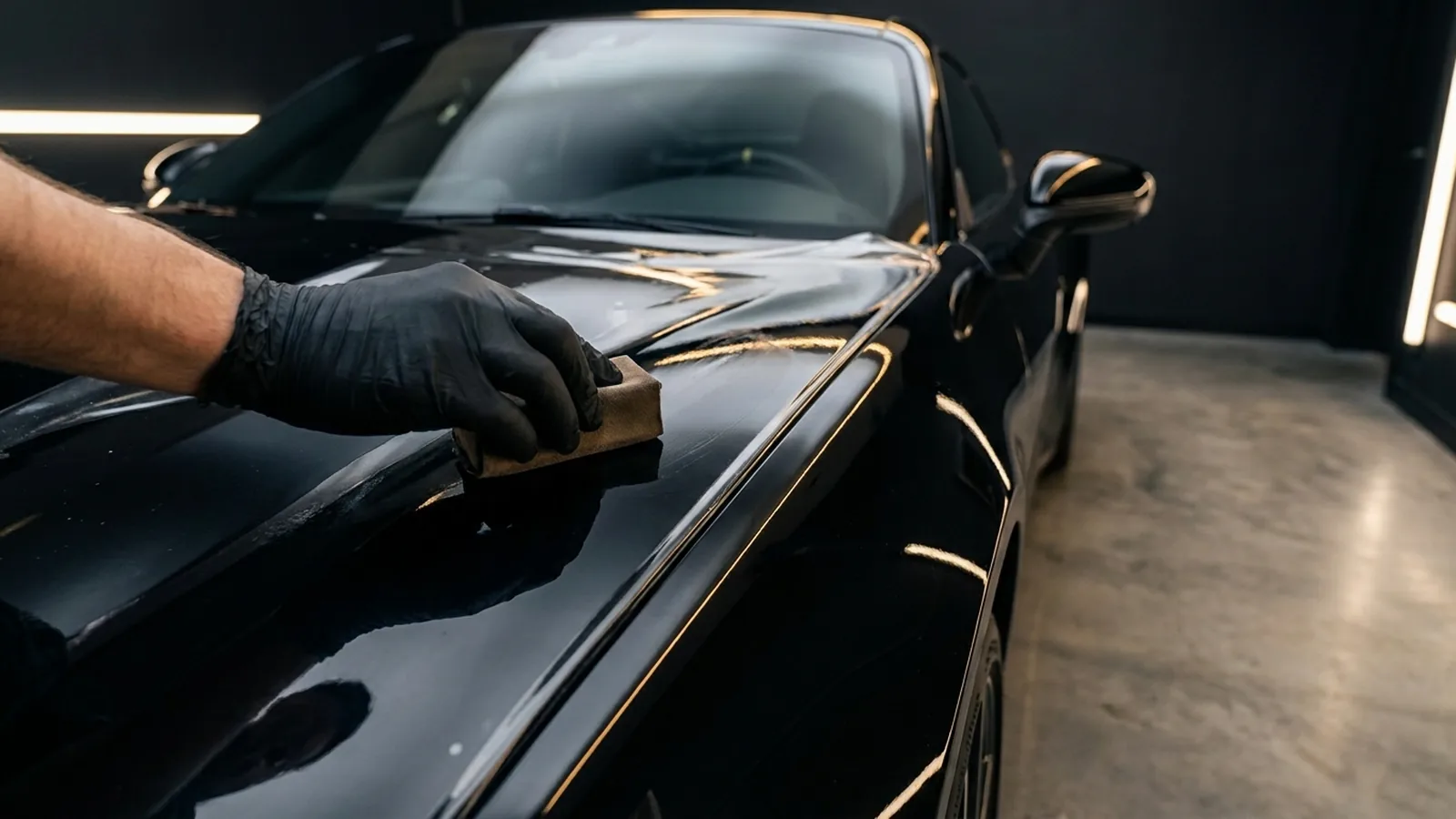
Ask whether a ceramic coating over PPF voids the film warranty and you will get the same answer everywhere: no, as long as the coating is film-safe. It is repeated on installer sites, in forum threads, and in the summaries that answer engines assemble from them. We went and read the published warranty documents for five paint protection films, including the four we install ourselves. The reassuring answer is wrong for two of them — and one of those two is our own supplier.
Does Ceramic Coating Over PPF Void the Film Warranty? The Short Answer
It depends on the brand of film, not on whether the coating is film-safe. Across five published warranty documents we found four different positions. XPEL excludes "Use of non-XPEL branded ceramic coatings" as exclusion 13 of revision R1224, and STEK's current terms exclude "Non-STEK branded ceramic coatings or any third-party coatings" while making STEK's own care product "a fundamental requirement of this Warranty". SunTek goes the opposite way, invalidating coverage for non-wax coatings and supplemental clear coats "other than ceramic coating" — an express carve-out that attaches no brand condition, though the same sentence still invalidates coverage for improper care. 3M's rule is about composition rather than brand, but it sits in the care instructions rather than the warranty: waxes without "dyes, abrasive polishes and/or rubbing compounds". Neither 3M's nor GSWF's warranty document mentions ceramic coatings at all, which is an absence rather than a permission.
First, Which Warranty Are We Talking About?
A protected car in Calgary usually carries three separate instruments, and almost all of the confusion on this topic comes from collapsing them into one word. This article is about the first one only.
| The document | Issued by | What a coating over the film has to do with it |
|---|---|---|
| The film’s warranty | The film manufacturer | Everything. This is the document that may or may not list ceramic coatings among its exclusions, and it is the subject of this article. |
| The coating’s warranty | The coating manufacturer | Nothing directly. It governs whether the coating itself fails early, on its own conditions and its own annual-service ladder. |
| The workmanship guarantee | The shop that did the work | Nothing, and it survives the others. It answers whether the film and coating were applied correctly, and it is the one owners actually use most. |
A fourth document sits outside that table deliberately: your vehicle's own factory warranty. Whether film or coating can touch it is a separate question with a separate answer, and we worked through the Canadian warranty booklets for it rather than repeating the American legal framing that dominates most pages — that is the factory-warranty question, which has a different answer again. And if what you are really asking is whether the coating itself will pay out when it fails, what a coating's own warranty covers, separately from the film's is where that lives.
Five Documents, Four Positions — and One Document Holds Two of Them
Here is what the documents actually say. Four positions across five documents, because 3M occupies two of them — its warranty never raises coatings, while its care instructions restrict what a product may contain. Each panel quotes the clause it comes from, with the revision marking where the document carries one.
Five documents, four positions
Select a position to read the clause it comes from. Five panels, four positions: the first two are the same position — a brand lock — with STEK adding a maintenance duty on top of it, and 3M appears twice, because its warranty is silent on coatings while its care instructions impose a rule about composition.
A coating brand can be an exclusion in its own right
"13. Use of non-XPEL branded ceramic coatings;"
What it means. This is the clause that breaks the internet answer. It does not ask whether the coating is film-safe, professionally applied, or any good. It asks whose name is on the bottle. Alongside it sits a general condition that the film must be maintained "in accordance with instructions provided by the Company", and the published XPEL product-care instruction is to "Seal with XPEL Ceramic Boost at least once every 6 months". XPEL closes the loop itself, on its own site, in a sentence worth quoting because it is not a criticism: the XPEL FAQ states that XPEL FUSION PLUS Ceramic Coating will not void the XPEL PPF warranty. Exclusion, care instruction and approved product all point at the same catalogue. That is a coherent position rather than a trap — simply one you want to know about before you buy the coating, not after.
Ask this: If your film is XPEL, ask which coating the shop intends to use before you agree to anything, because the answer decides whether your film warranty survives it.
Some documents add a product you must keep buying
"Non-STEK branded ceramic coatings or any third-party coatings that may be applied to the film after installation." … "Use of STEK PPF Care Solution is a fundamental requirement of this Warranty."
What it means. STEK takes the brand-lock position and adds a maintenance obligation on top of it. We install STEK, so this is our own supplier, and it is the reason the post exists rather than a reason to leave it out. Note also that the same page states the consequence twice and differently: one passage says failure to use the Care Solution on schedule "may void this Limited Warranty", another says it "will void the Limited Warranty".
Ask this: Ask what the ongoing care product is, what it costs, and on what schedule — a maintenance duty is a running cost, not a one-time condition.
A restriction on what is in the bottle, not whose name is on it
"Use waxes that do not contain dyes, abrasive polishes and/or rubbing compounds." … "The cleaner must be wet, non-abrasive, without solvents, and have a pH value between 6 and 8."
What it means. This is a different kind of rule and the distinction matters. 3M restricts what a product is made of — abrasives and dyes are what mar a film surface — and excludes no brand at all. The word "ceramic" does not appear in the warranty document at all. A composition rule you can satisfy with many products is not the same instrument as a brand lock you can satisfy with one.
Ask this: Judge the product by its contents against the published spec, and keep the pH window in mind through salt season — winter presoaks are often strongly alkaline.
One document excepts ceramic coatings from its exclusion by name
"Warranty coverage is invalid if the Product is subjected to abuse, improper care or use of abrasive or unapproved cleaning agents or in the event that any type of non-wax coating or supplemental clear coat, other than ceramic coating, is applied to the Product."
What it means. Read that clause slowly, because the three words in the middle reverse it. Non-wax coatings and supplemental clear coats are excluded — except ceramic coatings, which are carved out of the exclusion. Any brand. SunTek says the same thing in its own words on its own website, where it answers whether a ceramic coating can go over Reaction with the observation that coatings may be applied but are not necessary on that film. There is one limit worth knowing: the manufacturer disclaims responsibility for re-applying your coating if the film is ever replaced under warranty.
Ask this: If you want a free hand in choosing the coating, this is the regime that gives it to you — and budget for the coating separately if the film is ever replaced.
Two documents never mention coatings at all
"Non-compliance with GSWF guides or instructions."
What it means. We searched both the 3M warranty card and the GSWF warranty sheet for the words ceramic, sealant and coating. In neither document do they appear. That is not permission and it is not prohibition — it is an absence, and it is worth naming as one, because an absence still leaves the general non-compliance clause standing. If a dispute ever arose it would be argued there rather than under a specific coating term.
Ask this: Where the document is silent, get the shop position in writing on your invoice — silence gives you nothing to point at later.
Brand Locks and Composition Rules Are Not the Same Thing
The most useful distinction in this whole subject is the one nobody draws, and once you have it the documents stop looking like a jumble of fine print. Two different kinds of rule are at work.
A composition rule tells you what a product may not contain. 3M's care instruction is exactly this: waxes without dyes, abrasive polishes or rubbing compounds, because abrasive particles damage the film surface. Its technical data sheet adds a cleaner specification with an actual number in it — a pH between 6 and 8, neither strongly acidic nor strongly alkaline. Rules like these are testable, many products satisfy them, and you can comply while choosing freely. That number is the one worth carrying into a Calgary February. The touchless presoaks used to strip salt film work by being strongly alkaline — that is the mechanism rather than a defect — and a presoak chosen to lift road chemistry off a filmed hood is not chosen against 3M's window. Calgary compounds it from the other direction: the City runs hard municipal water, and it puts down sodium chloride and calcium chloride rather than the magnesium chloride the internet repeats, switching below −15°C to a 3% salt, 97% gravel mix. The hard water is the mineral spotting; the gravel is the impact story the film is there for in the first place. The pH spec sits between the two, and it is the only number anywhere in this material you can check a product against before you use it.
A brand lock tells you whose product you may use. It makes no claim about chemistry and offers no test you can run. XPEL's exclusion 13 does not describe a property that a disqualifying coating has; it describes a label it lacks. Nothing about that is improper — a manufacturer is entitled to warrant its film only in the condition it has tested — but it is a fundamentally different bargain from a composition rule, and it is worth seeing that the restriction and the manufacturer's own product recommendation point in the same direction. That is a thing published documents let you observe, not an accusation.
Silence Is Not Permission
Two of the five documents simply never raise the subject. We searched the 3M Scotchgard Pro Series owner care guide and warranty document and the GSWF warranty sheet for the words ceramic, sealant and coating. In neither document do they appear. It is tempting to read that as approval, and the temptation should be resisted, because an absence is not an allowance. In the GSWF document there is a general exclusion an argument would land on instead — "Non-compliance with GSWF guides or instructions" — which reaches whatever care instructions the manufacturer has published, coatings included. 3M's document carries care instructions of its own. There is no specific coating term to breach in either, and no specific coating term to rely on either.
The difference is about evidence rather than permission. With an express carve-out you can point at a sentence; with silence you are pointing at the absence of one, two years after the fact, to someone who would rather not pay. One condition is worth knowing while we are here, because it is the cheapest way to lose a warranty you were never going to breach: GSWF requires its warranty to be registered online within thirty days of purchase. Registration is normally the installer's duty rather than yours, which is precisely why it is worth asking for the confirmation rather than assuming it happened.
The Document Can Change Under You
One structural problem cuts across all of this, and STEK's terms are the clearest illustration of it. They are published as a web page rather than a versioned PDF, carrying no revision code and no last-updated date, so there is nothing to compare a future version against. We know these terms do get revised: an earlier STEK paint protection film warranty document dated 2023 is still circulating on installer websites, and it is materially different from the current terms — no ceramic coating exclusion, no care-product requirement. Anyone still quoting that PDF is quoting a superseded document, almost certainly in good faith.
By contrast, XPEL's document carries the revision code R1224, 3M's technical data sheet is marked revision B, March 2024, and the GSWF sheet is dated 04/28/2021. Where a marking exists you can at least establish which version you are reading. Where it does not, the only reliable copy of the terms that govern your car is the one you saved on the day it was installed. It takes a minute and it is the single most useful thing in this article.
What This Means for the Films We Install
We install 3M, STEK, SunTek and GSWF, and we would rather set out where each of them lands than let the general reassurance stand. SunTek's document carves ceramic coatings out of its exclusion by name, without attaching a brand condition. 3M's and GSWF's warranties do not address coatings, so nothing specific is breached and 3M's compositional restrictions on waxes still apply. STEK — our own supplier — restricts coverage to its own branded products and makes its care solution a requirement of the warranty. That is not a comfortable sentence to publish about a brand we sell, and it is the reason this article is worth writing: the same fact would have been true whether or not we told you, and you would have found out at claim time.
What it changes in practice is the order of the conversation rather than the recommendation. Film first, coating over it, is still the right build for a Calgary car — why the film goes on first and the coating over it covers the mechanics and the combined pricing. What moves earlier is the question of which coating, because on two of these five films that choice has a consequence attached. If the film is already on your car from another shop, bring the film's paperwork rather than the coating's, and if you are still choosing, which film brands you can actually buy in Calgary is the other half of the decision. The structure behind all of it — a manufacturer document and an installer document, doing different jobs — is set out in the two separate documents behind any film warranty.
What We Could Not Establish
Three things, named rather than filled in. First, we could not find a warranty document published by SunTek itself — suntekfilms.com carries no warranty PDF, so the full text we read is a dealer-hosted copy, and although SunTek's own website corroborates the permission in its own words, a manufacturer-hosted copy of the complete terms is not something we could produce. Second, nobody publishes claim outcomes, so how often any of these exclusions is actually invoked is unknown, and any article that tells you otherwise is guessing. Third, we found no case applying these clauses in Alberta, which means the documents are the best evidence available of what would happen rather than a record of what has. Where the manufacturer's document is silent, the practical answer remains the shop's written position on your invoice — and if you want the surface behaviour a coating provides while keeping the question simple, keeping film clean without a coating at all is a legitimate route that no document restricts.
What to Ask Before You Coat Over Film
- Ask which film is on the car, by brand and line. Every answer on this page turns on it, and most owners have the coating paperwork rather than the film paperwork.
- Ask to see the film's exclusion list, not a summary of it. You are looking for one thing: whether the word ceramic appears, and whether it appears next to a brand name.
- Ask whether the document carries a revision marking. If it does, note it. If it does not, that is worth knowing too, because the terms can be revised in place.
- Ask what the ongoing care product is and what it costs. Where a maintenance product is a condition of coverage, it is a running cost for the life of the film rather than a one-time purchase.
- Save a dated copy on install day, and get the registration confirmation. Where a maker requires registration — GSWF requires it online within thirty days — it is usually the installer's duty, and the version in force on your install date is the one that governs your car.
Ask Us Which Document Sits Behind Your Film
Before you book a coating over film — ours or anyone's — we will tell you what that film's warranty says about coatings, and what it does not say. Call (587) 323-3222 and ask us the five questions above. 4.9 stars across 705+ Calgary reviews, 10,000+ vehicles protected.
Book a Protection ConsultationIf you are still deciding what goes on the car in the first place, the films we install and the warranty document behind each one sets out the options, and what each coverage level costs is the other half of the sum.
A note on what this article is. Every clause quoted above was read in the manufacturer's own published warranty or care document, and each is cited below with its revision marking where the document carries one — several of these terms are revised in place at the same web addresses, and one of them carries no version marking at all. Two documents came with limits worth restating: SunTek publishes no warranty PDF on its own site, so the full text we read is a dealer-hosted copy corroborated by SunTek's own FAQ, and STEK's terms are an unversioned web page. Nothing here is a statement about any Calgary shop's practices, and these brands are quotable precisely because they publish their terms, which is to their credit. A brand-conditioned warranty is a legitimate commercial choice, not a defect. We are a protection studio rather than counsel — the manufacturer's current document, and the revision in force on your own install date, outrank anything written here.
Ready to Protect Your Vehicle from Rock Chips?
Join 705+ Calgary drivers who trust Obsidian Auto for PPF installation
Serving Calgary and surrounding areas • Free Uber shuttle with every service
Frequently Asked Questions
Sources
External references used in this guide
- XPEL — Ultimate Plus & Stealth Paint Protection Film Warranty, revision R1224 (PDF, linked from XPEL's warranty information page). The primary source for the brand-lock position: exclusion 13 is "Use of non-XPEL branded ceramic coatings", and the document conditions coverage on the film being "stored, handled, installed, used, and maintained in accordance with instructions provided by the Company". Cited as the clearest published example of a brand-conditioned exclusion. We do not install XPEL film
- XPEL — product care instructions. The companion half of the same loop: XPEL's published care instruction for these films is to "Seal with XPEL Ceramic Boost at least once every 6 months". Cited to show that the exclusion and the maintenance instruction point at the same product
- XPEL — frequently asked questions. Cited for the other half of the brand-lock loop in XPEL's own words: XPEL states that its FUSION PLUS Ceramic Coating will not void XPEL's PPF warranty. Quoted to show that the exclusion and the approved product are two ends of one coherent position rather than an inconsistency
- STEK — Warranty Coverage, Paint Protection Film (DYNO Series). Source for the second brand-lock position, which excludes "Non-STEK branded ceramic coatings or any third-party coatings that may be applied to the film after installation" and states that "Use of STEK PPF Care Solution is a fundamental requirement of this Warranty". IMPORTANT SCOPE NOTE: these terms are published as a web page carrying no revision code and no last-updated date, and the same page states the consequence of a missed care schedule inconsistently, once as "may void this Limited Warranty" and once as "will void the Limited Warranty". A separate STEK PPF warranty PDF dated 2023 remains in circulation on third-party installer sites and is materially different — it contains no ceramic coating exclusion and no care-product requirement — so it should not be relied on as current
- 3M — Scotchgard Paint Protection Film Pro Series owner care guide and warranty information (PDF). Source for the finding that 3M's warranty document does not address ceramic coatings at all, and that its stated chemical restriction is compositional: "Use waxes that do not contain dyes, abrasive polishes and/or rubbing compounds".
- 3M — Scotchgard Paint Protection Film Pro Series 200 Gloss technical data sheet, revision B, March 2024 (PDF). Source for the cleaner specification quoted here — "The cleaner must be wet, non-abrasive, without solvents, and have a pH value between 6 and 8 (neither strongly acidic nor strongly alkaline)" —
- SunTek — Paint Protection Film Limited Warranty, Eastman Performance Films, print code (03/22) (PDF). The source of the express carve-out: coverage is invalid where "any type of non-wax coating or supplemental clear coat, other than ceramic coating, is applied to the Product", and the manufacturer "is not responsible for the reapplication of any ceramic coatings" following a claim. SCOPE NOTE: suntekfilms.com publishes no warranty PDF of its own, so the full document is available only as a dealer-hosted copy; the permission itself is corroborated on SunTek's own website (next entry)
- SunTek — frequently asked questions (manufacturer-owned). Corroborates the carve-out in SunTek's own words: asked whether a ceramic coating can be applied over Reaction paint protection film, SunTek answers that coatings may be applied over the surface of its paint protection film, while noting it is not necessary on that particular film because of its own slick surface
- City of Calgary — water quality and water hardness data. The basis for reading a cleaner pH specification as locally load-bearing rather than boilerplate: Calgary runs hard municipal water, which is what produces the mineral spotting owners see on coated and filmed panels
- City of Calgary — road salt management plan. Source for what Calgary actually applies: of the four common road salts the City states it uses only sodium chloride and calcium chloride, and below −15°C switches to a 3% salt / 97% gravel sanding mixture called Pickle plus liquid calcium chloride. Cited because the magnesium chloride commonly named in detailing content is not what the City puts down
- GSWF — warranty information, dated 04/28/2021 (PDF). Cited as the second negative finding: a keyword search of the document returns no occurrence of ceramic, wax, sealant or coating, so the nearest applicable clause is the general "Non-compliance with GSWF guides or instructions". The document also requires online registration within 30 days of purchase, and states terms by film and climate zone rather than as a single figure — Canada falls in Zone 1

Ready to Protect Your Vehicle?
Get a quote from Calgary's most trusted detailing studio. We use only the best materials and back our work with industry-leading warranties.
Get A QuoteRelated Intelligence
Satin PPF Care: What the Film Makers Actually Instruct
Every page says the same thing about satin paint protection film: never wax it, never seal it. We read the published care documents for five films and found four different instructions and one silence. One forbids it outright, one instructs an annual wax, one requires sealing every six months, one hands the decision back to you, and one never raises the subject.

Pressure Washing PPF: How Far Back Do You Hold It?
Everyone publishes a number and almost nobody publishes a source. We read the care documents for six paint protection films and found three different standoff distances and two refusals: 3M asks for 12 inches, GSWF for 24, STEK for 36, while SunTek and Ceramic Pro say do not use a pressure washer on film at all. Only one of the six sets a pressure limit — and one document manages to call a pressure washer optimal on one page and forbid it outright on another.

Can You PPF a Factory Matte or Satin Car in Calgary?
Bought a car in a factory matte or satin colour — Porsche Chalk, BMW Individual Frozen, AMG magno? You can protect it with paint protection film, but only the right one. How matte PPF preserves the flat finish without adding gloss, why matte paint can never be polished, and how to care for it in Calgary.