Maintenance
Can You Go Through a Carwash with PPF Film? The Complete Answer
Obsidian Auto Team, , updated , 9 Minute Read
Contents
Quick answer: Touchless automatic car washes are safe for PPF—no brushes means no risk of edge lifting or film damage. Automatic car washes with spinning brushes should be avoided—brushes can snag film edges and cause peeling over time. Hand washing is the gold standard for PPF care, using pH-neutral soap, microfiber mitts, and the two-bucket method.
Key Takeaways
- Touchless automatic car washes are safe for PPF—no brushes means no risk of edge lifting or film damage.
- Automatic car washes with spinning brushes should be avoided—brushes can snag film edges and cause peeling over time.
- Hand washing is the gold standard for PPF care, using pH-neutral soap, microfiber mitts, and the two-bucket method.
- Self-serve pressure wash bays are safe as long as you don't aim the pressure washer directly at film edges from close range.
- Adding ceramic coating over PPF makes every wash method easier—dirt and grime slide off with minimal effort.
Short answer: yes. A touchless automatic wash is completely safe for PPF—no brushes, no contact, no risk to your film. What you want to avoid is a brush tunnel or a close-range high-pressure jet, and you want to keep a freshly installed car out of any wash until the adhesive has cured (about 48 hours before any wash, a full week before a tunnel). That's the whole rule. Below, Obsidian Auto breaks down every wash method so you can keep your PPF-protected vehicle clean without shortening its life.
The Quick Answer: Car Wash Compatibility Guide
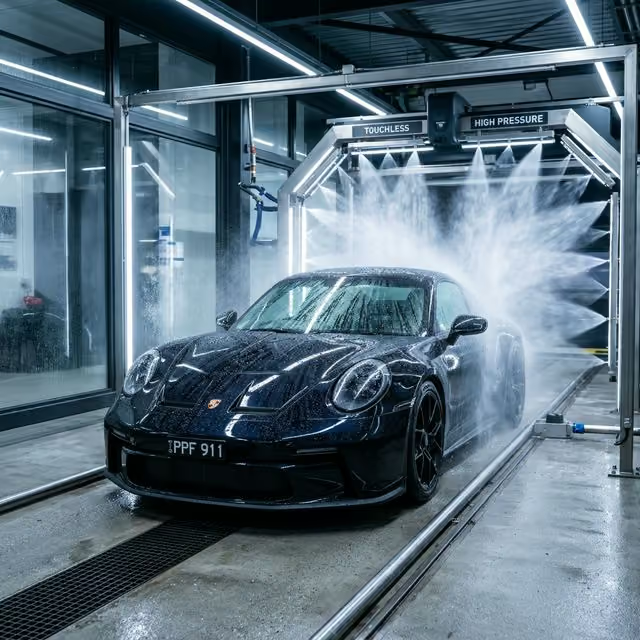
✅ Touchless Automatic Car Wash
High-pressure water jets and soap only—no physical contact with your paint. Fully safe for PPF. This is the most convenient option for PPF owners who prefer automated washing.
✅ Hand Washing
The gold standard. pH-neutral soap, microfiber mitt, two-bucket method, air dry or pat dry with microfiber. Best possible care for PPF.
✅ Self-Serve Pressure Wash Bay
Safe when used properly: wide spray pattern, well back from the surface, and never aimed directly at film edges. Good for quick winter salt rinses. The minimum distance is set by your film's maker and they disagree — see the standoff distance each film maker publishes below.
❌ Brush Automatic Car Wash
Spinning cloth or plastic brushes catch on PPF edges, causing lifting and peeling over time. Avoid entirely. One trip probably won't cause damage, but repeated use will.
Why Brush Car Washes Are Dangerous for PPF
PPF is applied in sections with edges that sit on your paint surface. While these edges are tucked into body lines or wrapped under panels by a quality installer, they still create a subtle lip. Spinning brushes in automatic car washes can:
Catch Film Edges
Brush fibers hook under edge lips and pull, gradually lifting the film from its adhesive bond.
Create Micro-Tears
Repeated brush friction at edges creates tiny tears that grow over time, allowing water and dirt underneath.
Trap Debris
Dirty brushes carry grit from previous vehicles that scratches the film surface—deeper than self-healing can repair.
One visit to a brush car wash probably won't cause noticeable damage. But regular weekly use over months will gradually weaken edge adhesion and reduce film lifespan by years. The $5 savings per wash isn't worth the $1,500+ in premature PPF replacement. It is worth understanding the home-wash rules that push owners into a tunnel in the first place, because they permit more than most people think.
Where Wash Damage Starts
Wash damage to PPF almost always starts at an edge: along the hood, a fender or a mirror cap, where a spinning brush can snag the film and work it loose over a season of weekly tunnels. The other common cause is washing too soon after an install, before the adhesive has settled, which forces water under an edge that hasn't fully bonded. Hence the two rules below: no wash of any kind for the first 48 hours, and no brush tunnel at all.
Right After an Install: When You Can Wash
New film needs a short settling period before it sees water pressure. Your installer's instructions for your specific film come first; the usual timeline looks like this:
- First 48 hours: no washing at all. Don't wash, rinse or aim water at the film. If a bird dropping or sap lands on it, blot it gently with a damp microfiber rather than scrubbing.
- 48 hours to 7 days: gentle hand wash only. pH-neutral soap, a soft mitt, cool or lukewarm water. No pressure washer, no automatic wash, nothing aimed at an edge.
- After the first week: normal washing. Touchless washes, hand washing and a careful wand bay are all fine from here. Brush tunnels stay off the list for good.
Small bubbles or hazy spots in the first week or two are normal: the film goes on wet and the leftover moisture works its way out through it. Leave them alone, and ask your installer to check anything still there after two to three weeks.
The Perfect Hand Wash Routine for PPF
If you want to give your PPF the absolute best care, here's the professional hand wash method we recommend:
Pre-Rinse
Rinse the entire vehicle with clean water to remove loose dirt and debris. This prevents scratching during the wash stage. Use moderate pressure, not maximum.
Two-Bucket Wash
Bucket 1: pH-neutral car soap solution. Bucket 2: Clean rinse water with a grit guard. Dip your microfiber wash mitt in soap, wash one panel, rinse the mitt in the clean water, repeat. This prevents cross-contamination.
Wash Top to Bottom
Start from the roof and work down. Lower panels have the most dirt (rocker panels, bumpers) so save these for last to avoid dragging grit over cleaner areas.
Rinse Thoroughly
Remove all soap residue. Soap left to dry—especially at film edges—can leave mineral deposits that cloud the film surface over time.
Dry with Microfiber
Pat dry with clean, plush microfiber towels—don't drag. Even better: use a blower or compressed air (leaf blower works great) to remove water without touching the surface at all.
Winter Washing Tips for Calgary PPF Owners
Calgary winters mean road salt and calcium chloride on every drive. Here's how to manage winter washing with PPF:
Calgary Winter Wash Rules
- Wash weekly minimum during salt season (November–April). Road salt left on paint or PPF for weeks accelerates degradation.
- Use a touchless car wash for convenience—many Calgary locations like Petro-Canada and Turbo offer touchless options.
- Focus on lower panels where salt spray accumulates most: rocker panels, wheel wells, front bumper lower edge.
- Don't let salt sit for more than a week. If you can't wash the whole car, at least rinse the lower panels.
- Add ceramic coating over PPF before winter. The hydrophobic layer repels salt water and makes cleaning dramatically easier. On satin or matte film, match the coating to the finish — a standard gloss coating will change how the film looks.
Pressure Washing PPF: What the Film Makers Publish
There is no single safe distance, because the film makers don't agree. What each one publishes (sources at the end of this article):
- 3M: nozzle at least 12 inches from the film and square to it, a spray pattern of at least 40 degrees, no more than 80 bar (about 1,160 psi), and water no hotter than 140°F (60°C). It is the only maker that publishes a pressure limit or an angle.
- GSWF: at least 24 inches, with a 40-degree tip, and never directly at edges or seams.
- STEK: hand washing recommended; with a pressure washer, at least 36 inches.
- SunTek: avoid power washes and automatic car washes altogether.
- XPEL: stay 3 feet away on its colour PPF.
The practical version: find out which film is on your car and use that maker's figure. If you can't, work to the most conservative one (36 inches), use the widest fan tip on the wand, keep the nozzle square to the panel, and never run the stream along a seam or edge. At a self-serve bay you can't know the wand pressure or water temperature, since operators don't publish them, so distance and angle are the parts you control. In deep cold, rinse before you touch anything: below about -15°C the City spreads a 3% salt, 97% gravel mix, so much of what is on the lower panels is grit.
Your owner's manual may add its own rules. Volvo and Polestar tell owners of new cars to stay out of automatic car washes while the paint is still hardening, and Cadillac, Infiniti and Lucid publish 1,200 psi as a pressure ceiling, not a target. It is worth reading the washing section before the first wash.
Ceramic Coating + PPF: The Easy Maintenance Combo
The ultimate combination for easy washing is ceramic coating applied over your PPF. Here's why:
Hydrophobic Water Beading
Water beads and sheets off the surface, carrying dirt with it. Many light contaminants rinse off with just water—no soap needed for a quick clean.
Chemical Resistance
Ceramic coating adds a chemical-resistant layer over the PPF, preventing salt, bug splatter, and bird droppings from bonding to the film surface.
With ceramic coating over PPF, many of our Calgary clients find they only need to hand wash every 2–3 weeks instead of weekly—and each wash takes half the time because contaminants don't stick to the surface. For the stubborn stuff that survives a normal wash, our guide on how to safely remove bugs and tar from PPF walks through the right technique.
Products to Avoid on PPF
Not all car care products are PPF-safe. Avoid these:
Want Ceramic Coating Over Your PPF?
Make car washing effortless. Add ceramic coating to your PPF for ultimate easy-clean protection.
Get Ceramic + PPF QuoteRelated Resources
Ready to Protect Your Vehicle from Rock Chips?
Join 696+ Calgary drivers who trust Obsidian Auto for PPF installation
- Free Consultation
- Same-Day Response
- 10-Year Warranty
Serving Calgary and surrounding areas • Drop-off at our SE Calgary studio
Pros
- Touchless car washes are perfectly safe and convenient for PPF-protected vehicles.
- Self-serve pressure-wash bays work great when used at reasonable distance from edges.
- Hand washing PPF is actually easier than bare paint—self-healing surface means fewer swirl marks.
- Ceramic coating over PPF reduces wash frequency and effort dramatically.
- You don't need special products—standard pH-neutral car soap works perfectly.
- PPF simplifies winter washing—salt rinses off film surface more easily than bare paint.
Cons
- Automatic brush car washes are off-limits—brushes can catch and lift film edges.
- Very high-pressure jets aimed directly at edges can cause lifting over time.
- Some car wash soaps contain harsh chemicals that can damage PPF's clear coat layer.
- You need to be mindful of film edges when drying with towels.
- Can't use abrasive waxes or compounds that are safe on bare paint.
- First 48 hours after installation: no washing at all while adhesive cures.
Frequently Asked Questions
Sources
External references used in this guide
- 3M — Paint Protection Film Installation Guidelines (PDF), pressure-washing specification
- GSWF — Official Maintenance Guide (PDF), section 2: Pressure Washing
- STEK — FAQs (pressure-washer distance)
- SunTek — paint protection film FAQs (car washes and power washes)
- XPEL — product care instructions
- Volvo Cars — XC90 owner's manual, washing the vehicle in an automatic car wash
- Lucid Motors — Lucid Air owner's manual (PDF)
- The City of Calgary — road salt management

Written by
Obsidian Auto Team
PPF, Ceramic Coating & Window Tint Installers
- Consumer Choice Award winner 2022–2025
- We install 3M, STEK, SunTek, GSWF paint protection film
- Computer-cut patterns, wrapped edges, no blades on paint
- 4.9-star average across 696+ Google reviews
- 10,000+ Calgary vehicles since 2020
- Calgary studio serving Airdrie, Cochrane, Okotoks & Chestermere
A crew of full-time installers and detailers in southeast Calgary, working on Calgary cars since 2020. Our guides are researched and drafted with AI assistance, then checked against our own prices and policies before publishing.
Meet the team
Ready to protect your paint?
Self-healing paint protection film in five coverage tiers, plotter-cut and edge-wrapped, with a 10-year film warranty.
Get my free quote
Maintenance
How to Clean and Maintain PPF in Calgary: The Definitive Care Guide
21st of April 2026
Protect your investment. The dos and don'ts of washing PPF, choosing soaps, and using ceramic boosters.
Maintenance
How to Safely Remove Bugs, Tar, and Sap from PPF Without Damage
21st of April 2026
Summer road trips mean bug splatters. Here is the safe way to clean sticky contaminants from your PPF.

Maintenance
Can You Polish Scratches Out of PPF? What Works and What Ruins It
21st of April 2026
Your PPF has some light scratches from Calgary roads. Can you treat it like paint and polish it? The answer is yes, but with extreme caution.