
What Your Owner's Manual Says About the Car Wash
Quick answer: Two of the ten owner's manuals we read tell you not to use an automatic car wash while the paint on a new vehicle is still hardening. Volvo publishes it as "This allows the paintwork to harden properly"; Polestar publishes the same sentence with "cure" in place of "harden". Neither puts a number on how long — the phrase in…
Key Takeaways
- Two of the ten owner's manuals we read tell you not to use an automatic car wash while the paint on a new vehicle is still hardening. Volvo publishes it as "This allows the paintwork to harden properly"; Polestar publishes the same sentence with "cure" in place of "harden". Neither puts a number on how long — the phrase in both is "the first few months".
- That instruction cuts directly against the answer now in circulation. Ask how long to wait before washing a new car and you will be told factory paint is fully cured at delivery and no waiting period exists. That correction is about fresh respray, and two manufacturers publish current guidance that contradicts it for their own cars.
- Cadillac, Infiniti and Lucid each publish 1,200 psi as the pressure not to exceed. Rivian publishes a table with a maximum of 1,100 psi. Consumer guidance commonly presents 1,200 to 1,900 PSI as the safe working range, which inverts the number — a reader following it can sit above three published ceilings while believing they are inside a safe band.
- Five of the ten manuals we read land on a 30 cm minimum standoff. Lexus asks for at least 11.9 in. (30 cm), and Mercedes, Cadillac, Infiniti and Lucid reach the same distance in their own units. Rivian asks for 15 in (40 cm), and Mercedes asks for 70 cm over foil-covered panels. Consumer advice commonly suggests around six inches.
- Two of the ten manuals publish no number at all. Genesis asks owners to "maintain sufficient distance" and Acura to "Keep sufficient distance", neither defining it. We checked the Genesis washing pages for any figure in psi, kPa, bar, centimetres or inches and found none. An owner reading either manual in good faith comes away with nothing actionable.
- The chemical the manuals warn about is acid, not the paint-stripping soap of internet legend. Infiniti and Lucid both warn that acid in wash detergent can react with plastic components and crack them, and both close with the same instruction — check with your car wash to confirm that acid is not used. Mercedes warns separately that acidic alloy wheel cleaners could damage wheel bolts and brake components.
- One manual ties the automatic wash to warranty coverage, and the wording is narrower than the folklore. Lucid states that "Vehicle or paint damage caused by using an automatic car wash are not covered under the vehicle warranty", and prints the same for pressure washers. That is a coverage exclusion for one damage mode, not a voided warranty — a distinction the extended-warranty pages ranking for this question tend to blur.
- Six of the ten manuals raise the brakes after a wash, and it is the instruction with the widest gap between how consistently it is published and how rarely anyone has read it. Volvo and Polestar say to test them including the parking brake; Genesis describes drying them by applying them lightly at low speed; Mercedes prints a WARNING that braking efficiency is reduced after washing.
- The six do not agree on how firmly to say it. Lucid's version instructs the driver to dry the brakes rather than test them, and Rivian makes the step explicitly optional. So the substance is near-universal across the manuals that raise it, and the force behind it is not.
- Porsche, BMW, Tesla and Audi are absent from this article because their manuals could not be obtained — Porsche's is an application shell with a closed API, BMW's is gated behind a VIN, Tesla refuses automated access and Audi sits behind a CAPTCHA. Those are four of the marques we most often work on, so every count in this piece is scoped to the ten manuals we could read and none of it should be read as an industry-wide tally.
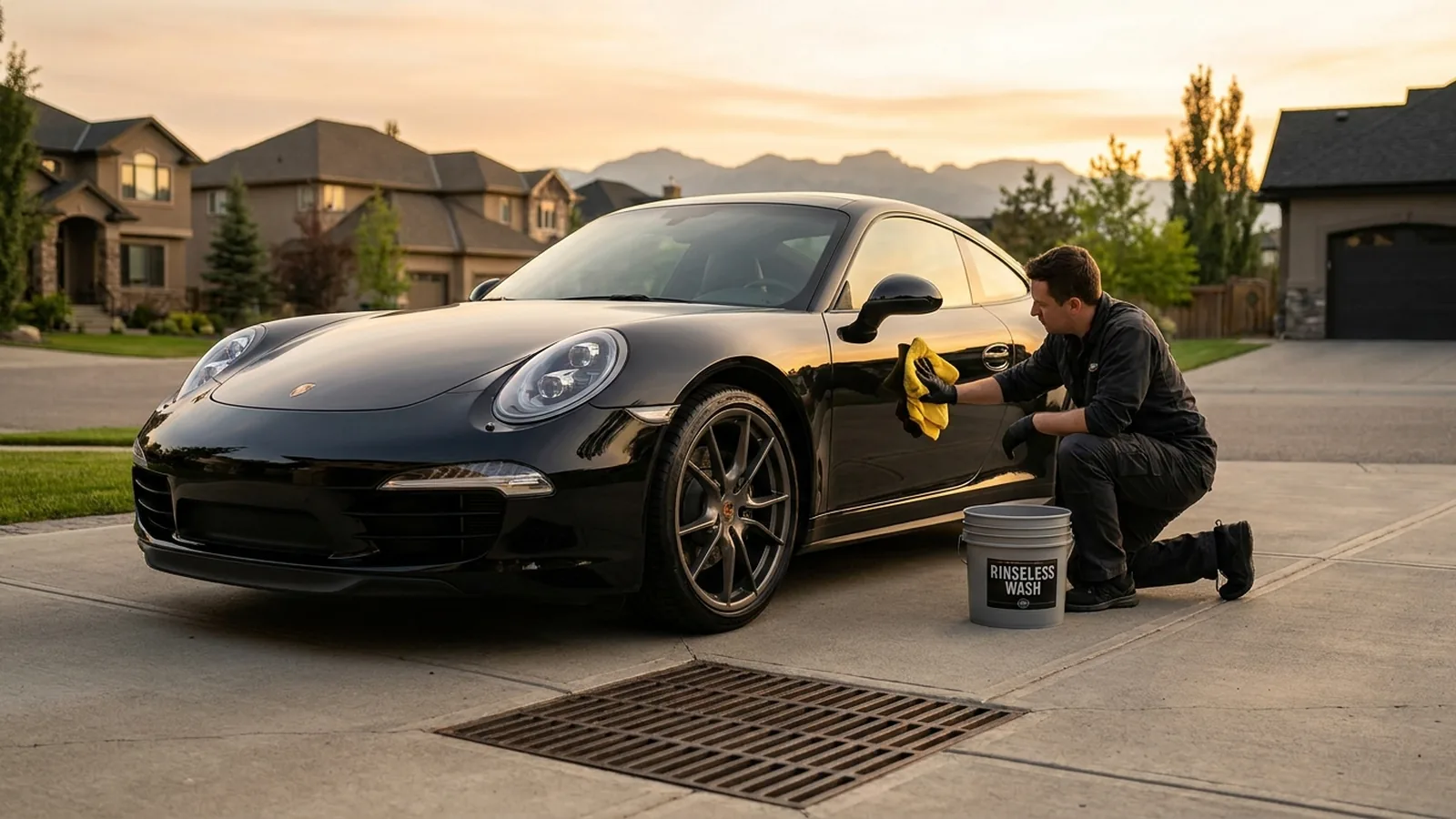
The short answer
Two of the ten owner’s manuals we read tell you not to use an automatic car wash while a new car’s paint is still hardening. Volvo publishes it as “This allows the paintwork to harden properly”; Polestar publishes the same sentence with “cure”. Three more — Cadillac, Infiniti and Lucid — publish 1,200 psi as a pressure ceiling, not the floor the internet has turned it into. And one, Lucid, puts the automatic wash in the warranty section. None of this is secret. It is in the book in your glovebox, and almost nobody quotes it.
There is a document that came with your car, written by the people who built it, that tells you exactly how they want it washed. It is free. It is usually online. And it is, as a body of guidance, almost completely absent from the conversation. A citation audit run for this article looked at roughly fifty ranking pages across six wash-related questions — is the automatic wash bad for paint, how long to wait before washing a new car, how close to hold a pressure washer, whether a wash can void a warranty — and found exactly one manufacturer domain among them.
What fills that space instead is a mix of detailing blogs, product vendors, car-wash chains, one company that manufactures the wash equipment, and several firms that sell extended warranties. None of that is disqualifying on its own. But the numbers those pages publish run consistently more permissive than the manufacturers’, and in one case run in the opposite direction entirely. So we did the obvious thing nobody seems to do: we read the manuals. Ten of them, on 16 September 2026 — eight as PDFs, two as the manufacturers’ own online manuals.
Two manufacturers say wait, and the internet says they are wrong
According to Volvo’s XC90 owner’s manual, a new car should stay out of the automatic wash for “the first few months” so the paintwork can harden. Volvo publishes no number of days.
Ask any answer engine how long to wait before taking a new car through a wash and you will get a confident myth-correction: factory paint is fully cured when the vehicle leaves the plant, the thirty-day rule is a body-shop rule about fresh respray, and it does not apply to you. That is a reasonable correction and it is right about respray. It is also, for two of the cars in this set, contradicted by the manufacturer.
The same sentence, two manufacturers, two verbs
Volvo: “Volvo recommends that you do not use an automatic car wash during the first few months when the vehicle is still new. This allows the paintwork to harden properly.”
Polestar: “Polestar recommends that you do not use an automatic car wash during the first few months, when the vehicle is still new. This allows the paintwork to cure properly.”
The two sentences are otherwise identical, down to the rhythm, because the two companies share a manual platform — the articles carry the same identifier on both sites. What differs is one verb and one comma. It is a small thing and it is the kind of small thing that tells you these are real published instructions maintained by real documentation teams rather than boilerplate nobody has looked at since 2015.
Now notice what is not there. Neither manufacturer puts a number on it. Not thirty days, not sixty, not ninety. The phrase in both documents is “the first few months”, and it is left exactly that loose. We are not going to tighten it for them, because the whole problem with this topic is people inventing precision that no source supports. The other eight manuals we read do not raise the subject at all — which is not the same as permitting it, and should not be reported as though it were.
We should be straight about a tension this creates with our own writing rather than quietly routing around it. When we set out what to do in the first forty-eight hours with a new car, we said what the industry generally holds: factory paint is cured in a high-temperature oven at the plant and does not need a waiting period before protective work begins. We still think that is right about film and coatings. But two manufacturers publish a recommendation to keep a new car out of an automatic wash for the first few months, and the reason they give is that the paintwork needs that time to harden. Those two positions sit awkwardly together, and they are about different things — one is about applying a product to the surface, the other about dragging equipment across it. We are not going to reconcile them on the manufacturers’ behalf. What we can say is that the instruction is published, it is current, and it is specific to those makes.
Nine instructions, quoted from the manuals
Select an instruction to read it as the manufacturer publishes it. Every quotation was read from the manual itself on 16 September 2026, not from a summary of it.
Two of the ten makers tell you to stay out of the automatic wash while the paint is new
"Volvo recommends that you do not use an automatic car wash during the first few months when the vehicle is still new. This allows the paintwork to harden properly."
What it means. This is the instruction most worth knowing, because the internet has confidently talked itself out of it. Ask an answer engine how long to wait before washing a new car and it will tell you that factory paint is fully cured when the vehicle leaves the plant and there is no waiting period at all — a correction aimed at the body-shop rule about fresh respray. The correction is right about respray and wrong about these two cars. Volvo and Polestar both publish a recommendation to avoid the automatic wash for the first few months on a new vehicle, and they publish it as current guidance rather than as legacy text. Note what neither of them does: put a number on it. There is no 30 days, no 60, no 90. The phrase is "the first few months" and it is left exactly that loose.
Do this: If you have taken delivery recently and the car is a Volvo or a Polestar, wash it by hand for the first stretch of ownership. Both manuals also tell you to wash the vehicle as soon as it gets dirty, so this is an instruction about the method, not permission to leave salt on the paint.
One of the ten puts the automatic wash in the warranty section
"Vehicle or paint damage caused by using an automatic car wash are not covered under the vehicle warranty."
What it means. Lucid states it twice — once for automatic car washes and once for pressure washers — and the precision matters more than the drama. This is a coverage exclusion, not a voiding condition. It removes one cause of damage from what the warranty will pay for; it does not cancel the warranty, and nothing in the manual says a wash history can. That distinction is worth holding onto because the pages currently ranking for warranty-and-car-wash questions are largely published by companies that sell extended warranties, and they blur exclusion into voiding in a direction that happens to sell policies. Lucid also narrows which automatic washes it will tolerate at all: it recommends using only touch-free automated car washes that do not bring brushes or other cleaning tools into direct contact with the body.
Do this: Read your own warranty booklet for the word "exclusion" rather than the word "void". They do different work, and only one of them is usually in the document.
1,200 PSI is a maximum in three manuals, and the internet treats it as a minimum
"Avoid using high-pressure washers closer than 30 cm (12 in) to the surface of the vehicle. Use of power washers exceeding 8,274 kPa (1,200 psi) can result in damage or removal of paint and decals."
What it means. This is the finding with the sharpest practical edge, because the number in circulation is inverted. Search for pressure-washer guidance and you will be told that 1,200 to 1,900 PSI is the safe working range, with 1,200 as roughly the minimum needed to clean a car properly. Three manufacturers in this set — Cadillac, Infiniti and Lucid, who share no platform and no parts — independently publish 1,200 psi as the figure not to exceed. Rivian is stricter still. A reader following the top-ranked consumer advice can therefore be several hundred PSI above three manufacturers' published ceiling while believing they are comfortably inside a safe band. Cadillac is also the one manual in the set that contradicts itself on this: it warns against pressure washing the vehicle frame because it can remove corrosion protection, then a few sentences later instructs owners with power-assist steps to extend them and use a high pressure wash to clean all joints and gaps.
Do this: Look up the rating on the machine before you point it at the car. A widely sold consumer electric unit is rated around 1,900 PSI, which is above every ceiling published in this set.
Five manuals land on 30 cm, one asks for 40, and one adds 70 over film
"Keep the tip of the nozzle at least 11.9 in. (30 cm) away from the vehicle body."
What it means. Thirty centimetres is the closest thing to a consensus in this corpus. Lexus, Mercedes, Cadillac, Infiniti and Lucid all land on it, in their own units and their own words. Rivian is the outlier in both directions at once — a maximum of 1,100 psi, the lowest ceiling in the set, and a minimum spray distance of 15 in (40 cm), the longest standoff — and it is the only manual here that sets a minimum spray angle as a general rule rather than an underhood one. Mercedes goes further than anyone for wrapped panels, asking for at least 70 cm between the nozzle and any foil-covered part of the vehicle. Set that against the figure most commonly published for consumers, which is around six inches from paint, and the advice in circulation is somewhere between half and a quarter of the manufacturer minimum.
Do this: If you cannot remember which number applies to your car, use the longest one in this set. No manual in it is made worse by standing further back.
Two manuals publish no number at all
"When using high-pressure washers, make sure to maintain sufficient distance from the vehicle. Insufficient clearance or excessive pressure can lead to component damage or water penetration."
What it means. Two of the ten manuals decline to quantify anything. Genesis names the failure modes — component damage, water penetration — and then asks for "sufficient distance" without saying what sufficient means. Acura does the same in fewer words. We checked the Genesis washing and care pages for any figure at all, in psi, kPa, bar, centimetres or inches, and found none. This is worth reporting rather than glossing over, because it is a real answer to the question people are asking: two manufacturers in this set looked at the same problem their competitors quantified and chose not to. An owner reading their own manual in good faith comes away with nothing actionable, which is presumably how the vendor numbers filled the gap.
Do this: If your manual gives you a word instead of a number, borrow a number from a manual that has one rather than from a product listing that is selling you the machine.
The chemical the manuals actually warn about is not the one the internet warns about
"Do not use car washes that use acid in the detergent. Some car washes, especially brushless ones, use some acid for cleaning. The acid may react with some plastic vehicle components, causing them to crack... Always check with your car wash to confirm that acid is not used."
What it means. The circulating warning about touchless washes is that their chemistry strips paint. That is an overstatement — the defensible version is that aggressive presoaks degrade wax and sealant, which are sacrificial layers, and that without mechanical agitation they often will not manage even that. Meanwhile the hazard two manufacturers in this set name explicitly, and a third names for wheels, is barely discussed anywhere: acid. Infiniti and Lucid both single out brushless and automated washes, both tie the risk to plastic components cracking rather than to paint, and both end with the same instruction to go and ask. Mercedes addresses it on the wheels instead, telling owners to use acid-free alloy wheel cleaners and warning that acidic ones could damage wheel bolts and brake components.
Do this: Ask the wash whether its presoak is acidic. Two manufacturers in this set instruct you to ask in exactly those terms, which makes it a reasonable question rather than a fussy one.
Matte and satin finishes get a separate rulebook
"Do not polish or use products intended for high-gloss paintwork on surfaces that have matte paintwork. This may create a permanent gloss on the surface."
What it means. Four of the ten manuals carve matte paint out and give it its own instructions, and the reason they give is mechanical rather than chemical. The widely repeated explanation for why a matte car should avoid the automatic wash is that silicones and gloss agents in the soap will ruin the finish. The manuals point somewhere else. Volvo and Polestar warn that high-gloss products can create a permanent gloss on a matte surface. Genesis objects to the brushes specifically, instructing that an automatic car wash which uses rotating brushes should not be used. Mercedes bans the hot-wax finishing programme and polishing outright. The through-line is that anything which smooths or fills the surface — a brush, a polish, a wax pass — is what takes the flatness out of a matte panel.
Do this: If your car left the factory in a matte or satin finish, treat the drive-through wash menu as off-limits rather than the wash itself, and keep polish away from it entirely.
Mercedes publishes a pre-wash checklist almost nobody has read
"The key is at a minimum distance of 6 m from the vehicle. Otherwise, the boot lid or a door could open unintentionally. This also applies to the Digital Vehicle Key."
What it means. The full list runs to nine items and reads like something written by someone who has watched it go wrong. The last of them is the key: kept at least six metres away, because otherwise a door or the boot lid could open while the car is inside the wash. Lexus has its own version of the key rule and sets it an order of magnitude tighter, asking for the key to be placed 6 ft. (2 m) or more away from the vehicle while it is being washed. Rivian solves the same class of problem in software with a Car Wash Mode that rolls up the windows, closes the door handles and the charge port, mutes the parking sensors and stops the automatic wipers activating.
- Active Distance Assist DISTRONIC is deactivated
- The HOLD function is switched off
- The 360-degree or reversing camera is switched off
- The vehicle is locked and the door handles are retracted
- The side windows and sliding sunroof are completely closed
- The outside mirrors are folded in
- The blower for the ventilation and heating is switched off
- The windscreen wiper switch is in its off position
- The key is at a minimum distance of 6 m from the vehicle
Do this: If your car has driver assistance that can move it, brake it, or open it, find the car-wash section of your own manual before the next visit. This is the part of the corpus with the least folklore and the most specifics.
Six manuals raise the brakes, and they disagree on how firmly
"Always test the brakes after washing, including the parking brake. This helps prevent moisture from causing corrosion, which could reduce brake performance."
What it means. Six of the ten manuals raise it, and what they agree on is the substance rather than the strength. Volvo, Polestar and Genesis all tell the driver to test the brakes after a wash — Genesis goes further and describes the remedy, instructing the driver to dry them by applying them lightly while maintaining a slow forward speed if performance is impaired. Mercedes classifies it as an accident risk rather than a maintenance note. Lucid is the odd one out and the difference is worth preserving: its warning is about drying the brakes rather than testing them, and it frames the consequence as longer stopping distances. Rivian makes the same step explicitly optional. So the instruction is close to universal in this corpus, and the strength of it is not.
Do this: Leaving a wash onto a road that was salted an hour ago is exactly the situation these warnings describe. A gentle brake application before you reach traffic costs nothing.
The 1,200 PSI number is upside down
According to Cadillac’s 2025 Escalade owner’s manual, power washers exceeding 8,274 kPa (1,200 psi) can damage or remove paint and decals. It is a ceiling, not a target.
This is the finding with the sharpest practical edge, because the figure in circulation is not merely imprecise. It is inverted. Consumer guidance commonly presents 1,200 to 1,900 PSI as the safe working range for washing a car, with 1,200 as roughly the minimum you need for the water to do anything useful. Three manufacturers in this set publish 1,200 psi as the number not to exceed.
Eight of the ten manuals address pressure washing directly and are set out below. Volvo and Polestar are absent from this table for a simple reason: what we read of theirs, and what is quoted throughout this article, is their guidance on the automatic car wash rather than a pressure-washer specification.
| Manual | Pressure ceiling | Minimum standoff | Spray angle |
|---|---|---|---|
| Rivian R1S (MY25) | Maximum 1,100 psi | Minimum 15 in (40 cm) | Minimum 25 degrees |
| Cadillac Escalade (2025) | 8,274 kPa (1,200 psi) | 30 cm (12 in) | Not stated for body |
| Infiniti QX60 (2025) | 1,200 psi (8,274 kPa) | 12 in (30 cm) | Wide-angle nozzle only |
| Lucid Air | 1,200 PSI (82 bar) | 12 in (30 cm) | No circular jet |
| Lexus NX350 (2026) | Not stated | 11.9 in. (30 cm) | Not stated |
| Mercedes E-Class (W214) | Not stated | 30 cm; 70 cm over film | Round-spray nozzle warning |
| Genesis G80 (2024) | Not stated | “Sufficient distance” | Not stated |
| Acura RDX (2019) | Not stated | “Sufficient distance” | Not stated |
Cadillac, Infiniti and Lucid share no platform, no parts supplier and no corporate parent, and all three land on the same figure as a maximum. Rivian goes lower at 1,100 psi and further back at 40 cm, and is the only manual in the set that sets a minimum spray angle as a general rule rather than an underhood one. A reader following the top-ranked consumer advice can therefore be several hundred PSI above three manufacturers’ published ceiling while believing they are comfortably inside a safe band.
One caution on how to use that table, because it would be easy to over-read. A machine’s rating is its maximum output at the pump, not the pressure arriving at your paint, which depends on the nozzle fitted and how far back you are standing. The table is a record of what each manufacturer published, not a measurement of anything. And these are instructions about washing the vehicle. If your car wears paint protection film, the film maker publishes its own numbers and they are not these ones — we read six of those care documents separately and found three different standoff distances and two refusals across the film brands alone, which is a different corpus answering a different question and should never be merged with this one.
According to Lexus’s 2026 NX350 owner’s manual, the nozzle must stay at least 11.9 in. (30 cm) from the body. Five of the ten manuals we read land on 30 cm.
Two manuals decline to give you a number at all
Two of the ten owner’s manuals we read — Genesis and Acura — publish no pressure-washer figure of any kind, in psi, kPa, bar, centimetres or inches.
Genesis names the failure modes precisely — component damage, water penetration — and then asks owners to “make sure to maintain sufficient distance from the vehicle” without ever saying what sufficient means. Acura does the same in fewer words: “Keep sufficient distance between the cleaning nozzle and the vehicle body.” We searched the Genesis washing and care pages for a figure in psi, kPa, bar, centimetres or inches and found none. Lexus and Mercedes publish a distance but no pressure ceiling; Genesis and Acura are the only two in the set that publish neither.
That absence is worth reporting rather than glossing over, because it is a genuine answer to the question people are asking. Two manufacturers looked at the same problem their competitors quantified and chose not to. An owner who does the responsible thing, opens their own manual, and reads it carefully comes away with nothing they can act on — which is presumably how the vendor numbers came to fill the gap in the first place.
The chemical owner’s manuals actually warn about at the car wash
The circulating warning about touchless washes is that the chemistry strips your paint. That is an escalation of something real: aggressive presoaks degrade wax and sealant, which are sacrificial layers doing exactly the job of being degraded, and without mechanical agitation they frequently will not manage even that. Clear coat is a different matter and the claim is not supported.
Meanwhile the hazard two of these manufacturers name outright is barely discussed anywhere. Infiniti warns that some car washes, especially brushless ones, use acid for cleaning, that it may react with plastic components and cause them to crack, and closes with a direct instruction: “Always check with your car wash to confirm that acid is not used.” Lucid’s acid warning ends with that same sentence, word for word. Mercedes puts the warning on the wheels instead, asking for acid-free alloy wheel cleaners and noting that acidic ones could damage wheel bolts and brake components.
What the owner’s manual says about the car wash and your warranty
Lucid is the only manufacturer in this set that connects the automatic wash to warranty coverage, and it does so in language narrower than the folklore: “Vehicle or paint damage caused by using an automatic car wash are not covered under the vehicle warranty.” It prints the same construction again for pressure washers. Cadillac uses the same structure in a more specific place, warning that damage from a wash using silicon carbide tire and wheel cleaning brushes would not be covered.
The distinction that matters here is between an exclusion and a voiding, and it is worth being pedantic about because the difference is real money. An exclusion removes one cause of damage from what the warranty will pay for. A voiding cancels the coverage. Nothing we read does the second thing, and nothing we read suggests a wash history could. If you want to know where the scarier version comes from, look at who publishes it: a good share of the pages ranking for warranty-and-car-wash questions are run by companies selling extended warranty products, and “a car wash can void your warranty” is a considerably more saleable sentence than the true one. This is a different question from whether protective work itself affects coverage, which we looked at separately in our read of the Canadian warranty position on film and coatings, and the conclusions do not transfer between the two.
What these owner’s manual rules mean in a Calgary winter
Here is the honest limit of everything above. Not one of these ten manuals addresses washing below freezing. None sets a temperature at which to stop, none mentions road salt by name, and none acknowledges that for roughly five months of the year an owner in this city cannot reasonably hand wash a car outdoors. That is a real gap in the corpus and we are not going to fill it with a number we do not have.
What is documented is the environment these instructions have to survive. The City of Calgary publishes what it puts on the road: between 0 and -14 degrees Celsius, rock salt and brines; below -15 with colder weather forecast, a sanding chip mixture it calls Pickle that is 3 per cent salt and 97 per cent gravel, together with liquid calcium chloride. Across a season it applies roughly 40,000 to 50,000 tonnes of road salts. And the City’s 2024 climate work puts the historical-adjusted baseline at 107.4 freeze-thaw cycles a year, 43.5 of them in winter — worth noting carefully, because in the same table those numbers are projected to fall rather than rise, so this is a description of the climate we have had rather than a trend line.
Put those together and the bind is obvious. The months when the car most needs washing — Deerfoot spray on a February thaw day, brine and Pickle drying on the rockers overnight — are the months when washing it properly is least possible, which pushes nearly everyone toward the automatic wash at precisely the point where two of these manufacturers would rather a new car stayed out of one. No document resolves that, and anyone who tells you it does is selling something. What we would say, from the bay rather than from the manuals: a touchless wash is usually the least-bad option available in February, and it is a materially better one if you have asked whether the presoak is acidic.
Note also that everything above is written for bare factory paint, because that is what an owner’s manual is written for. Once there is film over the paint the question changes shape and the answer changes with it — we set out what a wash tunnel actually does to a filmed car separately, and the verdict there is not the same one the manuals reach here.
How to read your own owner’s manual before the next wash
Open your own manual and find the vehicle care or exterior cleaning section before your next wash. Read all of it rather than the first relevant paragraph, because these instructions are routinely split across several places — the automatic wash, the pressure washer, the wheels and the matte-paint rules often live in different sections, and reading one gives you a partial answer. Check the model year while you are there: we found an instruction in a 2024 edition of one manual that had been deleted from the 2025 edition of the same book.
If your car is new and it is a Volvo or a Polestar, keep it out of the automatic wash for the first stretch of ownership — and note that both manuals also tell you to wash the vehicle as soon as it gets dirty, so that is an instruction about method, not a licence to leave salt sitting on the paint. If you pressure wash at home, check your machine’s rating against the ceilings above and stand further back than feels necessary. If your car wears a matte or satin finish, keep polish away from it entirely and treat the wash menu rather than the wash itself as the thing to scrutinise — the same logic we set out in our guide to what the film makers instruct about caring for satin finishes, which is the aftermarket counterpart to these factory rules.
And one caveat that matters more than it looks. Porsche, BMW, Tesla and Audi are absent from this article for a dull reason: we could not get their manuals. Porsche publishes its through an application shell whose interface refuses access, BMW gates its behind a VIN, Tesla declines automated requests, and Audi sits behind bot protection. Those happen to be four of the marques we work on most, so every count above is scoped to the ten manuals we could read and none of it should be taken as an industry-wide tally. If you own one of those four, your manual may well say something none of this predicts — which is the entire argument for going and reading it.
Where the manuals run out is roughly where our job starts. Every instruction above is about limiting the damage a wash does; none of it addresses what the road does between washes, which in this city is the larger share of the problem. It is also worth knowing that the duties which carry an actual financial consequence tend not to live in the manual at all — when we read the washing and inspection obligations written into the corrosion warranty itself, they sat in the warranty booklet rather than the owner’s manual, which is a different document with different teeth. And a professionally applied coating is the part that makes the wash you can actually get in February do more with less contact — not because any manual recommends one, since none of the ten does, but because less contact is the thing every one of them is trying to buy you.
Get That Showroom Shine That Lasts
Join 705+ Calgary drivers who trust Obsidian Auto for ceramic coating
Serving Calgary and surrounding areas • Free Uber shuttle with every service
Frequently Asked Questions
Sources
External references used in this guide
- Volvo Cars — XC90 owner's manual, "Washing the vehicle in an automatic car wash" and "Polishing and waxing" (HTML). Source of the new-paint hardening recommendation quoted here, of the brake-testing instruction, and of the matte-paintwork restriction. SCOPE NOTE: Volvo's PDF manual path refuses automated access; the HTML manual on volvocars.com is the citable source and is what was read. Volvo and Polestar share a manual platform — the corresponding articles carry the same article identifier — which is why their wording is otherwise identical
- Polestar — Polestar 3 (2025) owner's manual, "Washing the vehicle in an automatic car wash". Source of the "cure" variant of the new-paint sentence. SCOPE NOTE: this article reports the two differences from Volvo's wording exactly as published — "cure" in place of "harden", and a comma after "months" — because both were read from the two manufacturers' own sites on the same day
- Lucid Motors — Lucid Air Owners Manual North America (PDF). Source of the two warranty NOTEs quoted here, of the 1,200 PSI (82 bar) ceiling, the 12 inch (30 cm) standoff, the 120F (48C) temperature limit, the circular-jet prohibition, the acid warning and the touch-free recommendation. SCOPE NOTE: the grammatical error in "Vehicle or paint damage ... are not covered" is in the original and appears twice; it is reproduced here unaltered
- General Motors — 2025 Cadillac Escalade/Escalade ESV Owner Manual (PDF). Source of the 30 cm (12 in) standoff, the 8,274 kPa (1,200 psi) ceiling, and the silicon carbide brush warranty warning. SCOPE NOTE: only the en_ca content path resolves; the en_us paths in the search index return errors. This manual also contains an internal contradiction reported in the article — it warns against pressure washing the vehicle frame and then instructs owners to use a high pressure wash on extended power-assist steps
- INFINITI — 2025 QX60 Owner's Manual and Maintenance Information (PDF), "WASHING". Source of the 1,200 psi (8,274 kPa) ceiling, the 12 inch (30 cm) standoff, the wide-angle nozzle instruction and the acid-in-detergent CAUTION. SCOPE NOTE: Infiniti's and Lucid's acid warnings close with a word-for-word identical sentence, which this article reports as an observation and not as evidence of a shared source
- Lexus — 2026 NX350 Owner's Manual (PDF), "Using a high pressure washer to wash the vehicle". Source of the 11.9 in. (30 cm) nozzle distance, the instruction not to pressure wash the underside, and the 6 ft. (2 m) key-distance rule quoted here
- Mercedes-Benz — E-Class Saloon Owner's Manual, W214, June 2023 (PDF). Source of the 30 cm and 70 cm distances, the 60C water-temperature ceiling, the camera prohibition, the acidic wheel cleaner warning, the MATT FINISH restrictions, the nine-item pre-wash checklist including the 6 m key distance, and the WARNING that braking efficiency is reduced after washing. SCOPE NOTE: this is the INTERNATIONAL ENGLISH edition — the en-ca and en-us stores return errors. That is why it reads "boot lid", "windscreen", "programmes" and "matt", and why it is metric only. Its wording is quoted exactly and has not been Americanised
- Genesis — 2024 G80 Owner's Manual (PDF), "High-pressure washing" and vehicle care. Source of the qualitative "sufficient distance" instruction, the rotating-brush prohibition for matte paint, and the brake-drying instruction. SCOPE NOTE: the verified absence reported in this article was established by searching this manual's washing and care pages for any figure in psi, kPa, bar, centimetres or inches and finding none
- Rivian — R1S Owner's Guide, Model Year 2025, version 2024.23 (PDF). Source of the pressure-washing table quoted here: maximum 1,100 psi, minimum 25 degree spray angle, minimum 15 in (40 cm) spray distance, and of the Car Wash Mode behaviour. SCOPE NOTE: the table is identical in the later 2025.38 edition, but the sentence stating that Car Wash mode defaults to off after a vehicle restart appears only in the 2024.23 edition and was removed from the later one. This article therefore does not assert that behaviour as current
- Acura — 2019 RDX Owner's Manual (PDF), "Using High Pressure Cleaners". Source of the second verified absence: "Keep sufficient distance between the cleaning nozzle and the vehicle body", with no figure given. SCOPE NOTE: at model year 2019 this is the oldest document in the set by six years and is cited only for the absence of a number, not as current guidance for a current Acura
- The City of Calgary — snow, ice and salt: road salt management. Source of the Calgary winter figures used here: below -15 degrees Celsius with colder temperatures forecast the City uses a sanding chip mixture it calls Pickle that is 3 per cent salt and 97 per cent gravel, plus liquid calcium chloride, and it applies approximately 40,000 to 50,000 tonnes of road salts annually. SCOPE NOTE: this describes municipal winter practice and is not a measure of what is on any road at a given moment
- The City of Calgary — Climate Projections for Calgary (2024), Table 18, "Average number of freeze-thaw cycles in winter during the historical adjusted, 2050s and 2080s time periods". Source of the 107.4 annual and 43.5 winter freeze-thaw figures. SCOPE NOTE: both are the HISTORICAL ADJUSTED baseline. In the same table the projections fall rather than rise — a 2050s median of 85.3 and a 2080s median of 64.1 annually — so this figure must never be presented as an increasing trend
Ready to Protect Your Vehicle?
Get a quote from Calgary's most trusted detailing studio. We use only the best materials and back our work with industry-leading warranties.
Get A QuoteRelated Intelligence
How to Prep a Luxury Car for Winter Storage in Calgary
Every winter storage checklist online is about the machinery — battery, fuel, tires, mice. The paint gets five words: give it a good wash. This is the other half: why bonded contamination sitting for five months is a different problem, what a Calgary winter's 43.5 freeze-thaw cycles do to a car in an unheated garage, the cover question answered by the people who make covers, and the honest case for coating before a lay-up.
Paint Correction in Calgary: Single vs Multi-Stage Polishing Explained (2026)
The honest breakdown of single-stage vs multi-stage paint correction in Calgary — what each removes, what each costs in 2026, and how to choose before a ceramic coating or PPF install.
Car Detailing Cost in Calgary: 2026 Price Guide
How much does car detailing cost in Calgary? A transparent 2026 breakdown of every package — from $149 maintenance details to $1,299 ceramic-protection details — plus the vehicle-size and add-on pricing that changes your quote.