
New Car Paint Protection Checklist: The First 48 Hours
Quick answer: The delivery-day window is real, but it's about sequence, not speed. A new car's paint is at its most perfect the day you take the keys — before the first automatic wash, gravel highway, or careless towel adds swirls and chips. The goal isn't to rush; it's to get the right prep order done before anything is locked in permanently…
Key Takeaways
- The delivery-day window is real, but it's about sequence, not speed. A new car's paint is at its most perfect the day you take the keys — before the first automatic wash, gravel highway, or careless towel adds swirls and chips. The goal isn't to rush; it's to get the right prep order done before anything is locked in permanently under film or coating.
- Ignore the 'let the paint cure first' advice — it's the most common myth. Modern factory paint is baked and fully cured in the plant's ovens before the car ships, so it can be protected immediately. A wait only applies to a fresh body-shop repaint, which off-gasses solvents at low temperatures — and even there the figure is set by the clear coat that was sprayed, usually days rather than months. Waiting three months on factory paint just means three months of unprotected chips.
- Decline the dealer's courtesy wash — politely and in advance. Dealer lot washes and 'complimentary' details are a leading source of the fine swirl marks new owners find in the first week. The honest nuance: it's the method (dirty mitts, grit, harsh drying), not automation itself, so a good touchless wash is low-risk while a dirty hand-wash can be worse.
- The correct order never changes: inspect, decontaminate, correct, then film, then coating. Any swirls or defects have to be polished out before protection goes on, because you cannot correct paint underneath PPF later. Paint protection film is installed first onto bare, corrected paint; a ceramic coating goes on top of the cured film and over the remaining panels — never the reverse.
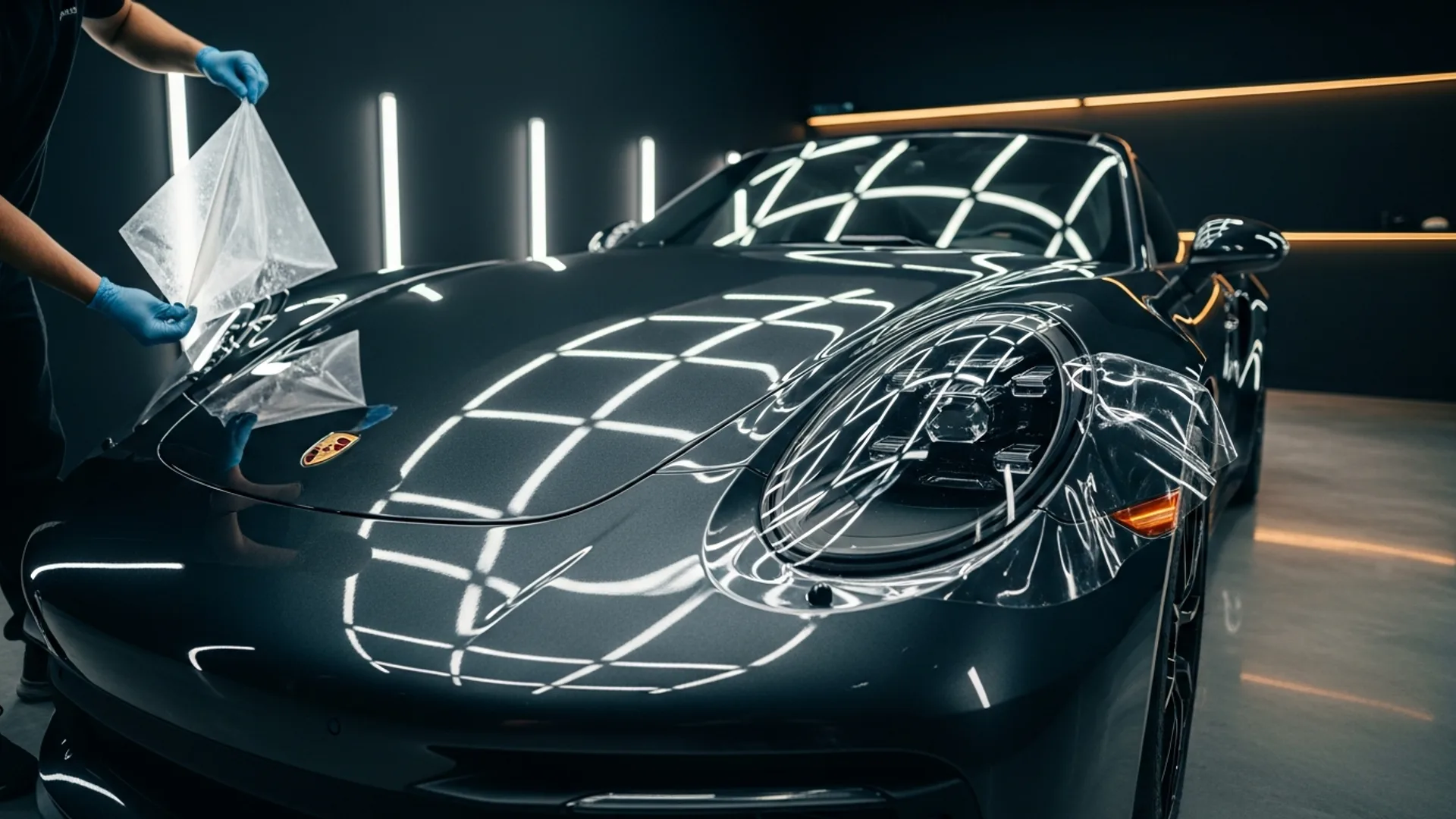
There's a narrow, perfect window in a car's life that never comes back: the moment you take delivery, when the paint is flawless and the odometer still reads zero. What you do — and don't do — in those first hours decides how that finish looks for years. This is the new car paint protection checklist we walk every luxury owner through: the right order, the myth that costs people three months of protection, and the one dealer habit to head off before it ever touches your paint. It also pairs with our honest take on whether to take the dealer's paint protection package or go to a dedicated studio.
The short answer: Protect a new car's paint as soon as it's properly prepped — and you do not need to wait for factory paint to "cure." Modern factory paint is oven-baked and fully cured at the plant, so it can be protected immediately; only a fresh body-shop repaint needs a wait. The correct order never changes: inspect the car and decline the dealer's courtesy wash → decontaminate and correct any dealer-lot swirls → install paint protection film first → apply a ceramic coating over the cured film. Get that sequence right and the car that stopped you in the showroom stays that way.
We see the two extremes at the studio constantly. One owner babies a new 911, Cayenne, Model S, or exotic for three months because a forum told them to "let the paint cure," and spends that whole time collecting chips on unprotected paint. Another drops the car at the dealer for a "complimentary detail" and picks it up already laced with swirl marks. Both mistakes are avoidable, and both come from not knowing the simple, correct sequence. Let's walk it in order.
Why the First 48 Hours Actually Matter
The delivery-day window is real, but it's worth being precise about why. It isn't that the paint is chemically fragile or on some countdown timer. It's simply that the day you take delivery is the one day the finish is guaranteed to be as good as it will ever be — no rock chips, no wash swirls, no etching from bird droppings or hard water. Every kilometre after that is a chance to add a mark you'll later pay to remove. Protecting the paint while it's still perfect means the film and coating are preserving a flawless finish, not sealing in damage that's already there.
So the "48 hours" is a mindset, not a deadline. You do not need to white-knuckle the car home and refuse to drive it. What you need is to make the right decisions in that window — decline the wrong things, book the right prep — so the protection goes on before daily life starts marking up your paint. On a six-figure car whose finish is genuinely thin and, on some marques, surprisingly soft, that head start is worth a lot.
Step 1 — Decline the Dealer's Courtesy Wash
This is the single most overlooked line on the checklist, and it happens before you even leave the lot. When you buy a new car, the dealer almost always offers to "clean it up" or throws in a complimentary wash or detail before handover. On a premium car, politely decline it — ideally in advance, in writing on the deal, with a simple "please do not wash, buff, or apply anything to the paint."
The reason is that dealer lot washes are one of the most common sources of the fine swirl marks new owners discover in their first week — the spiderweb scratches that only show up under direct sun or a bright light. There's even a wry name for it in enthusiast circles: cars arrive with a free "dealer-installed swirl option." Some lots go a step further and hide existing swirls under a temporary glaze that washes out after a few weeks, so the paint looks perfect at handover and then reveals the damage later.
One honest caveat, because blanket panic isn't fair: the damage comes from the method, not from the act of washing itself. It's dirty wash mitts, gritty brushes, and rough drying towels dragging contamination across soft clear coat that cause marring — not the mere fact of cleaning. A well-maintained touchless wash is low-risk; a careless single-bucket hand wash with a dirty rag can be worse than a good machine. But since you can't audit how the dealer's team will do it, the safe move on a new luxury car is simply: don't let anyone touch the paint until it reaches a shop that will prep it properly.
The Myth That Costs Owners Three Months: "Let the Paint Cure"
Here's the piece of advice that derails more new-car protection than any other. Somewhere online, an owner reads that they must wait 30, 60, or even 90 days before applying PPF or a ceramic coating so the "paint can cure." They dutifully wait — and spend the entire summer driving unprotected paint down Calgary's gravel-strewn ring roads, collecting exactly the chips they were trying to prevent. The sibling myth that delays just as many bookings is whether protecting it costs you your factory warranty, and it deserves the same scrutiny.
It's a myth, at least as it's usually applied. Modern factory paint is baked and fully cured before the car ever leaves the assembly line. Automakers run bodies through high-temperature curing ovens that harden the paint far faster and more completely than air-drying ever could. By the time a new car reaches the dealer, the finish is done curing and ready for protection. The clearest proof: manufacturers like Porsche offer factory paint protection film as a build option, applied when the car is only days old — impossible if the paint needed three months to cure.
Where the Cure Wait Is Real
The 30-to-90-day rule is misapplied, and overstated even where it does apply. It exists for fresh body-shop repaints. When a panel is resprayed at a body shop it cures at much lower temperatures than a factory oven, and residual solvents have to gas off; seal a coating over that paint too early and you can trap them, causing hazing or adhesion failure. But the duration is set by the clear coat that was sprayed, and paint manufacturers publish it — Axalta's Cromax CC3100 data sheet, for instance, lists 72 hours before decals go on. So the honest rule is: original factory paint can be protected now; a fresh repair or repaint waits as long as its own data sheet says, usually days rather than months (confirm with the shop that did the work). If your car has never been repainted, there is no cure clock to wait out.
The Correct Order, Start to Finish
Everything else on the checklist is about doing the steps in the right sequence — because several of them can't be undone once the paint is sealed. Here's the order a proper shop follows, and why each step has to come where it does.
Inspect Under Proper Light
Day 0The car is examined under direct and raking light to document any swirls, rail dust, transport-film residue, or transport damage before a single step is taken.
Decontamination Wash
Day 0–1A proper two-bucket wash plus clay and iron removal strips the bonded fallout and film a normal wash leaves behind — the real starting point for a clean surface.
Paint Correction (as needed)
Day 1Any dealer-lot or transport swirls are machine-polished out now. This MUST happen before film or coating — you cannot correct paint underneath them later.
Paint Protection Film
Day 1–2Film is installed onto the bare, corrected paint over the high-impact zones — the full front at minimum, more for hard-driven or exotic cars.
Ceramic Coating on Top
Day 2+Once the film has cured, a ceramic coating is applied over it and over the unfilmed panels for uniform gloss, UV resistance, and slick, salt-shedding hydrophobics.
The reason correction comes before protection is worth underlining, because it's the step people are tempted to skip on a "new" car. Film and, especially, a glossy ceramic coating will faithfully preserve whatever is under them — including swirls. Lock a swirl-marked finish under a coating and the only way to fix it later is to strip the protection, correct the paint, and reapply. That's exactly the logic behind why correction always comes before any coating, and it applies just as firmly to a brand-new car as to a neglected one. If the paint needs it, a light correction to undo any dealer-lot swirls is a small, one-time step that pays off for the life of the car.
PPF First, Ceramic on Top — Never the Reverse
Of all the sequencing on the list, this is the one that actually breaks things if you get it backwards. Paint protection film goes on first; the ceramic coating goes on top of it. Film adhesive has to bond to clean, bare paint — lay a slick ceramic coating down first and the film can't grip properly, which invites edge lifting and a failed install. Do it in the right order and each layer does its job: the professional paint protection film takes the rock chips, and a ceramic coating layered over the film and the rest of the body adds gloss and easy cleaning.
| Correct: PPF → Ceramic | Wrong: Ceramic → PPF | |
|---|---|---|
| Film adhesion | Bonds to bare, prepped paint | Slick coating repels the adhesive |
| Result over time | Sealed edges, long service life | Edge lifting, premature failure |
| What each layer does | Film stops chips, coating adds gloss | Coating wasted under the film |
| Coverage | Coating goes over film AND bare panels | Uniform finish is hard to achieve |
One more nuance owners ask about: how long between the two steps? It depends on the film and conditions — anywhere from a couple of hours to a week or so — and a good shop simply lets the film settle before coating over it. If you're also adding window tint, the full premium sequence is tint first, then PPF, then ceramic. We cover how the two protective layers work as a system in our guide to running film and ceramic together from day one.
"But It's Brand New" — Why Decon and Correction Still Apply
The instinct to skip prep on a new car is understandable — surely a car with 12 kilometres on it is already perfect? In reality, "new" and "flawless" aren't the same thing. Between the assembly line and your driveway, a car is shipped by rail and truck, sits on a lot, and gets prepped and often washed by the dealer. Along the way it can pick up rail dust (tiny metal particles that embed and rust), industrial fallout, transport-film adhesive residue, and lot-wash swirls. Factory paint itself occasionally carries light buffer trails from the plant.
That's why a proper decontamination — a two-bucket wash with clay and iron removal — is a real step even on a new car: it strips the bonded contamination a normal wash can't touch, so the film and coating bond to genuinely clean paint. And a paint inspection tells the installer whether any correction is actually needed. Sometimes it's a quick single-stage polish to erase dealer swirls; sometimes the paint is clean enough to go straight to film. The point isn't to over-work new paint — it's to make sure it's truly perfect before it's sealed for good.
The Pros
- PROTECT EARLY AND YOU PRESERVE PERFECTION: film and coating go on over flawless paint, so there's no damage to seal in.
- CORRECTION NOW IS A ONE-TIME STEP: erasing dealer-lot swirls before protection means you never have to strip and redo it later.
- FILM STOPS THE CHIPS DAILY DRIVING ADDS: the thick, self-healing layer takes highway gravel hits your thin factory clear can't.
- CERAMIC MAKES CALGARY WINTERS EASY: over the film and bare panels, the slick surface sheds road salt and washes off in minutes.
The Cons
- WAITING TO "CURE" FACTORY PAINT WASTES MONTHS: it's already cured — every unprotected week just adds chips.
- A DEALER WASH CAN SWIRL IT FIRST: skip it, or those spiderweb marks get locked under your protection.
- CERAMIC-BEFORE-FILM BREAKS THE INSTALL: the wrong order causes edge lifting and a failed film job.
- SKIPPING DECON SEALS IN CONTAMINATION: rail dust and fallout trapped under film or coating are permanent.
The Calgary Factor: Delivery Day Meets Road Salt and Gravel
Every step above matters more here than almost anywhere. A new car delivered in Calgary faces gravel-strewn ring roads like Deerfoot and Stoney Trail, the chip-sealed highway out to the mountains, and — for much of the year — road salt and calcium-chloride brine that eat at anything unprotected. Take delivery in winter and there's grit on the roads the day you drive off the lot; take it in summer and you're straight onto gravel toward Banff. There is no gentle break-in season for paint in this city.
That's exactly why the delivery-day window is worth acting on rather than waiting out. A couple of practical notes for our climate: film and ceramic cure more slowly in the cold, so a reputable shop works in a heated bay and gives realistic cure times in winter, and you'll want to keep a freshly protected car dry and out of the salt for the first day or two. Once it's on, though, washing the car safely once the film is on is straightforward — and far easier than scrubbing salt off bare paint all winter.
Protect It Right From Day One
Picking up a new Porsche, Tesla, or exotic? Book your protection before delivery and we'll have the bay ready — inspect and decontaminate the paint, correct any dealer swirls, and install film and ceramic in the right order while the finish is still flawless. Honest advice, backed by 705+ reviews and a 4.9-star rating across Calgary.
Reserve My Delivery-Day ProtectionSo the real new-car checklist is shorter and calmer than the internet makes it sound. Don't wait for factory paint to "cure" — it already has. Don't let the dealer wash it. Get it inspected, decontaminated, and corrected, then filmed and coated in that order, ideally before daily driving starts adding the first marks. Do that, and you've spent the one window that never comes back exactly right — and the car that stopped you in the showroom will still look that way years and many Calgary winters from now.
Ready to Protect Your Vehicle from Rock Chips?
Join 705+ Calgary drivers who trust Obsidian Auto for PPF installation
Serving Calgary and surrounding areas • Free Uber shuttle with every service
Frequently Asked Questions
Sources
External references used in this guide
Ready to Protect Your Vehicle?
Get a quote from Calgary's most trusted detailing studio. We use only the best materials and back our work with industry-leading warranties.
Get A QuoteRelated Intelligence
Ceramic Coating Over PPF: Does It Void Your Film Warranty?
Every page says the same thing: coating over film is fine as long as it is film-safe. We read the published warranty documents for five paint protection films and found four different positions. Two exclude coatings by brand, one excepts ceramic from its exclusions by name, and two never mention the subject at all — and one of the brand-locked films is our own supplier.
Satin PPF Care: What the Film Makers Actually Instruct
Every page says the same thing about satin paint protection film: never wax it, never seal it. We read the published care documents for five films and found four different instructions and one silence. One forbids it outright, one instructs an annual wax, one requires sealing every six months, one hands the decision back to you, and one never raises the subject.
Pressure Washing PPF: How Far Back Do You Hold It?
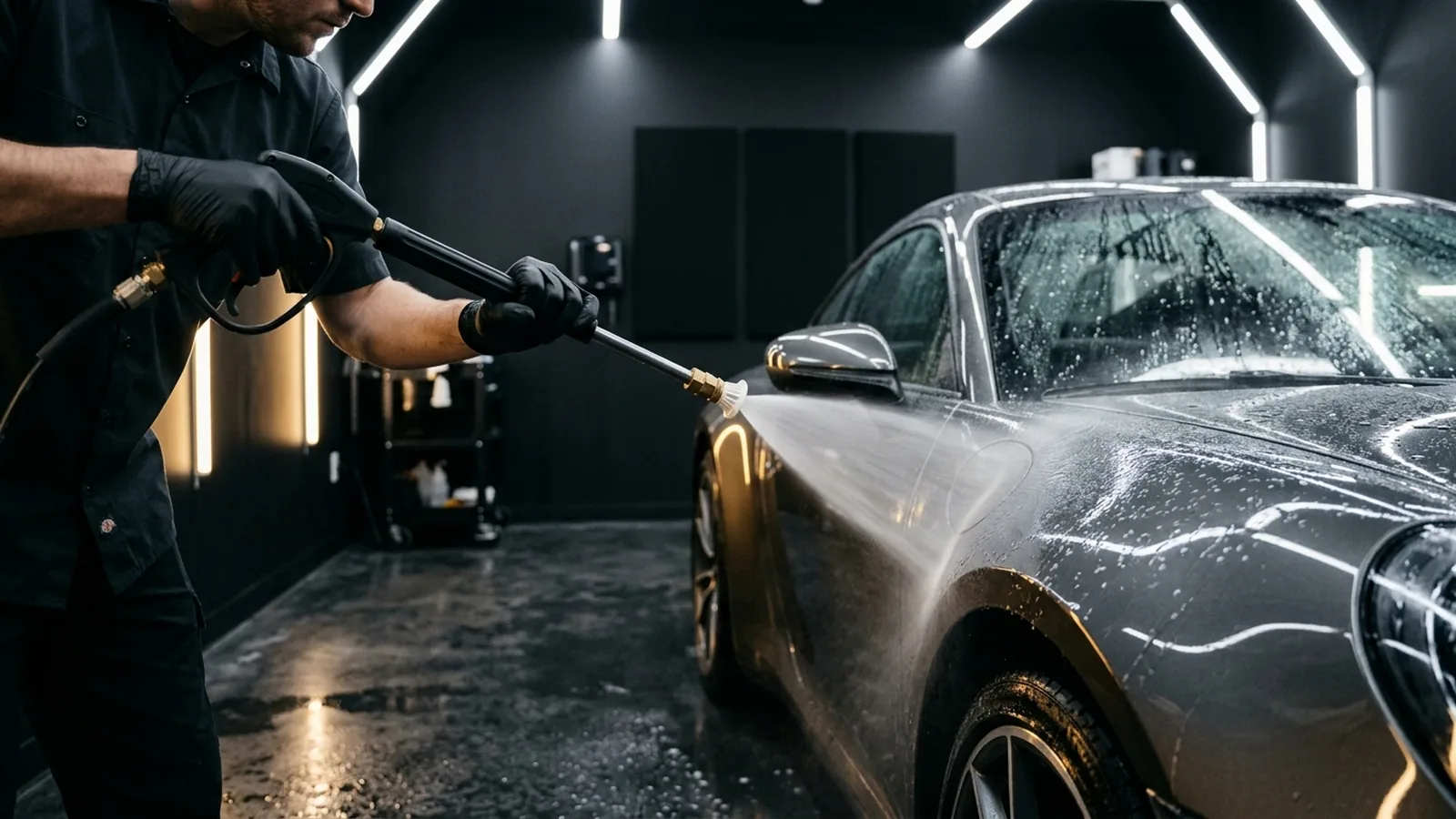
Everyone publishes a number and almost nobody publishes a source. We read the care documents for six paint protection films and found three different standoff distances and two refusals: 3M asks for 12 inches, GSWF for 24, STEK for 36, while SunTek and Ceramic Pro say do not use a pressure washer on film at all. Only one of the six sets a pressure limit — and one document manages to call a pressure washer optimal on one page and forbid it outright on another.