
Does Your Paint Warranty Cover Rock Chips? Read the Clause
Quick answer: Does a paint warranty cover rock chips? No. Most new vehicles carry two bodywork warranties rather than one — a short paint and surface-corrosion term, and a long rust-perforation term — and a rock chip falls outside both. In the two Canadian booklets we read in full it can cost you the second as well. Not legal advice.
Key Takeaways
- Does a paint warranty cover rock chips? No. Most new vehicles carry two bodywork warranties rather than one — a short paint and surface-corrosion term, and a long rust-perforation term — and a rock chip falls outside both. In the two Canadian booklets we read in full it can cost you the second as well. Not legal advice.
- Perforation is the highest bar in the booklet and almost nobody knows its definition. BMW Canada’s published page defines it as corrosion “from the inner surface, through to the outer surface”; the 2024 Nissan Canada booklet as “rust through, from the inner surface to the outer surface, resulting in a hole”. Rust that starts where a stone landed travels the wrong way through both definitions.
- The 2024 Nissan Canada booklet excludes “Rust where paint has been damaged by stone chipping or debris from the road”, and the 2025 Mazda Canada booklet excludes “Cosmetic conditions or surface corrosion from stone chips or scratches in the paint”. Both are quoted here from the documents themselves; terms differ by brand and model year, so read your own.
- The sentence that closes the loop sits outside the warranty terms entirely. On printed page 27 of the 2024 Nissan booklet, under car care rather than coverage: “Surface corrosion which is not corrected will result in perforation, as a result of not correcting surface rust subsequent perforation is not eligible for warranty.”
- Mazda’s 2025 booklet goes further than excluding chips — it makes repairing them your duty. Inside the Anti-Perforation Limited Warranty, Your Responsibilities instructs owners to inspect panels frequently and “touch them up immediately”, to flush the underbody monthly on salted roads, and to fit stone guards if driving frequently on gravel. A separate exclusion removes perforation that results from not doing it.
- The 2024 Nissan Canada booklet names gravel as cause number one. Its list of what causes corrosion opens with paint removal “through damage caused by stone or gravel impacts”, ahead of road salt. Below -15°C the City of Calgary spreads a mixture that is roughly 3% salt and 97% gravel.
- Three premium brands publish warranty pages carrying no paint terms at all. On the BMW Canada, Audi Canada and Porsche Canada warranty pages we read on 4 September 2026, the word paint appears zero times; BMW and Audi both name a corrosion perforation warranty on the same page. That is a finding about what is published, not proof that no paint warranty exists — Audi’s page directs owners to a booklet that is not public.
- None of this is an argument that film extends, restores or preserves a factory warranty, because it does not and cannot. It is narrower and it is the honest version: the booklets exclude a specific mechanism by name, and that mechanism is a stone hitting paint. This is general information about private contracts, not legal advice.
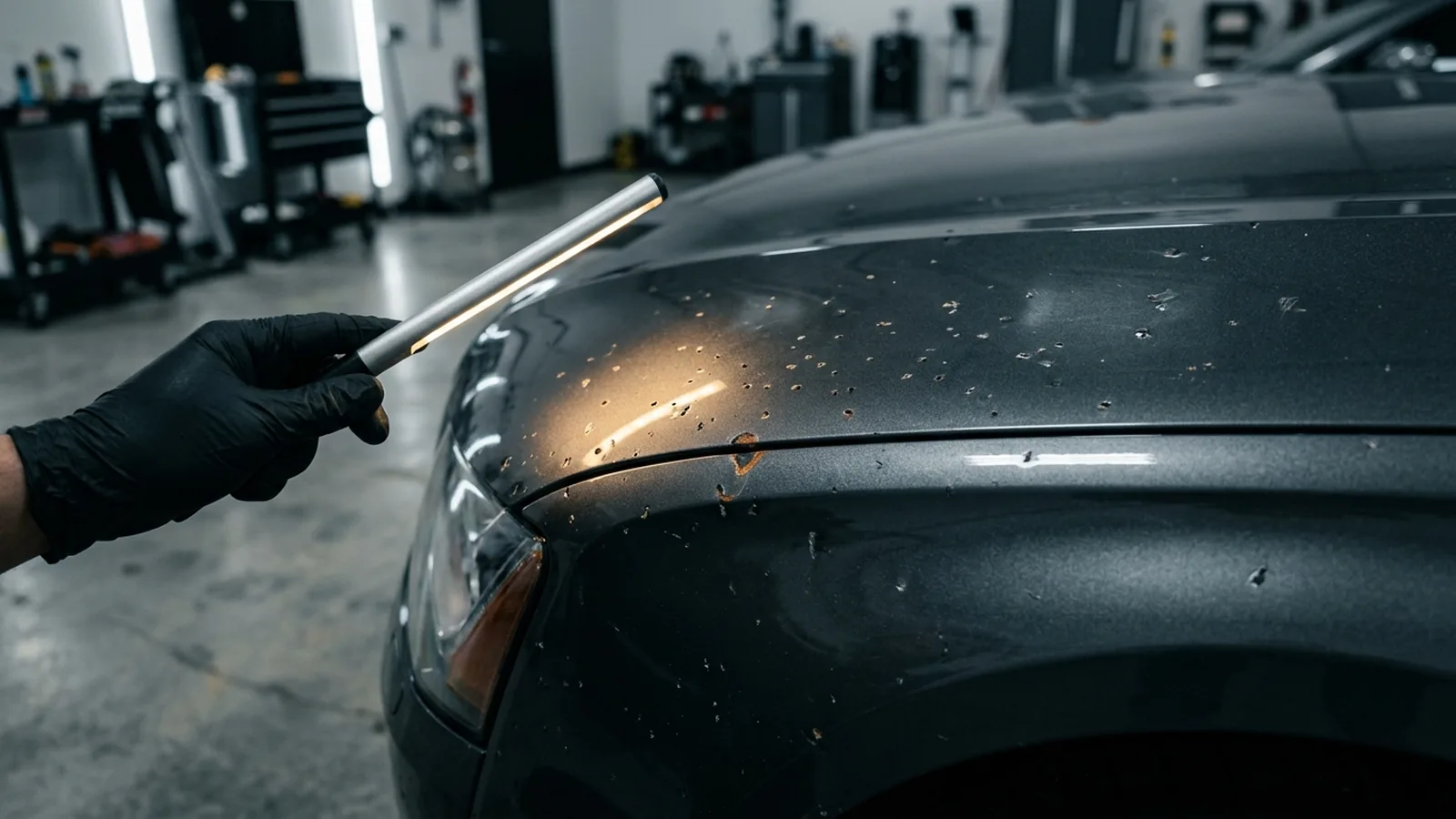
Ask whether a factory paint warranty covers rock chips and you will get the answer from a forum reply. The consensus is correct and the reasoning is missing, which is why the follow-up question — what about the twelve-year rust warranty? — keeps getting answered badly. We downloaded two Canadian warranty booklets and read three manufacturers' published warranty pages, and the useful finding is not that stone chips are excluded. It is that your car carries two separate pieces of bodywork coverage, a chip fails both for different reasons, and one of the booklets makes fixing that chip your contractual job rather than your option.
The short answer
No — not in either Canadian booklet we read in full. Paint and surface-corrosion coverage in both is short and covers manufacturing defects, and a stone strike is external damage — the 2025 Mazda Canada booklet excludes “Cosmetic conditions or surface corrosion from stone chips or scratches in the paint” by name. The long rust-perforation warranty does not catch it either, because it is defined by direction rather than by severity: the 2024 Nissan Canada booklet requires “rust through, from the inner surface to the outer surface, resulting in a hole”, and BMW Canada's published page uses almost the same words. Corrosion that starts in a chip runs outside-in, the wrong way through both definitions. Terms differ by brand and model year, so the booklet in your glovebox is the one that governs. General information, not legal advice.
Two warranties over one panel — and a rock chip fails both
The confusion starts with the phrase “paint warranty”, because there is rarely just one instrument covering the outside of the car. There are usually two, they run for very different lengths, and they are triggered by different things. Owners hear the long number, assume it applies to whatever goes wrong with the bodywork, and only discover the split at a service desk years later.
| Paint / surface corrosion | Rust perforation | |
|---|---|---|
| Typical length | Short — tracks or sits near the basic warranty | Long — five to twelve years, often unlimited distance |
| Nissan Canada, 2024 booklet | 3 years / 60,000 km (surface corrosion) | 5 years / unlimited km |
| Mazda Canada, 2025 booklet | Within the New Vehicle Limited Warranty | 84 months, unlimited distance |
| BMW Canada, published page | Not published on that page | 12 years / unlimited km |
| What triggers it | A defect in materials or workmanship | Rust through the panel, inner surface to outer |
| Where a rock chip lands | Outside — external damage, not a defect | Outside — wrong direction through the panel |
Read the bottom two rows together and the trap becomes obvious. A chip is not a defect, so it fails the short warranty. The rust it starts travels from the outside inward, so it fails the long one. There is no sequence of events beginning with a stone off a gravel truck on Deerfoot that arrives inside either definition, and no amount of remaining coverage changes that, because what is missing is not time.
Perforation is a direction, not a severity
This is the single most misunderstood word in the document, and it is misunderstood in a consistent way: owners read it as “serious rust” when it actually means “rust that went a particular way through the metal”. A panel can be visibly, badly, structurally rusty on its outer face and remain entirely outside the perforation warranty, because the corrosion never made the journey the definition requires.
The 2024 Nissan booklet and BMW Canada's published page state it in almost identical words. The 2025 Mazda booklet takes the other available route, defining perforation simply as a hole through the body panel and then excluding surface corrosion that does not produce one — which arrives at the same place from the opposite direction. What the manufacturer is standing behind is the way the body was built — sealed cavities, treated seams, drainage that works — and a failure of that build shows up as rust emerging from inside a panel it should never have started in. That is a real promise and a valuable one. It is simply a promise about the inside of the car, and everything Calgary does to a vehicle happens on the outside.
The clauses, in their own words
Seven passages, each read from the source document. Choose one.
Nissan Canada · 2024 Warranty Information Booklet
Surface corrosion which is not corrected will result in perforation, as a result of not correcting surface rust subsequent perforation is not eligible for warranty.
Printed page 27, under Car Care and Maintenance — not in the warranty terms
This is the sentence that closes the loop. Perforation is the covered event. Surface rust is the uncovered one. And the booklet states that if you let the uncovered one run, the covered one stops being claimable. The chip does not merely fall outside the paint side of the booklet; it can carry the rust side out with it.
Nissan Canada · 2024 Warranty Information Booklet
Rust where paint has been damaged by stone chipping or debris from the road
Printed page 13, under Rust/Perforation and Surface Corrosion Warranties — Does Not Cover
Read it slowly, because the exclusion is not aimed at the chip. It is aimed at the rust that follows one. A gravel strike is not itself a warranty event under any booklet we read; this clause goes further and puts the corrosion downstream of it outside coverage too, no matter which of the two corrosion warranties you were hoping to claim under.
Nissan Canada · 2024 Warranty Information Booklet
Removal of paint and/or protective coatings on the surface of the vehicle and underbody through damage caused by stone or gravel impacts.
Printed page 27, first item under What Causes Corrosion
The manufacturer and the film installer agree about the mechanism and disagree about nothing except who pays. Gravel impact is listed first, ahead of road salt accumulation, in the booklet’s own account of how a car starts to rust. The phrase "protective coatings" is the booklet’s, not ours.
Mazda Canada · 2025 Warranty Details
Inspect the body sheet metal panels of your Mazda Vehicle frequently and if you detect any stone chips or scratches in the paint or protective coating, touch them up immediately.
Printed page 24, Your Responsibilities, inside the Anti-Perforation Limited Warranty
This is the part almost nobody knows exists. It is not advice in an owner’s manual — it sits inside the warranty, and the exclusion three paragraphs earlier removes perforation that results from failing to follow it. Chip repair is not framed as something you may want to do. It is framed as a condition.
Mazda Canada · 2025 Warranty Details
If you drive frequently on gravel roads, we recommend that you install stone guards behind each wheel.
Printed page 24, Your Responsibilities, inside the Anti-Perforation Limited Warranty
A manufacturer recommending an aftermarket physical barrier against stone impact, inside its own rust warranty, is worth sitting with. It is a mudflap recommendation rather than a film one and we are not going to pretend otherwise. What it concedes is the principle: the booklet expects the owner to interrupt the impact, because the booklet is not going to pay for what the impact starts.
Mazda Canada · 2025 Warranty Details
Any surface corrosion of the Mazda Vehicle which does not result in perforation, such as that typically caused by sand, salt, saltpeter/nitre, hail or stones.
Printed page 23, Anti-Perforation Limited Warranty — What Is Not Covered
Corrosion that stays on the outside of the panel is not what this warranty is for. Sand, salt and stones are named as typical causes of exactly the kind that is not covered — which is a fair description of a Calgary February. The warranty waits for a hole.
BMW Canada · Published warranty page, read 4 September 2026
“Perforation” means the rust or corrosion of any components of the automobile body from the inner surface, through to the outer surface.
Footnote to the Limited Rust Perforation Warranty
Twelve years and unlimited kilometres sounds generous until you read the direction of travel. The corrosion has to start inside the panel and finish outside it. Rust that begins where a stone landed is travelling the wrong way through that definition, and no amount of time left on the clock changes which way it is going.
The clause that makes it your job
Everything above is an exclusion: a list of what the manufacturer will not pay for. The 2025 Mazda Canada booklet does something materially different, and it is the passage that changed how we talk about chip repair at the counter. Inside the Anti-Perforation Limited Warranty — not in the owner's manual, not in a care leaflet, but within the warranty itself — there is a section headed Your Responsibilities, and it reads as a set of duties.
Owners are told to inspect the body panels frequently and to touch up any stone chips or scratches immediately. To flush the underbody at least once a month with clean water if they drive on salted roads. To repair, without delay and at their own expense, body corrosion or damage arising from neglect, lack of maintenance or external causes. And, if they drive frequently on gravel roads, to install stone guards behind each wheel. Three paragraphs earlier, in the same warranty, sits an exclusion removing any perforation that results not from a manufacturing defect but from failure to follow those very procedures.
Read as a whole, the anti-perforation warranty is not a promise to cover rust. It is a promise about how the body was manufactured, conditioned on the owner not having supplied the cause. Nissan reaches the same destination by a different road, in a sentence sitting under car care rather than coverage: surface corrosion left uncorrected leads to perforation, and the perforation that follows is not eligible. The two brands write it differently and mean the same thing. Neither says a single unrepaired chip cancels your coverage across the car — that is an overreading — but both attach the consequence to the damage that grew out of the neglect.
What the premium brands publish, and what they do not
We expected the German marques to be the clearest, given how much of our work sits on them. They were the quietest. On 4 September 2026 we read the warranty pages published by BMW Canada, Audi Canada and Porsche Canada and counted the word paint on each. It appears zero times on all three. BMW and Audi both name a corrosion perforation warranty on the same page; Porsche's page names four warranties and none of them concerns the bodywork finish at all.
It is worth being precise about what that does and does not show, because the tempting conclusion is the wrong one. This is a finding about publication, not about coverage. Audi's page says as much in its own footnote, describing itself as not legal information and directing owners to the warranty booklet for complete details — a booklet that is not available at that address. What it means practically is that an owner of a premium vehicle in Calgary cannot answer this question from the manufacturer's website at all. The mass-market brands hand you a PDF; the premium brands hand you a phone number. If you own one of the three, the document you need came in the car. There is one exception worth knowing about: their leasing arms do publish a chip standard, and Porsche's is the strictest of the six we read.
Why the gravel line matters here
There is a piece of local folk wisdom that Alberta gravels its roads instead of salting them, and that cars here therefore do not rust. It is half right in a way that costs money. The City of Calgary applies roughly 40,000 to 50,000 tonnes of road salt a year, and of the four common road salts it uses sodium chloride and calcium chloride — not the magnesium chloride that detailing content usually names. Below about -15°C it switches to a sanding mixture that is roughly 3% salt and 97% gravel, called Pickle, alongside liquid calcium chloride.
Now put that ratio beside the 2024 Nissan booklet's own account of how corrosion begins. Its list of causes opens with paint and protective coatings being removed through damage caused by stone or gravel impacts, and only then reaches the accumulation of ice and snow melting agents. The manufacturer is describing a two-stage process in which the aggregate opens the surface and the chlorides work on what it opened. Calgary supplies both stages, frequently in the same week, and the folk wisdom treats the first of them as the harmless option. The practical consequence is not more alarm but a different order of operations: on a car that lives here, keeping the surface intact is part of a rust strategy rather than purely a cosmetic one, which is also why the aftermarket rust work aimed at cavities and underbody answers a genuinely different part of the problem than anything applied to the paint.
What this actually argues for
We are a protection shop writing about warranties, so it is worth stating the limit of the argument before making it. Film is not a warranty instrument. It does not extend your coverage, restore anything the booklet excluded, or improve your position in a claim, and any shop telling you otherwise is describing a product that does not exist. Whether adding film or a coating can jeopardise coverage you already hold is a separate question with its own answer, and we have set out the reverse question of whether protecting a car costs you coverage rather than folding it in here.
What the booklets do establish is narrower and, we think, more useful. They name a mechanism — a stone removing paint, and the corrosion that follows — they place it outside coverage in writing, and in at least one case they hand the owner a duty to interrupt it. That reframes the decision entirely. It stops being a question about warranties, which is settled, and becomes an ordinary maintenance calculation about a cost you are certain to carry yourself. Whether the answer is film across the front end, diligent chip repair every spring, or simply accepting the depreciation is a matter of what the car is worth to you and how long you intend to keep it. It is a legitimate answer to decide the chips do not bother you. What is not legitimate is deciding it on the belief that something else will pay.
For readers arriving at this already peppered, the sequence matters more than the product. Establish depth first, close anything that has reached primer or metal before covering it, and only then decide what goes over the panel — which is the same reasoning behind how existing damage changes a film job. If the pitch you are weighing came from a dealership finance office rather than a shop, what those packages contain and what they cost is worth reading first, because they are sold against precisely the gap this article documents. And if the damage feels like it should be someone else's problem, where an Alberta policy begins and ends is the third instrument in the set and answers a different question again.
On our side of it, the film we install and where it goes on the car is a physical barrier against the mechanism the booklets exclude, and what each level of front-end coverage costs here is published rather than quoted on the phone. Bring the booklet with you if you have it; we will read the corrosion section with you before anyone talks about packages.
A note on what this article is
Every clause quoted above was read from the document it is attributed to, on 4 September 2026, rather than from another article about it. The limits deserve stating as plainly as the findings. Two booklets were read in full and both are model-year specific, so a 2023 or a 2026 car may be governed by different words. Three premium warranty pages were read as published, and none of the three addresses paint at the address an owner would reach first. This is general information about private contracts rather than legal advice, and Alberta consumer legislation may vary the result — the Nissan booklet makes that point itself.
We hold a 4.9-star rating across 705+ Google reviews and install 3M, STEK, SunTek, GSWF film — and none of the findings above depend on either fact. The clauses read the same whether you ever call us or not.
Ready to Protect Your Vehicle from Rock Chips?
Join 705+ Calgary drivers who trust Obsidian Auto for PPF installation
Serving Calgary and surrounding areas • Free Uber shuttle with every service
Frequently Asked Questions
Sources
External references used in this guide
- Nissan Canada — 2024 Warranty Information Booklet (WB24EC NALLC1), English, for Canadian models (PDF). Read in full on 4 September 2026 and the source of four quotations here: the perforation definition on printed page 8 (“rust through, from the inner surface to the outer surface, resulting in a hole”, 60 months); the exclusions on printed page 13 under Rust/Perforation and Surface Corrosion Warranties — Does Not Cover (“Rust where paint has been damaged by stone chipping or debris from the road” and “Rust caused by environmental fallout, or, hail, tree sap, salt or submersion in water, sand or mud”); and two passages on printed page 27 under Car Care and Maintenance — the first listed cause of corrosion (“Removal of paint and/or protective coatings… through damage caused by stone or gravel impacts”) and the causal-chain sentence. The at-a-glance table on printed page 2 sets Corrosion Surface at 3 years/60,000 km and Corrosion Perforation at 5 years/unlimited km. SCOPE NOTE: this is the 2024 model-year booklet; terms change between model years
- Mazda Canada — 2025 Warranty Details (PDF). Read in full on 4 September 2026. Source for the New Vehicle Limited Warranty exclusions on printed page 13 (“Cosmetic conditions or surface corrosion from stone chips or scratches in the paint”, and the environmental list naming salt, road debris and road hazards), and for the Anti-Perforation Limited Warranty on printed pages 23 and 24: the 84-month unlimited-distance term, the definition of perforation as a hole through the body panel, the exclusion of surface corrosion “which does not result in perforation, such as that typically caused by sand, salt, saltpeter/nitre, hail or stones”, the exclusion of perforation resulting from failure to follow item 4, and the Your Responsibilities duties themselves — inspecting panels and touching up stone chips immediately, flushing the underbody at least monthly on salted roads, installing stone guards behind each wheel when driving frequently on gravel roads, and repairing “without delay and at your expense, any body corrosion or damage due to customer neglect, lack of maintenance or external causes”. SCOPE NOTE: we verified by section structure that Your Responsibilities sits inside the Anti-Perforation warranty rather than the general warranty
- BMW Canada — published warranty page. Read on 4 September 2026 and the source of the perforation definition quoted here: “‘Perforation’ means the rust or corrosion of any components of the automobile body from the inner surface, through to the outer surface”, together with the stated term of 12 years / unlimited kilometres and the New Vehicle Limited Warranty of up to 4 years or 80,000 kilometres. SCOPE NOTE: a machine count of the rendered page returned zero occurrences of the word paint, and the four expandable sections are the emissions warranties and the Limited Rust Perforation Warranty. That is a finding about what BMW Canada publishes on this page, not evidence that no paint coverage exists in the booklet supplied with the vehicle
- Audi Canada — new vehicle warranty page. Read on 4 September 2026. Cited for the published list of warranty benefits, which names a New Vehicle Limited Warranty, a Corrosion Perforation Warranty, emissions warranties and e-tron high-voltage battery warranties, and for the page’s own caveat that it is “Not legal information” and that owners should “always refer to warranty booklet for complete details”. SCOPE NOTE: a machine count of the rendered page returned zero occurrences of the word paint. As with BMW, this is a publication finding and the governing booklet is not available online
- Porsche Canada — Warranty & Vehicle Information. Read on 4 September 2026. Cited as the third data point in the premium-brand publication finding: the page sets out the Porsche New Vehicle Warranty of four years or up to 80,000 km, the high-voltage battery warranty, the Porsche Approved Warranty and the parts warranty, and a machine count of the rendered page returned zero occurrences of paint, corrosion and perforation alike. SCOPE NOTE: Porsche’s warranty and maintenance handbook is not published at this address, so no inference about the underlying coverage is drawn here
- City of Calgary — snow, ice and salt. Source for what is actually applied to the roads this article is written about: of the four common road salts the City uses sodium chloride and calcium chloride only, 40,000 to 50,000 tonnes are applied annually, and below -15°C the City switches to a sanding chip mixture of 3% salt and 97% gravel called Pickle alongside liquid calcium chloride. Cited because the gravel ratio is what connects Calgary winters to the stone-impact clauses quoted above, and because the magnesium chloride commonly named in detailing content is not what the City puts down

Ready to Protect Your Vehicle?
Get a quote from Calgary's most trusted detailing studio. We use only the best materials and back our work with industry-leading warranties.
Get A QuoteRelated Intelligence

PPF and Ceramic Coating Together: Calgary Combo Guide
Running PPF and ceramic coating together in Calgary: which goes on first and why reversing it fails, real combo pricing from $2,698, whether the stack is worth it for how you drive, and how it beats gravel, brine, and freeze-thaw.

Stealth PPF in Calgary: Satin & Matte Finish Guide
Stealth PPF converts a glossy Porsche, Tesla, or exotic to a satin frozen finish without a respray — with the same self-healing rock-chip protection as gloss film. What it is, how it beats vinyl and factory matte paint, what it costs in Calgary from $1,499, which cars suit it, and the one matte-care rule.
How to Protect Your Car From Hail in Calgary
Calgary sits in Hailstorm Alley, and the honest truth is neither PPF nor ceramic coating stops a hail dent. What actually protects your car: covered parking, fitted padded hail covers, alert apps, and paintless dent repair if a summer storm catches you out.