
Lease Return Rock Chips: What Six Lenders Actually Allow
Quick answer: The same rock chip can be free on one lease and billable on another. We read the published lease-end wear-and-tear documents of six Canadian captive lenders and found three different tests applied to the identical piece of damage: a size test, a depth test and a count test. No two of the six set the chip allowance in the same place.
Key Takeaways
- The same rock chip can be free on one lease and billable on another. We read the published lease-end wear-and-tear documents of six Canadian captive lenders and found three different tests applied to the identical piece of damage: a size test, a depth test and a count test. No two of the six set the chip allowance in the same place.
- The strictest paint standard we read belongs to the most expensive car. Porsche Financial Services Canada permits "Dings, dents, scratches, and paint chips are only permitted if they are less than 4 cm and do not go through the clear coat" — two conditions joined by an and, where the generous-sounding 4 cm half is not the one that decides. A chip is a chip because material has been displaced, which is why the depth half is the half worth checking first.
- The most permissive is Ford Credit Canada, at "Up to fifteen (15) paint chips per panel" with no depth condition attached to that line at all. Honda Canada is close behind and is the only lender of the six to split the allowance by location: up to 15 chips on the hood or front bumper, up to 5 per panel elsewhere.
- BMW Canada sells relief from its own standard. Without the optional product, "Minor stone chips are smaller than 2" in diameter"; with Excess Wear and Use Protection, the list of acceptable damage simply reads "Any minor stone chips." Scratches move from two inches to four and dents from two inches to eight on the same page.
- Mercedes-Benz Canada decides with a credit card rather than a ruler, and — on the page we read — never names stone chips as their own category. Its Self-Inspection Test is to place a standard Canadian credit or debit card over the blemish, it allows a maximum of five damage occurrences per panel, and it applies the depth question first: a scratch that is not through the paint is acceptable regardless of size.
- Nissan Canada is the only one of the six that publishes no chip number at all. Its guide lists "Excessive number of chips" as excessive wear without ever saying what that number is, while giving owners the one test that needs no instrument: "Scratches deep enough to catch your fingernail" are excessive.
- Ford Credit Canada is the only one of the six whose document contains no depth condition anywhere at all. The other five each have one — through the clear coat, through the paint, breaking the paint, catching a fingernail — but where it sits differs, and that is what owners miss. On Honda's chip line it does not reach the chips. On Porsche's it applies to them directly, which is the single difference that decides most Calgary cases.
- Calgary generates precisely the damage these documents charge for. Below -15°C the City treats roads with a mixture it calls Pickle that is 3 per cent salt and 97 per cent gravel, plus liquid calcium chloride. A winter of driving on 97 per cent gravel is a chip-production process, and it works hardest on the surfaces facing forward. No document publishes a rate of accumulation and we have not measured one.
- Only one lender in the set publishes a price, and it is the oldest document we read. Honda's guide, which carries a 2013 copyright notice, prints "1 chip = $100 charge / 2 chips = $200 charge / Full windshield replacement = $450 charge" for glass, immediately qualified as approximate and excluding taxes. Treat those as 2013 figures as published rather than as today's rate — we found no newer edition. The other five lenders publish no dollar amount at all, so treat any quoted market rate with suspicion.
- No document in this set writes a rule for paint protection film at lease return, and the adjacent language pulls both ways. Porsche's guide requires aftermarket alterations to be removed and names "wheels not meeting Porsche OEM specifications, radios, tinted glass, spoilers etc." — film is not on that list. Mercedes-Benz goes the other way with the broadest language in the set: "Anything changed or added to your vehicle is considered an aftermarket alteration and is not acceptable, unless it was installed by an authorized Mercedes-Benz dealer." On its face that captures film. Get your lender's position in writing before you return the car, not after.
The short answer
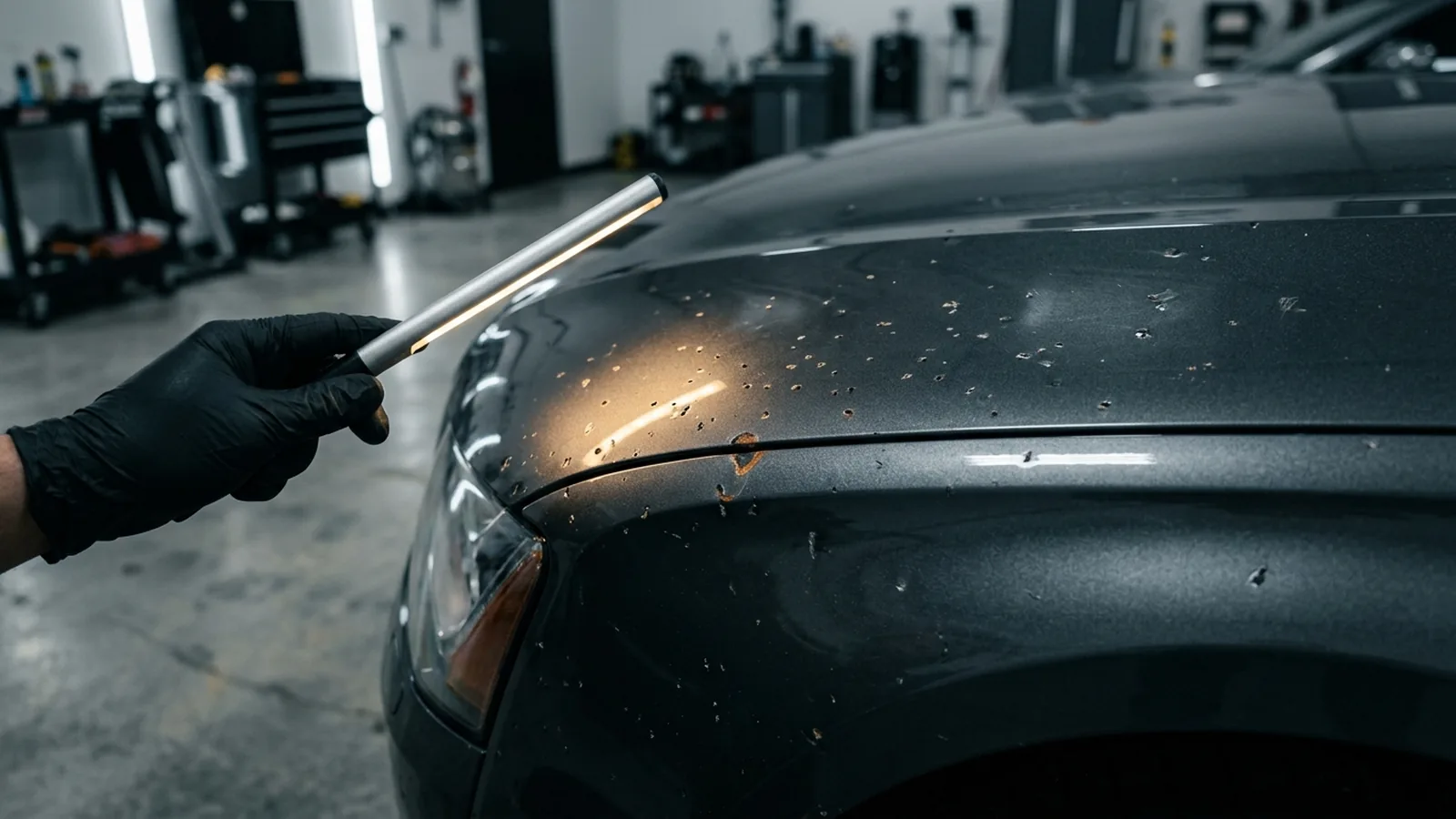
There is no Canadian standard for lease return rock chips. We read the published wear-and-tear documents of six Canadian captive lenders and found three different tests applied to the same piece of damage — a size test, a depth test and a count test — with no two chip allowances alike. Ford Credit Canada forgives fifteen paint chips per panel with no depth condition on that line. Porsche Financial Services Canada permits chips only if they are “less than 4 cm and do not go through the clear coat”, where the second half is the strict one. The strictest paint standard in the set belongs to the most expensive car.
Every Calgary lease return begins with the same conversation, and it is almost always conducted in the dark. An owner looks at the leading edge of a hood after three prairie winters, counts something between a dozen and fifty small chips, and tries to work out whether that is going to cost them nothing or several thousand dollars. The advice available to them is close to useless: written for American lenders, built on a figure somebody copied from somewhere, or — genuinely, on the search results we checked — about landlords charging tenants for repainting an apartment.
What almost nobody does is open the document. Every Canadian captive lender we looked for publishes its own wear-and-tear standard as a free PDF or web page, and those documents answer the question directly. So we read six of them end to end on 11 September 2026 — Porsche, BMW, Mercedes-Benz, Honda, Ford and Nissan — and extracted the text rather than trusting a summary of it. What we found was not a consensus with local variation. It was six organisations measuring different properties of the same chip.
Three tests, not one
The single most useful thing to understand before you look at your own car is that “how many chips am I allowed” has a published answer on only two of these six documents. Ford and Honda give the stone chip a number of its own. Porsche and BMW apply no count to chips at all and judge them by depth and by size respectively. Mercedes-Benz applies a general per-panel limit that chips fall under without being named, and Nissan calls an excessive number of chips chargeable without ever saying what that number is. Across the set, three distinct tests are in use, and four of the six documents use all three.
The size test is the one everybody expects — Porsche sets it at four centimetres, Honda at five, BMW at two inches, Ford at 101.6 millimetres, and Mercedes-Benz replaces the ruler entirely with the width of a credit card. Read those carefully, though, because only Porsche's and BMW's size limits name the stone chip directly. Mercedes-Benz's card reaches chips too, but only through its general exterior rule. Ford's 101.6 mm and Honda's 5 cm govern dings, dents and scratches, and both of those lenders give chips a separate line with no size on it at all. The count test is per panel rather than per car in every document that uses one, which matters enormously: a hood and two front fenders are three separate allowances, not one.
The depth test is the one owners almost never check, and it is the one that decides most Calgary cases. Five of the six documents contain a depth condition somewhere — through the clear coat, through the paint, breaking the paint, or catching a fingernail. What varies, and what almost nobody notices, is whether that condition reaches the stone-chip line itself. On Ford's and Honda's chip allowances it does not, so a chip is a chip and the count is the whole test. On Porsche's it does, and that single difference is why the same hood can pass one standard and fail another. This matters for stone chips specifically because a chip is a chip precisely by virtue of depth. Material has been knocked out of the surface; that is the difference between a chip and a scuff. On a standard that asks whether damage has gone through the clear coat, a two-millimetre chip and a two-centimetre chip can fail in exactly the same way, and measuring either one tells you nothing. If you want the ruler these clauses are implicitly using, our breakdown of how deep a rock chip actually goes sets out the four depths — clear coat only, clear coat and colour, down to primer, and bare metal — that decide which side of a depth test a mark falls on.
Six lenders, three tests, and no two chip allowances alike
Select a lender to read the clause it publishes. Every quotation below was read from the source document itself on 11 September 2026, not from a summary of it.
The strictest paint standard in the set, and it is a depth test
"Dings, dents, scratches, and paint chips are only permitted if they are less than 4 cm and do not go through the clear coat."
What it means. Read the whole sentence, because the two halves pull in opposite directions and almost every summary quotes only the generous half. Four centimetres is a permissive size allowance — wider than Nissan's, wider than BMW's. The clear-coat condition is what makes this the tightest standard of the six, and it is joined to the size rule by an "and", so both must hold. A stone chip is a chip precisely because material has been displaced from the surface; that is what separates it from a scuff. So on this standard the depth question is the one to ask first, and the size of the chip is the second question rather than the first. We are not going to tell you what proportion of chips go through the clear coat, because no document in this set says and we have not measured it. Porsche is also the only one of the six to apply a single rule to dings, dents, scratches and paint chips at once rather than giving each its own allowance.
Do this: If you lease a Porsche, do not measure your chips. Look at whether they have broken through the clear coat, because that is the test that will be applied.
A size test, a count test, and relief sold separately
"Minor stone chips are smaller than 2" in diameter." … "Any scratches or scuffs through the paint are less than 2" in length." … "A maximum of three dents per panel."
What it means. BMW gives the stone chip its own line and sets the bar at a size rather than a depth, which on its face is generous — a two-inch chip is an enormous chip. But the more interesting sentence sits further down the same page, under the heading Excess Wear and Use Protection, where the list of additionally acceptable damage closes with "Any minor stone chips." That is the quiet commercial core of the document: without the paid protection product a stone chip is measured, and with it stone chips stop being counted at all. The same page extends scratches from two inches to four and dents from two inches to eight for customers who bought in. BMW is also unusually practical about measurement, telling owners they can gauge a two-inch dent with the width of a credit card and printing a ruler on page three.
Do this: If you did not opt in to Excess Wear and Use Protection, your chips are measured against a two-inch limit and your scratches against two inches rather than four. Note that BMW pitches the product toward your next vehicle rather than offering it retroactively.
A credit card decides, and on this page chips are never named
"Scratches are not through the paint (regardless of the size)." … "a maximum of 5 damage occurrences (that pass the Self-Inspection Test) per panel is acceptable."
What it means. Mercedes-Benz replaces the ruler with an object almost everyone already carries. Its Self-Inspection Test is to "Place a standard Canadian Credit/Debit Card over an exterior or interior blemish", and the page gives the card's approximate dimensions as 8.5 cm by 5.5 cm, which is a far larger allowance than Porsche's four centimetres. Two things are worth noticing. First, the depth test comes before the size test: a scratch that has not gone through the paint is acceptable at any size, and only scratches that have gone through the paint get measured against the card. Second, and this surprised us, the exterior list never names stone chips as their own category — on the page we read, every occurrence of the word chip is in the glass section or in the note about the card. Chips are not exempt; they simply fall under the general exterior rules rather than getting the dedicated allowance that Honda, Ford and BMW each give them.
Do this: Mercedes-Benz is explicit that the card test "is for estimation purposes only and is not a replacement of the vehicle pre-inspection or of the determination in the Lease End Statement". Treat a pass as reassurance, not as a ruling.
The only allowance that changes by panel, and the only published prices
"Stone chips — Up to 15 chips on hood or front bumper — Up to 5 chips per panel on other body panels" … "Minor dings or dents to body panels that do not break the paint … (max. 3 per panel)"
What it means. Honda is the only lender of the six to split its chip allowance by location, fifteen on the hood or front bumper and five on every other panel. The guide does not say why. The obvious reading, which we cannot confirm from the document, is that it reflects where chips actually land. It is also the only one of the six to print what anything costs. Its glass section states "1 chip = $100 charge / 2 chips = $200 charge / Full windshield replacement = $450 charge", immediately qualified as approximate and excluding taxes. Read those as 2013 figures, because this guide carries a 2013 copyright notice and is the oldest document in the set — we looked for a newer edition and did not find one. They are not a market rate and they are not current, but they remain the only published prices in the entire set, which makes them the only place an owner can see the shape of a bill rather than just the rule. Note that Honda's dent allowance carries a depth condition too — dents are forgiven if they "do not break the paint" — so even the most generous document in the set is not purely a size test.
Do this: If you lease a Honda, the hood and front bumper get three times the chip allowance of the doors. Whether that matches where your own car has collected damage is worth checking panel by panel before an inspection.
A flat count, applied the same way to every panel
"Exterior Body Panels — Includes dings, dents, scratches (excludes holes). No charge: Up to three (3) per panel with diameters up to 101.6 mm (4") — Up to fifteen (15) paint chips per panel"
What it means. Ford publishes the most permissive paint standard we read and the simplest to apply. Fifteen paint chips per panel is a large number, it is the same number on every panel, and — this is the part that separates Ford from the rest — the chip line carries no depth condition at all. Three dings, dents or scratches per panel are forgiven up to 101.6 mm, which the document helpfully gives in both units. Ford is also the most candid of the six about its own limits, closing with "This is not a comprehensive list of all wear and tear guidelines. For details regarding wear and tear, see your lease agreement." That sentence is worth more than it looks: the published guide is a summary, and the contract is the thing that binds. Ford also notes that the final inspection is "conducted by a third-party inspection company" rather than by the dealer.
Do this: Ford's fifteen-chip allowance is per panel, not per car. A hood and two front fenders are three separate allowances.
The fingernail decides, and the chip count is never stated
"Scratches deep enough to catch your fingernail" … "Scratches longer than 6cm in length" … "Excessive number of chips"
What it means. Nissan is the only one of the six to hand the owner a test they can run without any instrument at all, and it is the same test a paint professional uses: if a fingernail catches in the mark, material is missing. The depth question turns out to be universal once you stop thinking in millimetres. Nissan states the principle openly — severity is "measured by size, quantity, depth, location and whether or not the paint has been broken" — which is the clearest articulation in the set of why these documents disagree so much: there are five variables, and each lender weights them differently. The gap in Nissan's guide is chips. Its summary card lists "Excessive number of chips" as excessive wear and never says what number that is, making Nissan the only one of the six to give the owner no chip figure to work against.
Do this: Run a fingernail over the marks on your Nissan before the inspection. It is the published test, and it costs nothing.
The premium standards are the strict ones
The pattern that emerged as we read is the opposite of the one most owners assume. There is a widespread belief that a premium lease comes with premium latitude. In these six documents it comes with less. Porsche publishes the tightest paint rule in the set. BMW measures a stone chip that Ford does not measure at all, and then offers to stop measuring it for a fee. The most generous chip allowances belong to Ford and Honda.
That is not a criticism of anybody, and the reason is commercially obvious once stated: these standards are written against the cost of putting the car back into a particular resale channel. A vehicle whose value depends on a flawless finish is being measured against the cost of refinishing a panel, not against the cost of a polish. It does mean, though, that advice written about a mainstream lease transfers badly to a premium one — and that the reflex of reading a general article about lease returns is close to worthless if your car is on a Porsche or BMW contract.
| Lender | Stone chip allowance as published | Depth condition? |
|---|---|---|
| Ford Credit Canada | Up to fifteen (15) paint chips per panel | Not on the chip line |
| Honda Canada | Up to 15 on hood or front bumper; up to 5 per panel elsewhere | On dents, not on the chip line |
| BMW Canada | No count; each chip smaller than 2" in diameter | Separately, for scratches |
| Mercedes-Benz Canada | Not named as a category; general limit of 5 occurrences per panel | Yes, on scratches; chips fall under the general rules |
| Porsche Financial Services Canada | Under 4 cm and not through the clear coat | Yes — the deciding condition, applied to chips directly |
| Nissan Canada | "Excessive number of chips" — no figure published | Yes, but on scratches — chips carry no stated condition |
Why Calgary produces exactly this damage
There is a reason this question lands harder here than in Vancouver or Toronto, and it is in the City's own winter maintenance practice. When road surfaces fall below -15°C, Calgary treats them with a sanding mixture it calls Pickle, which is 3 per cent salt and 97 per cent gravel, alongside liquid calcium chloride. Below that temperature salt stops doing useful work, so what is being laid down is overwhelmingly aggregate, for traction.
Loose gravel on a cold road, thrown by the vehicle in front, is a chip-production mechanism, and it concentrates on the leading surfaces of a car. We think that is almost certainly why Honda — alone among the six — writes a larger allowance for the hood and front bumper than for the rest of the vehicle. It is the one document in the set whose structure acknowledges that chips are not distributed evenly.
We are deliberately not going to tell you how many chips a Calgary winter produces. None of these documents publishes a rate of accumulation, we have not measured one, and a confident-sounding number here would be exactly the kind of invented figure this article exists to argue against. What is fair to say is narrower and still useful: the leading edge of a car driven here collects chips faster than the rest of it, a Calgary lease term usually spans three or four winters rather than one, and two of these six standards — Porsche's and BMW's — would not count those chips at all, judging them by depth and by size instead.
What this means if you are deciding about film
The connection between these clauses and paint protection film is more direct than the usual marketing version of it, and it follows from the depth test rather than from anything we would assert. Five of these six documents contain a depth condition somewhere, and on Porsche's, Mercedes-Benz's and Nissan's it is the condition that decides. Film that absorbs an impact means there is no depth for that test to find. That is a mechanism, not a promise, and it is the honest version of the argument — the film does not make your car invulnerable, it changes which surface takes the hit and therefore which document applies to the result.
If you are weighing that against the cost, the useful comparison is not film against nothing. It is film against the specific charge your own lender publishes, which is why reading their document first is worth more than reading ours. Our PPF pricing for Calgary sets out what coverage costs, and the honest framing is that front-end coverage addresses the panels these guides treat as highest-risk while leaving the rest of the car on the standard you have just read. For marks that are already there, whether they can be improved before an inspection is a question about depth again, and it is the same question our piece on what temperature PPF actually needs to self-heal works through, using the same depth test.
The question these documents do not answer
There is one thing we cannot tell you, and we would rather say so than guess. None of these six documents writes a rule for paint protection film at lease return.
Porsche's guide requires that aftermarket alterations “should be professionally removed and the vehicle returned to its original condition” and names “wheels not meeting Porsche OEM specifications, radios, tinted glass, spoilers etc.” Film is not in that list. Honda's exterior list charges for accessories that have left “holes, scratches or damage that requires repair and refinish”, which is a charge for what removal leaves behind rather than for the accessory itself.
Mercedes-Benz goes furthest, and it is the sentence we would least like to be quoting: “Anything changed or added to your vehicle is considered an aftermarket alteration and is not acceptable, unless it was installed by an authorized Mercedes-Benz dealer.” On its face that captures paint protection film. It is the broadest language in the set, it appears under Aftermarket Modifications rather than anywhere near the paint rules, and it is the single strongest reason we will not tell you that film is safe at lease return. The same page does accept aftermarket window tint provided it is “free of any scratches, bubbling, tears, or discolouring” — but that line sits in the glass condition list rather than the alterations list, so we would not read it as a general endorsement of aftermarket additions.
So the position we will defend is this: no document in this set writes a rule for film, the adjacent language ranges from Porsche's specific list that omits it to Mercedes-Benz's catch-all that would appear to capture it, and an owner is entitled to a better answer than an installer's opinion. Ask your lender in writing before the car goes back, and keep the reply. That is worth doing whoever installed the film, including us — and if the answer comes back badly for a car we filmed, we would rather you knew in time to act on it.
What to do before your inspection
Find your own lender's document and read the paint section — all six we used are linked in the sources below, and the detail is sometimes not on the page you land on. Then run the fingernail test across the marks on the leading edge, because depth is the variable most of these standards care about and it is free to check. Count per panel rather than per car, since every count in the set is written that way. Book early: BMW requires its inspection 75 days before maturity, and the gap between inspection and return is the only period in which anything you learn is still actionable.
Two cautions from the documents themselves. Nissan lists scratches covered with touch-up paint as excessive, so an optimistic DIY repair can convert forgiven damage into chargeable damage. And Ford states plainly that its published guide is not comprehensive and that the lease agreement governs — a reminder that every figure in this article, ours included, is a summary of something else. If you are also preparing the car's condition more broadly, our guide to preparing a car for a lease-return inspection covers the interior and cosmetic items these same guides price separately.
Ready to Protect Your Vehicle from Rock Chips?
Join 705+ Calgary drivers who trust Obsidian Auto for PPF installation
Serving Calgary and surrounding areas • Free Uber shuttle with every service
Frequently Asked Questions
Sources
External references used in this guide
- Porsche Financial Services Canada — Excess Wear Guide, Final Inspection Guidelines (PDF). Source of the strictest paint standard in the set: "Dings, dents, scratches, and paint chips are only permitted if they are less than 4 cm and do not go through the clear coat." Also the source of the windshield rule quoted here, "Cracks, stars, pits, or chips are permitted only if they fall outside the wiper span and have a maximum diameter of 6.4 mm", of the aftermarket-alteration sentence naming "wheels not meeting Porsche OEM specifications, radios, tinted glass, spoilers etc.", and of the complimentary pre-inspection statement. SCOPE NOTE: a single-page PDF with no revision code and no printed date
- BMW Canada — At-Home Wear & Use Evaluator (PDF), © 2025 BMW Canada Inc. Source of the standard-wear thresholds quoted here, "Minor stone chips are smaller than 2" in diameter", "Any scratches or scuffs through the paint are less than 2" in length", "Exterior dents measure 2" or less" and "A maximum of three dents per panel"; of the Excess Wear and Use Protection list that extends these to 4" scratches, 8" dents and "Any minor stone chips"; and of the 75-day AutoVIN inspection requirement. SCOPE NOTE: this PDF typesets inches two different ways and mixes them within the same list — stone chips, scratches and the whole Excess Wear and Use Protection list use a doubled right single quote, while dents, tire tread and wheel scuffs use a right double quote. Machine-verified by codepoint; a typographic quirk rather than two units
- Mercedes-Benz Canada — Inspecting Your Vehicle. Source of the credit-card Self-Inspection Test ("Place a standard Canadian Credit/Debit Card over an exterior or interior blemish", card dimensions given as approximately 8.5 cm by 5.5 cm), of "Scratches are not through the paint (regardless of the size)", of the limit of "a maximum of 5 damage occurrences (that pass the Self-Inspection Test) per panel", of the glass rules quoted here (chips or plugs smaller than 3 mm, no more than 2 plugged, outside the wiper path), and of the estimation-only caveat quoted in full ("is for estimation purposes only and is not a replacement of the vehicle pre-inspection or of the determination in the Lease End Statement"), and of the broadest aftermarket language in the set, which appears under Aftermarket Modifications: "Anything changed or added to your vehicle is considered an aftermarket alteration and is not acceptable, unless it was installed by an authorized Mercedes-Benz dealer." The page separately accepts aftermarket window tint that is "free of any scratches, bubbling, tears, or discolouring", but that line sits in the Glass & Lenses condition list rather than the alterations list and is not read here as a general endorsement. SCOPE NOTE: on this page every occurrence of the word chip falls in the Glass & Lenses section or the credit-card note — the exterior list does not name stone chips as a separate category, which is a statement about the document and not a claim that chips are exempt. The separate Vehicle Condition Guidelines landing page carries no thresholds
- Honda Canada — Honda Financial Services Lease Care Guide (PDF), twenty pages. Source of the most location-aware chip allowance in the set, "Stone chips — Up to 15 chips on hood or front bumper — Up to 5 chips per panel on other body panels", of the dent rule "Minor dings or dents to body panels that do not break the paint and fit within the measurement on the Wear and Tear Card (max. 3 per panel)", of the chargeable counterpart "4 or more dings or minor dents per body panel", of the card summary "Dents and scratches are considered allowable if less than 5 cm", and of the only published prices in the set: "1 chip = $100 charge / 2 chips = $200 charge / Full windshield replacement = $450 charge", which the guide itself qualifies as approximate and excluding taxes. Also the source of the inspection mechanics cited here: the third-party company DataScan calls to schedule an inspection 30-45 days before lease maturity, the inspector "will not provide any quotes or estimates on chargeable damage repairs", and "The results of your inspection report will remain valid for 60 days." SCOPE NOTE: this guide carries a © 2013 Honda Canada Inc. notice and is the oldest document in the set — its dollar figures are 2013 figures as published and we found no newer edition. IMPORTANT: the 3.2 mm figure in this guide belongs to windshield chips and interior burn holes and is not a stone-chip size limit for paint
- Ford Credit Canada — Wear and Tear SELF-Evaluator Card & Guidelines (PDF), document code FRD-117-E/F-CAN. Source of the most permissive paint standard we read: "Exterior Body Panels — Includes dings, dents, scratches (excludes holes). No charge: Up to three (3) per panel with diameters up to 101.6 mm (4") — Up to fifteen (15) paint chips per panel." Also the source of the glass rules cited here ("All glass damage is chargeable", repair charge for up to two chips or cracks per panel each fitting within a 25.4 mm circle), of the wheel allowance of scratches and gouges up to 152.4 mm, of the third-party inspection note, and of the candid closing caveat "This is not a comprehensive list of all wear and tear guidelines. For details regarding wear and tear, see your lease agreement"
- Nissan Canada — end-of-lease guide (PDF), four pages. Source of the fingernail test ("Scratches deep enough to catch your fingernail"), of the scratch length "Scratches longer than 6cm in length", of the dent thresholds "Dents that exceed 2cm in diameter" and "Panels with four or more minor dents", of the forgiveness rule "The first three panels with 3 or less minor dents that can be fixed with paintless dent repair are generally forgiven", and of the five-variable statement that severity is "measured by size, quantity, depth, location and whether or not the paint has been broken". SCOPE NOTE: this is the only document of the six that publishes no number for chips, listing only "Excessive number of chips"
- City of Calgary — road salt management and winter maintenance information. Source of the only Calgary figure in this article: below -15°C the City treats roads with a sanding mixture it calls Pickle, made up of 3 per cent salt and 97 per cent gravel, together with liquid calcium chloride. SCOPE NOTE: this is a description of municipal winter practice and not a measurement of how quickly any vehicle accumulates chips — no such rate is published and none is claimed here

Ready to Protect Your Vehicle?
Get a quote from Calgary's most trusted detailing studio. We use only the best materials and back our work with industry-leading warranties.
Get A QuoteRelated Intelligence

PPF and Ceramic Coating Together: Calgary Combo Guide
Running PPF and ceramic coating together in Calgary: which goes on first and why reversing it fails, real combo pricing from $2,698, whether the stack is worth it for how you drive, and how it beats gravel, brine, and freeze-thaw.

Stealth PPF in Calgary: Satin & Matte Finish Guide
Stealth PPF converts a glossy Porsche, Tesla, or exotic to a satin frozen finish without a respray — with the same self-healing rock-chip protection as gloss film. What it is, how it beats vinyl and factory matte paint, what it costs in Calgary from $1,499, which cars suit it, and the one matte-care rule.
How to Protect Your Car From Hail in Calgary
Calgary sits in Hailstorm Alley, and the honest truth is neither PPF nor ceramic coating stops a hail dent. What actually protects your car: covered parking, fitted padded hail covers, alert apps, and paintless dent repair if a summer storm catches you out.