
Does Insurance Cover PPF Replacement in Alberta?
Quick answer: There is no single answer — it depends entirely on how the damage happened. Hail and vandalism fall to optional comprehensive coverage; an at-fault collision falls to optional collision; a not-at-fault collision with another vehicle falls to DCPD. Your paint protection film follows whichever coverage responds to the underlying damage, which is why 'is PPF covered?' is the wrong question…
Key Takeaways
- There is no single answer — it depends entirely on how the damage happened. Hail and vandalism fall to optional comprehensive coverage; an at-fault collision falls to optional collision; a not-at-fault collision with another vehicle falls to DCPD. Your paint protection film follows whichever coverage responds to the underlying damage, which is why 'is PPF covered?' is the wrong question and 'what happened to the car?' is the right one.
- Comprehensive is optional in Alberta, and that trips up more owners than any technicality. Hail damage is covered only if you carry comprehensive or all-perils coverage — neither is part of the mandatory minimum. A driver carrying only what the law requires has no hail protection at all, on the paint or the film.
- Alberta has no standard endorsement for paint protection film, and the advice telling you to ask for one is imported from the US. The province's Standard Endorsement Forms include equipment endorsements, but SEF 37 and 38 cover electronic accessories only, and SEF 20 is the Loss of Use (rental) endorsement — not custom equipment. Any PPF coverage would be a company-specific Conditionally Approved Endorsement, so ask your broker by name rather than by form number.
- When the film is torn but the paint underneath is intact, a claim almost never makes sense — and that is the film working as intended. A partial re-wrap typically costs less than a standard comprehensive deductible, so you would pay most of it regardless while adding a claim to your history. The film absorbed a hit that would otherwise be permanent damage to your paint; that is the return on the investment, not a claimable loss.
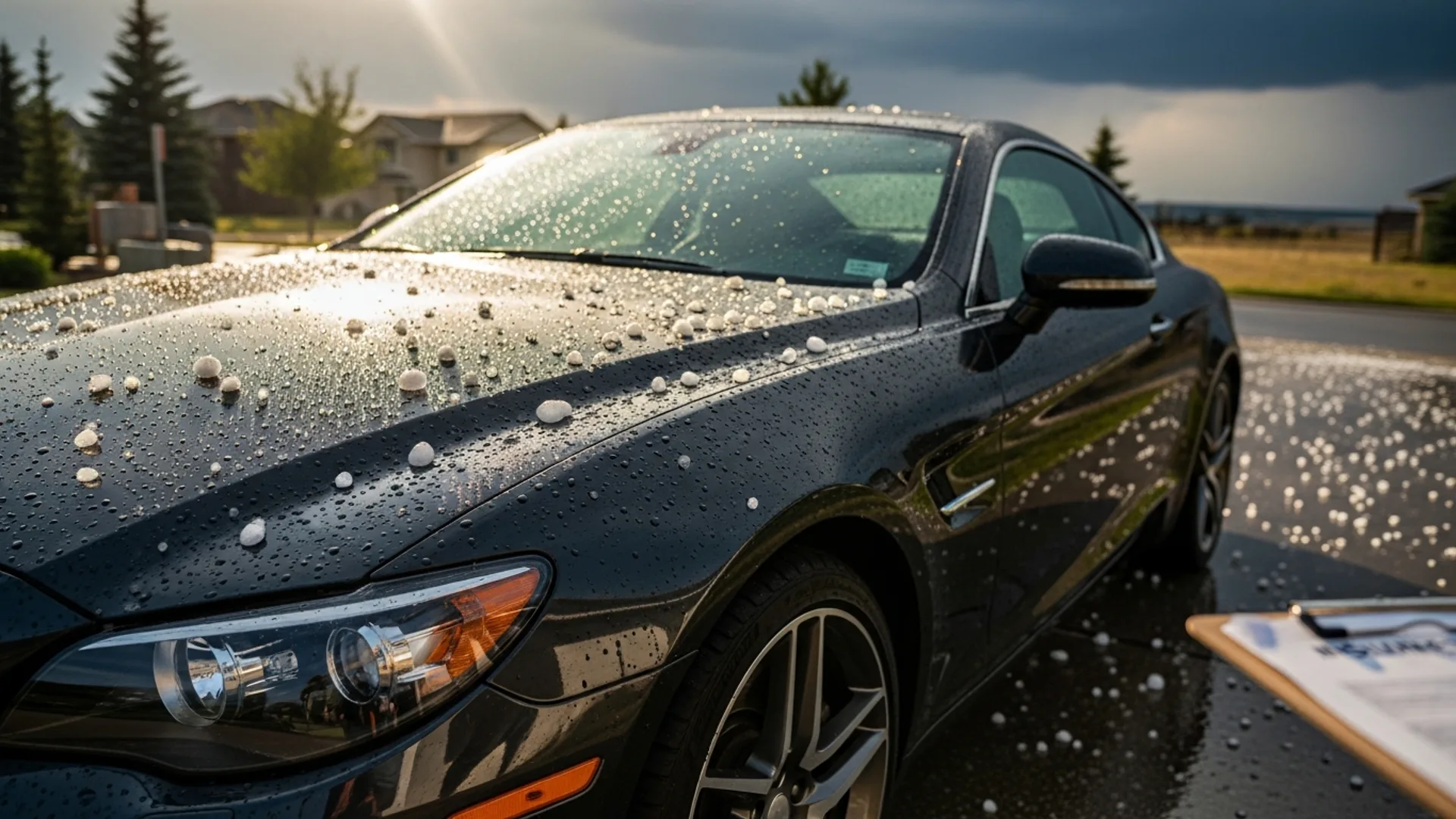
You spent several thousand dollars wrapping a car you care about, and then Calgary did what Calgary does — a July storm, a gravel truck on Stoney Trail, someone reversing in a parkade. The question every owner asks next is whether insurance covers PPF replacement. Most of what you will find answering that question online was written for Texas or Ontario. Alberta works differently, and the difference is worth knowing before you call your broker.
The short answer: In Alberta, your paint protection film follows whichever coverage responds to the underlying damage — so the question is never "is PPF covered?" but "what happened to the car?" Hail or vandalism falls to comprehensive, which is optional in Alberta and which you may not carry. A not-at-fault collision with another vehicle falls to DCPD, mandatory since January 1, 2022, with a $0 deductible by default — the most favourable path for getting film restored. An at-fault collision falls to optional collision coverage. And when the film is torn but the paint underneath is intact, a claim almost never makes sense, because the repair usually costs less than your deductible. That last case isn't a coverage failure — it's the film doing its job.
Why "Is PPF Covered?" Is the Wrong Question
Insurance does not think about paint protection film as a thing to be covered or excluded. It thinks in terms of perils — what caused the loss — and each peril routes to a different coverage on your policy. Your film is not a separate insured object sitting on the car; it is part of the car's finish, and its fate is decided by whichever coverage responds to the damage underneath it.
That is why owners get contradictory answers. One person says their film was replaced without argument after a collision; another says they were told flatly that film is not covered. Both are telling the truth about different perils. Once you sort it by what happened, the picture becomes consistent — and Alberta-specific in ways the US content never captures.
| What happened | Coverage that responds | Who pays for the film | Mandatory in Alberta? |
|---|---|---|---|
| Hail damage | Comprehensive / All Perils | Insurer, minus deductible | No — optional |
| Not-at-fault collision with another vehicle | DCPD | Your own insurer, $0 deductible by default | Yes — since Jan 1, 2022 |
| At-fault or single-vehicle collision | Collision | Insurer, minus deductible | No — optional |
| Vandalism, theft, fire | Comprehensive / All Perils | Insurer, minus deductible | No — optional |
| Rock tears film, paint intact | Usually none worth using | Realistically, you | — |
Note what the last column does to the conversation. Two of the four coverages that matter here are optional in Alberta. The provincial government states it plainly: additional coverage such as collision and comprehensive is not required by law. A driver carrying only the mandatory minimum has no hail protection at all — not on the film, and not on the paint underneath it. Before you ask whether your policy covers your PPF, confirm that it covers hail.
Which coverage applies to your situation?
Pick what happened to your car. General information for Alberta policies — your own wording governs.
Hail is the classic comprehensive claim, and it is the one Calgary owners actually file. The catch: comprehensive is optional in Alberta. If you carry only the mandatory minimum, hail damage is entirely on you — film or no film. When a panel is being repaired under a covered hail claim, the film that was on that panel is commonly written into the estimate, especially with an install invoice on file — that is standard practice rather than an entitlement, and it varies by carrier and adjuster.
Hail: The Calgary Case, and the Coverage You Might Not Have
This is not a hypothetical risk here, and there is a number that settles the argument. The Insurance Bureau of Canada reports that the August 2024 hailstorm in Calgary caused $3 billion in insured losses in just over an hour — the single most destructive weather event in Canada in 2024, in a year that became the costliest in Canadian history for severe-weather losses at over $8 billion. That storm went through this city, over these cars, in one afternoon.
When hail damages a covered vehicle, comprehensive responds and the repair is handled minus your deductible — which leaves timing the film reinstall against the repair date as your problem to sequence. Where the film comes in: if a panel is being repaired or refinished as part of that claim, the PPF that was on that panel is commonly written into the estimate — particularly when you can hand over the original install invoice showing what was on the car. That is standard industry practice rather than an Alberta rule, and it varies by carrier and adjuster, which is precisely why the invoice matters — and it is worth reading why removal and reinstall shows up as its own line on a hail estimate before an adjuster hands you a number.
What film will not do is make the car hail-proof, and any shop that suggests otherwise is selling rather than advising. Urethane absorbs impact and it genuinely helps against small stones and the finish damage that accompanies a storm, but a hailstone large enough to dent sheet metal will dent it through film. The realistic Calgary strategy is layered: film for the finish, comprehensive for the storm, and how to keep the car out of the storm in the first place for everything you can control.
DCPD: The Alberta Coverage Nobody Mentions
Here is the piece missing from every article ranking for this question, most of which were written in states and provinces where it does not exist. On January 1, 2022, Direct Compensation for Property Damage became mandatory on every Alberta auto policy, replacing the property-damage portion of third-party liability. It applies when another identified vehicle damages your car and you are not fully at fault.
Two features make it matter for film owners. First, you deal with your own insurer rather than pursuing the other driver's — no waiting on someone else's carrier to accept liability before your car gets fixed. Second, DCPD carries a $0 deductible by default in Alberta unless you specifically elected to add one. For a panel that had several thousand dollars of film on it, that is the cleanest path to having the film restored that exists in this province: no deductible standing in the way, and your own insurer's estimate to work from.
The honest limit: DCPD does not name paint protection film, or any aftermarket equipment, anywhere in its wording — it covers damage to your vehicle, its contents, and loss of use. And it applies only to collisions with another identified vehicle. It does nothing for hail, vandalism, rock chips, or single-vehicle incidents, which means it is irrelevant to the most common Calgary scenario of all. Useful when it applies; silent when it doesn't.
Alberta Has No Standard Endorsement for PPF
Search this topic for five minutes and someone will tell you to ask your insurer for a "custom equipment endorsement" to cover your film. That advice is imported from the American market, and in Alberta it does not land — because the endorsement being described does not exist here.
Alberta splits auto policy endorsements into exactly two categories, and the province spells this out directly: Standard Endorsement Forms (SEFs), approved by the Superintendent of Insurance and numbered consistently across every insurer, and Conditionally Approved Endorsements (CAEs) — non-standard forms the Superintendent approves for one particular company to meet its own clients' needs. Several SEFs deal with equipment. None of them covers non-electronic aftermarket additions like paint protection film:
| Endorsement | What it actually does | Does it cover PPF? |
|---|---|---|
| SEF 20 | Loss of Use — pays for a rental while your car is repaired | No — commonly miscited as custom equipment |
| SEF 37 / SEF 38 | Electronic accessories and electronic equipment | No — film is not electronic |
| SEF 19A | Valued Automobile — agreed value with a certified appraisal | No — values the whole car, not the film |
SEF 20 is the one worth flagging, because it gets cited as PPF coverage more than any other and it is simply the rental-car endorsement. If an Alberta insurer offers anything resembling coverage for aftermarket additions, it would come through a CAE — and the province notes that its published endorsement list excludes CAEs, because copies are available only from the insurers themselves. Which means there is no universal number for you to ask for. So the productive question for your broker is not "can I add SEF 20 for my film?" It is: "does your company have a conditionally approved endorsement that covers aftermarket paint protection?" Worth knowing too that the traffic does not run only one way: one approved Alberta endorsement does the opposite and deletes glass from comprehensive, which is a separate question from the paint and resolves differently.
This is also the cleanest place to separate two things owners routinely conflate. Insurance covers damage from external perils. It has nothing to do with the two warranties that cover the film itself — the manufacturer's warranty against yellowing and delamination, and the installer's workmanship warranty. Those cover the film failing. Your policy covers the world damaging it. Neither one substitutes for the other, and you want both — and neither is your vehicle's own factory warranty, which is a third thing entirely. That third document is narrower than most owners expect: the clauses that decide whether a chip is ever anyone else's problem sit in a section of the booklet almost nobody opens.
When the Film Tears and the Paint Is Fine
This is the scenario owners actually encounter most, and it deserves a straight answer rather than a hopeful one. A rock off a gravel truck hits your bumper. You inspect it and find a tear or a milky impact mark in the film — and pristine paint underneath. Can you claim it?
The technical answer is genuinely murky. No Alberta policy wording, SEF, or regulator source specifically includes or excludes film-only damage, and the detailing blogs asserting confident answers in both directions are all citing each other rather than a policy. But the practical answer is not murky at all, and it is arithmetic: replacing a section of film usually costs less than a comprehensive deductible. Look up your own deductible and hold it against the price of re-doing a bumper or a hood section — for most owners those two numbers land close enough together that a claim returns nearly nothing, while still adding a claim to your history. Check yours rather than taking our word for it; that single number decides this question for your car.
So the answer is usually no, and that is fine, because this outcome is the entire point of the investment. That rock was going to chip your paint. Instead it consumed a replaceable layer, and replacing a section of film is a scheduled visit rather than a bodywork job. Set against what a replacement install actually runs in Calgary, the film absorbing a hit and needing a patch is the good ending — especially on soft luxury paint that would have shown that chip forever.
The Pros
- A DOCUMENTED INSTALL TRAVELS WITH THE CLAIM: an itemized invoice turns your film from a story into a priced feature of the vehicle.
- DCPD IS THE OWNER-FRIENDLY PATH: not-at-fault collisions go through your own insurer at a $0 deductible by default.
- FILM ON A REPAIRED PANEL USUALLY RIDES ALONG: when the panel is being refinished under a covered claim, the film commonly lands in the estimate.
- TELLING YOUR BROKER COSTS NOTHING: putting the film on the record before a storm is the cheapest step in this entire article.
The Cons
- COMPREHENSIVE IS OPTIONAL IN ALBERTA: no comprehensive means no hail coverage — on the film or the paint beneath it.
- THERE IS NO SEF FOR PPF: the "custom equipment endorsement" advice is American, and SEF 20 is the rental endorsement.
- FILM-ONLY DAMAGE IS USUALLY BELOW YOUR DEDUCTIBLE: technically arguable, practically not worth claiming.
- NO INVOICE MEANS NO LEVERAGE: an adjuster cannot write in film that nobody can prove was there or what it cost.
The Documentation That Actually Decides This
Strip away the endorsement trivia and one thing separates owners who get their film handled from owners who argue about it: paperwork, created on install day rather than after a storm. Three items, and none of them cost anything beyond asking:
The itemized install invoice is the one that matters most — it shows exactly what was done, on which panels, with which product, at what price. This is what converts your film from something an adjuster has to take your word on into a documented, priced feature of the vehicle. The film manufacturer's warranty documentation establishes the brand and product line, which is how an estimator prices a replacement rather than guessing. And dated photographs of the finished car establish condition before the loss.
Then make one call. Tell your broker the film is on the car, name the brand, and give them the invoice figure. It takes two minutes and it means nobody is discovering several thousand dollars of film for the first time while looking at a hail-damaged hood. The same file does double duty later, which is the resale case for documented film — the buyer and the adjuster want the identical paperwork, so build it once.
One Myth Worth Retiring: Care-First Does Not Touch This
Because the timing overlaps, this comes up: Alberta's Care-First system launches January 1, 2027, and owners ask whether it changes how their film is handled. It does not, and the answer is not a nuance — it is a category difference. Care-First is a bodily-injury reform. It restructures medical care, rehabilitation, and income replacement after a collision. It leaves comprehensive, collision, and DCPD — the coverages that decide what happens to your paint and your film — entirely alone. If anyone tells you the 2027 changes affect your PPF, they have confused an injury reform with a physical-damage one.
A necessary note: this is general information for Alberta drivers, not insurance advice, and we are a detailing studio rather than a broker. Policy wording, deductibles, and claims practice vary by carrier and by adjuster, and your own policy governs. Confirm anything here with your broker or insurer before making a decision based on it.
Film, Documented Properly
Every install we do leaves with an itemized invoice, the manufacturer's warranty registration, and photographs of the finished car — exactly the documentation that makes an adjuster's job easy, and the file a buyer asks for years later. Book a professionally documented film install and the paperwork is handled before you ever need it. 4.9 stars across 705+ Calgary reviews.
Get My PPF QuoteSo the Alberta answer is more useful than the internet's answer, if less tidy. Your film is covered whenever the damage beneath it is covered — which means checking that you actually carry comprehensive, knowing DCPD hands you a $0-deductible path on a not-at-fault collision, and understanding that no endorsement in this province was written with paint protection film in mind. Keep the invoice, tell your broker, and accept the one case where a claim makes no sense: the rock that tore your film instead of your paint. You already got paid on that one — the day it hit.
Ready to Protect Your Vehicle from Rock Chips?
Join 705+ Calgary drivers who trust Obsidian Auto for PPF installation
Serving Calgary and surrounding areas • Free Uber shuttle with every service
Frequently Asked Questions
Sources
External references used in this guide
- Government of Alberta — Automobile insurance: Standard Endorsement Forms (SEFs) and Conditionally Approved Endorsements (CAEs)
- Automobile Insurance Rate Board — Direct Compensation for Property Damage
- Insurance Bureau of Canada — Hail and insurance
- Insurance Bureau of Canada — 2024 shatters record for costliest year for severe weather-related losses in Canadian history
Ready to Protect Your Vehicle?
Get a quote from Calgary's most trusted detailing studio. We use only the best materials and back our work with industry-leading warranties.
Get A QuoteRelated Intelligence
Can You Put PPF Over Existing Rock Chips? A Calgary Guide
Every PPF guide assumes a car that came off the truck last week. Most Calgary film work goes on a three-year-old car with a chipped nose. The depth rule that decides whether a chip gets filmed or filled, why no manufacturer publishes the touch-up cure time everyone quotes, the 8 microns of clear coat that limit what correction is even possible, and why film can make a chip look worse.
Hail Dents Under PPF: Does the Film Come Off for PDR?
The question no page answers properly: on a wrapped car, does the film have to come off before the dents get pushed out? It depends on the PDR method, not the film — rod work from behind leaves film untouched, while glue-pull tabs grip clear coat far more predictably than film. Plus why film can never be re-laid once removed, and the line item that should be its own line on the estimate.
Ceramic Coating Over PPF: Does It Void Your Film Warranty?
Every page says the same thing: coating over film is fine as long as it is film-safe. We read the published warranty documents for five paint protection films and found four different positions. Two exclude coatings by brand, one excepts ceramic from its exclusions by name, and two never mention the subject at all — and one of the brand-locked films is our own supplier.