
How to Protect Your Car From Wildfire Ash & Smoke in Calgary
Quick answer: Wildfire ash is the real threat to your paint — not the smoke haze itself. Ash is a gritty, abrasive mineral particulate that is typically alkaline, and once it gets wet from morning dew or rain it turns into a caustic, lye-like slurry that chemically etches your clear coat. It damages paint from the opposite end of the pH scale…
Key Takeaways
- Wildfire ash is the real threat to your paint — not the smoke haze itself. Ash is a gritty, abrasive mineral particulate that is typically alkaline, and once it gets wet from morning dew or rain it turns into a caustic, lye-like slurry that chemically etches your clear coat. It damages paint from the opposite end of the pH scale to acidic bird droppings, but the outcome is the same: permanent, dull etch marks if it's left to sit.
- Never wipe or dust dry ash off your car. This is the single most damaging mistake. Ash particles are harder than automotive clear coat, so dragging them across the paint with a cloth, duster, or your hand grinds them in like fine sandpaper and leaves swirl marks that only machine polishing can remove — most visible on dark colours.
- The safe method is rinse-first, contact-last: flood the car top-down with a hose (or blow it off with air) to float the ash away before anything touches the paint, then wash with a pH-neutral soap, lift rather than scrub, and blot dry with clean microfiber. Aim to do it within 24-48 hours of an ashfall, and always before the first dewy morning bakes it in under the sun.
- A ceramic coating or paint protection film makes ash far easier to rinse off and less likely to bond — they buy you time and make cleanup safer — but neither makes your car self-cleaning. You still have to remove the ash promptly. If ash has already etched the paint, professional decontamination and paint correction can usually restore it, depending on severity.
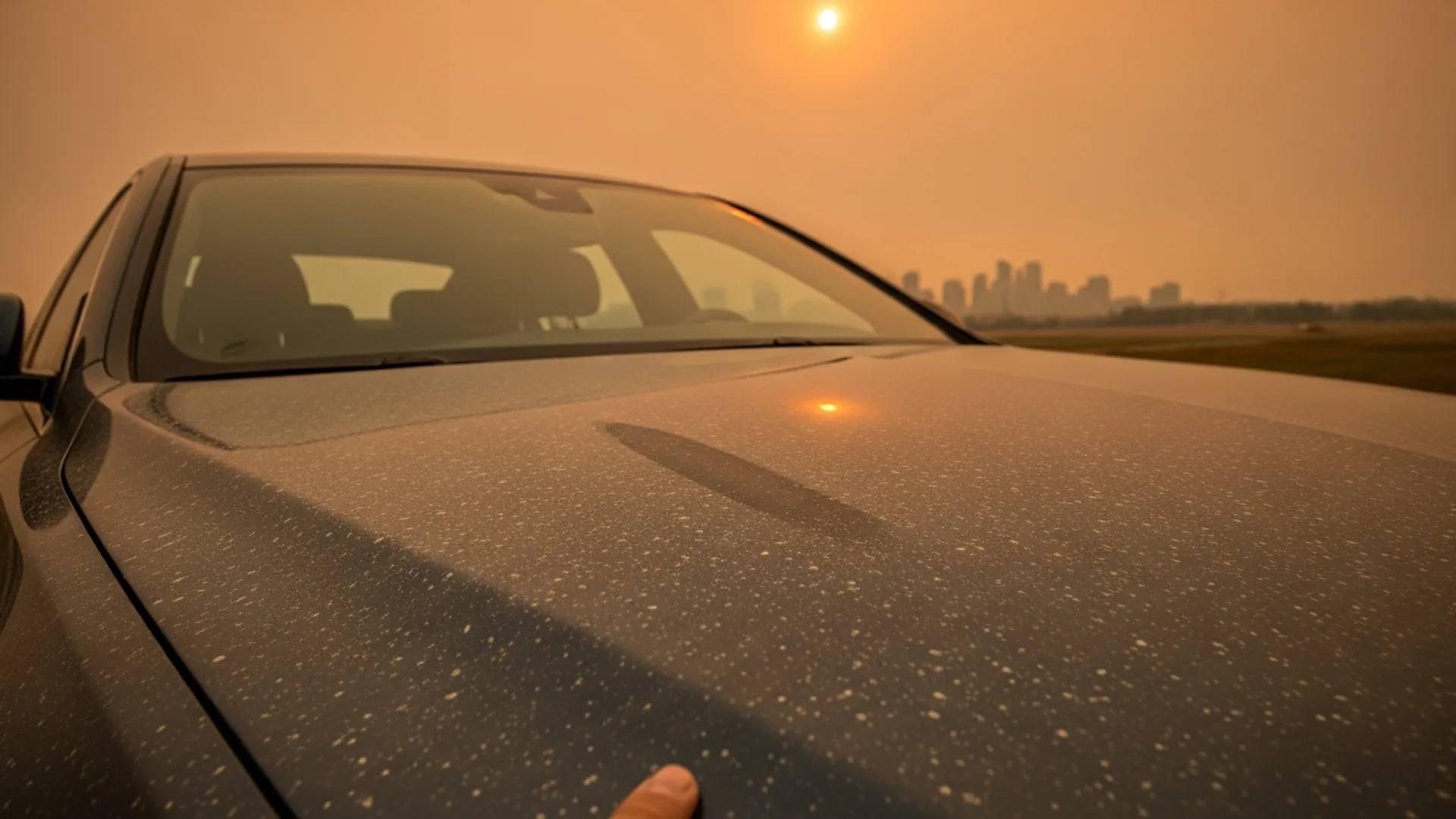
Every Alberta summer now brings the same routine: the sky turns amber, the sun becomes a dull orange disc, and a fine grey film of wildfire ash settles over every car parked outside. It looks harmless — like dust. It isn't. Left on your paint the wrong way, wildfire ash is one of the fastest ways to permanently scar a clear coat, and the instinct almost everyone acts on makes it dramatically worse.
The short answer: Wildfire ash is gritty and abrasive when dry, and turns into a caustic, alkaline slurry the moment it gets wet from dew or rain — so it can both scratch and chemically etch your paint. Never wipe or dust it off dry. Rinse the car top-down with a hose to float the ash away first, then wash with a pH-neutral soap and blot dry. Do it within 24-48 hours, and always before the next dewy morning bakes it in.
We see the aftermath every August at the studio. A client brings in a beautiful dark-metallic sedan covered in swirl marks that weren't there a month ago, and the story is always the same: "There was ash on it, so I wiped it off with a towel." That single wipe is what put the scratches there. Understanding why ash behaves the way it does is what stops you from causing the damage you're trying to prevent.
Why Wildfire Ash Damages Paint (It's Two Threats, Not One)
Wildfire ash attacks your clear coat in two completely different ways, and both matter.
When it's dry, ash is abrasive. It's a fine mineral and silica particulate — essentially microscopic grit — and it is harder than your car's clear coat. Sitting on the surface it does nothing. Dragged across the surface by a cloth, a duster, a car cover, or your hand, it acts exactly like fine sandpaper, cutting a web of micro-scratches and swirl marks into the paint. This is why the dry wipe is so destructive.
When it's wet, ash is caustic. Wildfire ash is typically alkaline — global studies of wildfire ash put it broadly between pH 6 and 11.2, averaging around 8.8. Once dew, fog, or rain dissolves it, the potassium and sodium compounds in the ash form a caustic, lye-like solution that chemically attacks the oily binders in your clear coat and etches the surface. Heat and direct sun accelerate the reaction — so a car left overnight collects dew, then bakes as the morning sun climbs, and the etching sets.
If that sounds familiar, it's the mirror image of the acidic etching from bird droppings and sap. In fact, the safe removal discipline is nearly identical — the same soak-and-lift approach we cover in our guide to removing bird droppings and tree sap without scratching applies here, just against an alkaline contaminant instead of an acidic one.
| Wildfire Ash | Bird Droppings | |
|---|---|---|
| Chemistry | Alkaline / caustic when wet (high pH) | Acidic (uric acid, low pH) |
| Second threat | Abrasive grit — scratches if wiped dry | Gritty crust — scratches if wiped dry |
| What activates it | Dew, fog, rain + heat | Moisture + heat |
| Safe removal | Rinse first, then pH-neutral wash, blot dry | Soak & dab, then rinse, blot dry |
| Worst mistake | Wiping it off dry | Wiping or scraping it off dry |
The Correct Way to Remove Wildfire Ash
The whole method is built around one principle: get the ash off the paint with as little physical contact as possible. Every step is ordered from least contact to most.
Rinse or Blow It Off First
Step 1Do not touch the car yet. Flood it top-down with a hose or pressure washer on a low-to-moderate setting so the ash floats and rinses away, or use forced air to blow it off. The goal is to remove the abrasive grit before anything solid ever drags across the paint.
Foam / Pre-Soak with pH-Neutral Soap
Step 2Coat the car in a pH-neutral car shampoo and let it dwell. This softens and lifts whatever ash is left and helps neutralize the alkaline residue before you make contact with a mitt.
Wash Gently — Lift, Don't Scrub
Step 3Use a clean, soft wash mitt and a two-bucket method, working top-down in straight-line motions with minimal pressure. You are lifting softened grime, not grinding it. Rinse the mitt often so you are never re-dragging ash.
Rinse Thoroughly, Then Blot Dry
Step 4Rinse every panel gap, mirror, and trim piece where ash hides. Dry by blotting with a clean microfiber towel rather than dragging it, and consider a fresh coat of protection afterward to make the next ashfall easier to clean.
Skip the Automatic Brush Wash During Ashfall
A drive-through brush wash during a smoke event is one of the worst things you can do. Those brushes are loaded with abrasive ash and grit from every car ahead of you, and they'll grind it straight into your paint. If you can't rinse and hand-wash safely yourself, a touchless wash or a professional maintenance detail is the safer call.
Does Ceramic Coating or PPF Actually Help?
This is the question we get most, and the honest answer is: yes, meaningfully — but not the way most people hope. Neither product makes your car self-cleaning, and neither lets you ignore the ash. What they do is change how the ash interacts with your surface.
A ceramic coating's slick, hydrophobic surface is non-porous, so ash has far less to grip and rinses off with much less effort and risk. That slickness is exactly what turns a nervous, high-contact clean into a quick, safe rinse. And because the coating is a hard sacrificial layer, mild alkaline residue works on the coating before it ever reaches your actual clear coat.
Paint protection film goes a step further on the abrasion side: it's a thick, self-healing urethane layer that physically absorbs the scuffing an accidental wipe would otherwise inflict on your paint, and light marring often heals out with heat. For a Calgary car that also faces highway gravel and road salt, that all-season barrier is why so many owners pair film on high-impact panels with a coating over everything.
The critical caveat, and the part marketing pages skip: a coated or filmed car left covered in ash through a hot, dewy day can still stain or etch. Protection buys you time and makes cleanup safe — it is not permission to leave the ash on.
The Pros
- RINSE-FIRST IS ALWAYS SAFE: flooding the car before contact removes the abrasive grit and prevents the swirl marks that dry-wiping causes.
- COATINGS MAKE ASH RINSE OFF EASILY: a hydrophobic ceramic surface gives ash almost nothing to bond to, turning cleanup into a quick, low-risk job.
- PPF TAKES THE ABRASIVE HIT: a self-healing film layer absorbs scuffing and heals light marring so your actual paint stays flawless.
- ETCHING IS USUALLY REVERSIBLE IF CAUGHT EARLY: prompt decontamination and paint correction restores most ash damage to a uniform gloss.
The Cons
- DRY-WIPING IS PERMANENT DAMAGE: hard ash particles scratch clear coat instantly, and only machine polishing removes the swirls afterward.
- WET ASH ETCHES FAST IN THE HEAT: dew or rain plus a sunny Calgary afternoon can bake alkaline etch marks in within a single day.
- NO COATING MAKES A CAR SELF-CLEANING: ceramic and PPF buy time and safety, but ash left sitting can still stain a protected surface.
- BRUSH CAR WASHES GRIND ASH IN: automatic washes during a smoke event drag everyone else's grit across your paint.
The Calgary Reality: This Is a Yearly Event Now
Alberta's wildfire season officially runs March 1 through October 31, and Calgary reliably sees its heaviest smoke later in that window, often peaking in August. A lot of the smoke and ash that settles on our cars doesn't even come from local fires — it drifts in from British Columbia and northern Alberta on the prevailing westerlies, and at times from Saskatchewan, which is why a clear-sky day can turn amber within hours. Air quality advisories and visible fallout on vehicles have become a normal part of a Calgary summer, not a rare one.
That predictability is the argument for getting ahead of it. If you already book a spring decontamination and protection refresh — the strategy we lay out in our year-round Calgary car care guide — heading into smoke season with a fresh coating means the inevitable ashfalls become a five-minute rinse instead of a risky scrub.
Don't Forget the Inside: Smoke Smell Is Its Own Problem
Ash is an exterior threat; smoke is an interior one. Smoke odour rides into the cabin through the fresh-air intake and settles into your seats, carpet, headliner, and ventilation ducts. The fix most people overlook is the cheapest one: replace the cabin air filter with a fresh activated-carbon (charcoal) filter, which adsorbs odour molecules rather than just catching particles, and run your climate system on recirculate during heavy smoke to limit what gets in.
When the smell has already soaked into the upholstery, a filter alone won't fix it — that calls for a deep interior detail and cabin deodorizing, and for stubborn embedded odour, an ozone or steam treatment that neutralizes the smell at its source instead of masking it. If any ash has already etched exterior paint, machine paint correction to level the etched marks is what brings the gloss back before you re-protect.
The bottom line for Calgary: wildfire smoke season is here to stay, and your paint's worst enemy during it isn't the ash itself — it's the reflex to wipe it off. Rinse first, wash gently, act within a day or two, and let a coating or film do the heavy lifting on the ashfalls you can't get to right away. Do that, and a smoky August is a minor inconvenience instead of a body-shop bill.
Ash Already Marked Your Paint?
Whether you need swirl marks and etching corrected after a smoke event, or want a ceramic coating so the next ashfall rinses off in minutes, our team will assess your paint and recommend the right protection. Backed by 705+ reviews and a 4.9-star rating across Calgary.
Get My Paint AssessmentGet That Showroom Shine That Lasts
Join 705+ Calgary drivers who trust Obsidian Auto for ceramic coating
Serving Calgary and surrounding areas • Free Uber shuttle with every service
Frequently Asked Questions
Sources
External references used in this guide

Ready to Protect Your Vehicle?
Get a quote from Calgary's most trusted detailing studio. We use only the best materials and back our work with industry-leading warranties.
Get A QuoteRelated Intelligence
UV Damage to Car Paint & Interiors: A Calgary Guide
Calgary owners blame winter for tired paint, but the city logs 2,396 hours of bright sunshine a year — more than any other large Canadian city. What UV actually destroys is the clear coat's sacrificial UV absorbers, which deplete invisibly for years and then fail suddenly. Plus the honest answer on whether ceramic coating blocks UV (it doesn't), and why heat, not UV, is what cracks your dashboard.
Washing Your Car at Home in Calgary: What's Actually Legal
Ask around and you will be told washing your car at home in Calgary is illegal and the fine is $3,000. Both halves are wrong, in opposite directions. Two different bylaws are involved: one governs soap in the storm drain year-round, the other governs when outdoor water may be used at all — and only one of them ever bans washing.
PPF and Ceramic Coating Together: Calgary Combo Guide
Running PPF and ceramic coating together in Calgary: which goes on first and why reversing it fails, real combo pricing from $2,698, whether the stack is worth it for how you drive, and how it beats gravel, brine, and freeze-thaw.