
Ceramic Coating for Wheels & Calipers in Calgary
Quick answer: Ceramic coating your wheels and brake calipers creates a slick, heat-stable barrier that stops baked-on brake dust and Calgary's calcium-chloride road brine from bonding to the metal — turning the hardest part of the car to clean into a quick rinse.
Key Takeaways
- Ceramic coating your wheels and brake calipers creates a slick, heat-stable barrier that stops baked-on brake dust and Calgary's calcium-chloride road brine from bonding to the metal — turning the hardest part of the car to clean into a quick rinse.
- The single biggest mistake Calgary owners make is timing: a wheel coating has to go on before the first salt drop of the season, because once brine has etched and corroded bare or curb-rashed alloy, the coating seals the damage in rather than preventing it.
- A proper wheel coating is done wheels-off, with each wheel dismounted so the full barrel and inner face — where brine and brake dust actually collect — are coated, not just the spokes you can see.
- Caliper coatings are formulated to survive sustained brake heat, so a coated caliper keeps its colour and sheds dust on both a winter commuter and a track-driven sports car — as long as the caliper is properly prepped first.
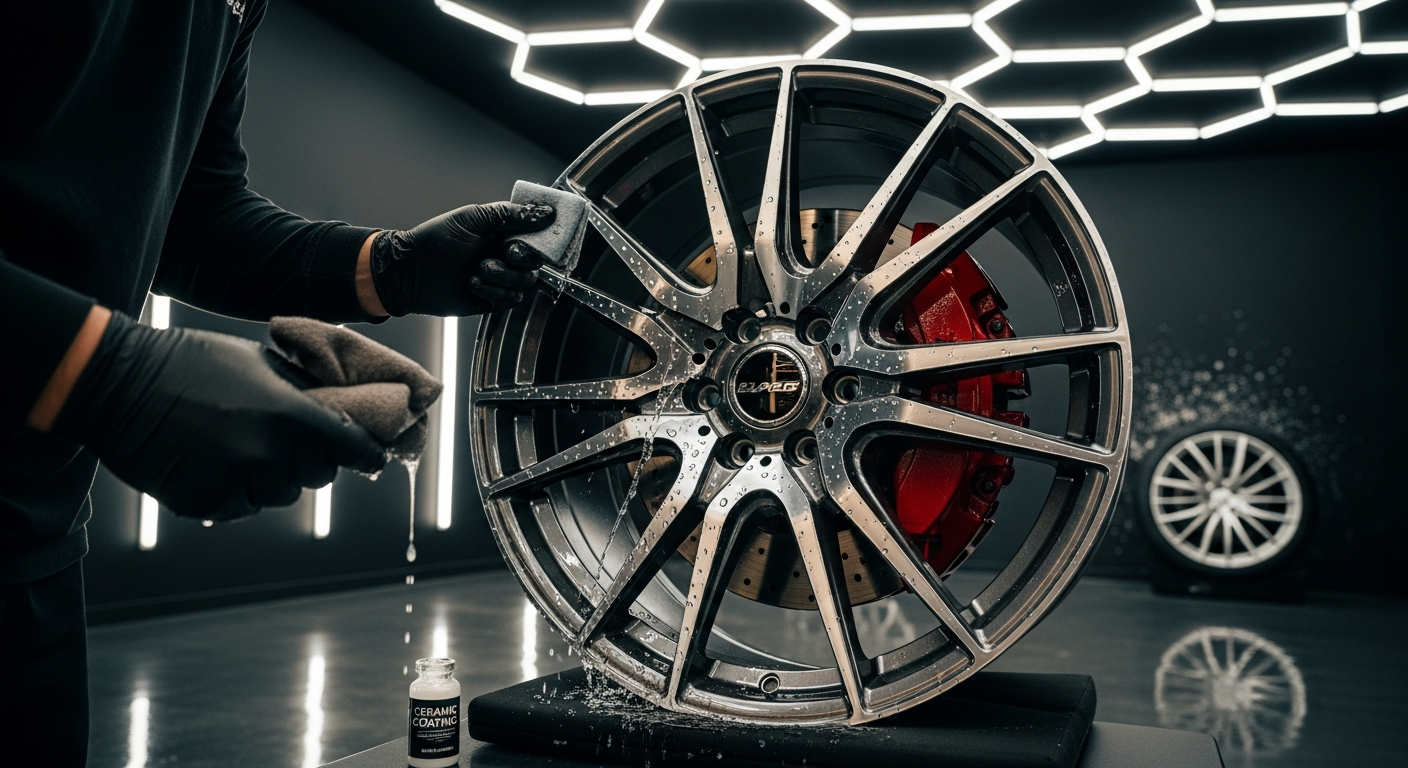
Most owners spend real money protecting their paint and then leave the most punished surfaces on the car completely defenceless. Ceramic coating wheels — and the brake calipers behind them — is the most overlooked upgrade in a Calgary winter — the wheels and calipers take more brake dust, brine, and abrasion than any panel on the body, yet they are the part most people never think to protect until the finish is already pitted and stained.
The short answer: Ceramic coating your wheels and brake calipers creates a slick, heat-stable barrier that stops baked-on brake dust and Calgary's calcium-chloride road brine from bonding to the metal — so the hardest part of the car to clean becomes a quick rinse, and an expensive alloy finish is protected from the salt corrosion that no polish can reverse. For it to work, coat clean, corrosion-free wheels before the season's first salt drop, and do it wheels-off so the brine-collecting barrel and inner face are protected, not just the spokes you can see.
If you have already coated your paint with Obsidian Auto's ceramic coating service, this is the logical next step — the same chemistry that makes your hood shed water and brine belongs on the surfaces that actually live in the spray. Here is exactly what a wheel and caliper coating does, why Calgary makes it worth more than almost anywhere else, and how to time it.
Why Wheels Take the Worst of a Calgary Winter
Your wheels and calipers absorb a punishment your body panels never see. Every kilometre, the wheels are spinning directly through the brine and traction sand the City of Calgary lays down on its snow and ice control program routes, while the calipers cycle through hundreds of degrees of brake heat. The brine here is the aggressive part: Calgary relies heavily on calcium-chloride solution, which is far harsher on alloy finishes than the rock salt many other cities use. Left on bare or curb-rashed metal, it triggers galvanic corrosion, white oxidation, and pitting that no polish can undo.
Layer brake dust on top of that. Brake dust is not ordinary dirt — it is hot, abrasive metallic particulate that fuses to a bare wheel and etches its finish over time. Combine baked-on dust with six months of brine and sand, and an uncoated luxury wheel ages from flawless to permanently stained in a single season. A ceramic coating attacks both problems at once: it seals the finish against corrosion and leaves it so slick that dust and brine sit on top instead of bonding.
What Punishes a Calgary Wheel Most (our rough ranking, illustrative)
What a Wheel & Caliper Coating Actually Does
It helps to be precise about what you are buying, because a coating is often oversold. A ceramic wheel coating is a thin, semi-permanent layer of SiO2-based chemistry that bonds to the wheel finish and changes its surface behaviour — it does not add visible thickness or change the look. Here is the honest split of what it does and does not do.
The Pros
- Seals the finish so calcium-chloride brine cannot reach and corrode the metal.
- Makes the surface so slick that brake dust and brine rinse off instead of bonding.
- Cuts wheel-cleaning time by more than half — no scrubbing each spoke by hand.
- Protects a forged or painted luxury wheel finish that costs four figures each to replace.
- Caliper formulations tolerate sustained brake heat and keep the colour bright.
The Cons
- DOESN'T make wheels self-cleaning — they still get dirty, they just get clean again fast.
- DOESN'T repair corrosion, pitting, or curb rash that is already present — it seals the surface as-is.
- DOESN'T replace a periodic brine rinse and the occasional iron decontamination.
- DOESN'T stop a fresh curb scrape from chipping the coating and the wheel beneath it.
The mechanism is the same one that protects your paint, which is why owners who understand coatings extend it to the wheels almost reflexively. If you want the deeper chemistry of how these layers repel brine and water spotting, our breakdown of whether a graphene additive is worth it in Calgary covers which formulation survives our winters best — and why an anti-static graphene layer can mean even less brake dust cling on a wheel.
Why It Has to Be Done Wheels-Off
This is where a real wheel coating separates from a surface-level one. The parts of a wheel that take the most brine and brake dust are the barrel and the inner face — precisely the areas you cannot see or reach with the wheel mounted on the car.
Coat the Barrel, Not Just the Spokes.
A faces-only coating with the wheels on the car protects the show side and leaves the most corrosion-prone surfaces — the inner barrel where brine pools — completely exposed. A premium wheel coating is done wheels-off: each wheel dismounted, decontaminated and iron-removed inside and out, then coated across the full barrel, inner face, and spokes. It is more labour, but it is the difference between protecting the wheel and protecting the part of it that nobody sees getting destroyed.
The Wheels-Off Coating Process
A correct wheel and caliper coating is mostly preparation — the coating itself is the final, fast step. Here is how the process runs in the studio.
Dismount & Inspect
Step 1Each wheel comes off the car so the full barrel and inner face are accessible. We inspect for existing corrosion, curb rash, and powder-coat condition before anything else.
Decontaminate & Iron-Remove
Step 2Inside and out: a thorough wash, iron-fallout remover to dissolve embedded brake particulate, and a solvent wipe so the coating bonds to bare, clean finish — not to trapped dust.
Coat Wheels Full-Face
Step 3SiO2 wheel coating applied across spokes, barrel, and inner face, then levelled. The full surface is sealed, not just the part you see.
Prep & Coat Calipers
Step 4Calipers are degreased meticulously, then a heat-tolerant caliper coating is applied so they shed dust and hold their colour through brake heat cycling.
Cure & Remount
Step 5The coating flashes and cures before the wheels are torqued back to spec. The result is a sealed, slick finish ready before the first salt drop.
Once it is on, keeping the coating performing is simple — the same discipline that keeps a body coating alive. Our guide to keeping your coating's beading alive through the salt season covers the brine-rinse routine and the occasional iron decontamination that keeps coated wheels shedding dust for their full rated life.
Wheels-On vs. Wheels-Off: What You Get
If a shop quotes you a wheel coating, the first question to ask is whether it is wheels-on or wheels-off. The price gap reflects a real difference in what is actually protected.
| Wheels-On (Faces Only) | Wheels-Off (Full Barrel) | |
|---|---|---|
| Surfaces coated | Spokes & outer face only | Spokes, barrel, inner face — full wheel |
| Brine protection | Show side only — barrel exposed | Complete, including where brine pools |
| Decontamination | Limited reach inside | Full inside-and-out iron removal |
| Labour & time | Lower | Higher (dismount + remount) |
| Best for | Light touch-up between details | Calgary winter / luxury wheel protection |
For most luxury and performance owners in a salt climate, wheels-off is the only version worth paying for — a faces-only job protects the half of the wheel that was never the problem. Coverage and finish drive the price, so the honest way to get a real number is a quick look at your specific wheels; our transparent ceramic coating pricing tiers show where wheel and caliper add-ons land alongside the body packages.
Timing: Coat Before the First Salt Drop
The most expensive mistake we see is coating too late. A ceramic coating is a barrier against future corrosion — it does nothing to reverse brine etching, pitting, or oxidation that has already started. Wheels coated in the fall, on clean and corrosion-free finishes, sail through the salt season; wheels brought in mid-winter, already showing white oxidation, can only have the damage sealed under the coating.
Protect Your Wheels Before the Salt Trucks Roll
Bring your wheels to our Calgary studio for a wheels-off ceramic coating — full barrel, inner face, and heat-tolerant caliper coating — and walk out with the hardest-to-clean part of your car sealed against brine and brake dust for years.
Book Your Wheel CoatingWhere Wheel Coating Fits in a Complete Build
A wheel coating is rarely the whole protection story — it is the piece that completes one. The premium Calgary build pairs physical impact protection on the high-impact body panels with chemical coatings on the surfaces that live in the spray. If you are filming the front end against gravel, see how pairing PPF on the body with coated wheels covers the two damage modes Calgary throws at a car — rock chips up front, brine and brake dust at the corners. Film stops the stone; the coating sheds the salt. The same logic finishes inside the cabin, where an interior coating protects the leather, Alcantara, and dashboard from the salt and sun that age a cabin faster than any body panel.
Modern wheel and caliper coatings borrow the same heat-stable, anti-corrosion chemistry that manufacturers like Gtechniq engineer for brake components — built specifically to tolerate the exact heat and salt cycling a Calgary winter delivers. Matched to the right wheel and the right prep, it is the difference between alloys that still look new after three winters and ones that are quietly corroding from the inside of the barrel out.
Get That Showroom Shine That Lasts
Join 705+ Calgary drivers who trust Obsidian Auto for ceramic coating
Serving Calgary and surrounding areas • Free Uber shuttle with every service
Frequently Asked Questions

Ready to Protect Your Vehicle?
Get a quote from Calgary's most trusted detailing studio. We use only the best materials and back our work with industry-leading warranties.
Get A QuoteRelated Intelligence
Paint Correction in Calgary: Single vs Multi-Stage Polishing Explained (2026)
The honest breakdown of single-stage vs multi-stage paint correction in Calgary — what each removes, what each costs in 2026, and how to choose before a ceramic coating or PPF install.
New EV Paint Protection in Calgary: Beyond Tesla
Rivian, Lucid, Polestar, Lyriq and the new EV wave ship with soft factory paint. Here is how to protect a new electric vehicle in Calgary: PPF, ceramic coating, and the delivery-week timing that matters most.
Interior Ceramic Coating in Calgary: Leather & Alcantara
Your paint gets protected while the cabin quietly ages. Here is how an interior ceramic coating shields leather, Alcantara, and fabric from Calgary road salt, spills, and high-altitude UV — and why each surface needs its own coating chemistry.