
Does PPF Affect Your Car's Sensors? A Calgary ADAS Guide
Quick answer: Paint protection film does not trigger ADAS recalibration — taking the bumper off does. Ask your installer what they remove, not what film they use. Ultrasonic parking sensors get a full cut-out: even entry-gauge PPF starts near 150 microns, and manufacturers cap total coating on that sensor face at 115–125.
Key Takeaways
- Paint protection film does not trigger ADAS recalibration — taking the bumper off does. Ask your installer what they remove, not what film they use.
- Ultrasonic parking sensors get a full cut-out: even entry-gauge PPF starts near 150 microns, and manufacturers cap total coating on that sensor face at 115–125.
- Front radar hides behind the bumper, but the bumper is its window — BMW, Porsche and Mazda all restrict adding film or stickers over the transmission area.
- We have found no published measurement of film attenuation over radar. If a shop quotes you a decibel figure, ask which test it comes from.
- In a Calgary winter, a 'sensor blocked' warning is almost always packed slush or brine on the sensor face — not the film.
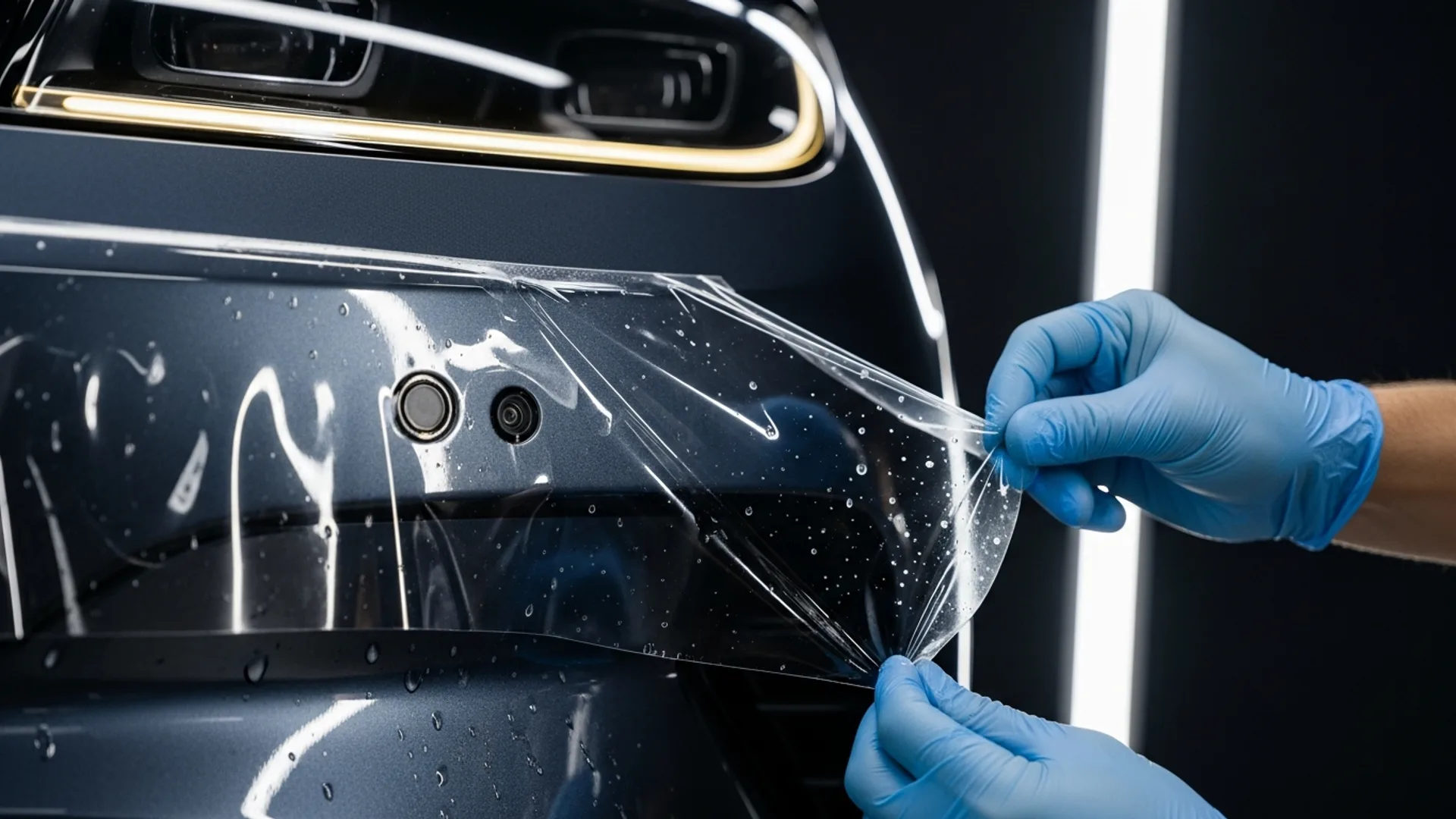
Ask a Calgary shop whether paint protection film affects your car's ADAS sensors and you will usually get a shrug and a reassurance: "don't worry, we cut around them." That answer is not wrong, but it is doing a lot of hiding. A modern luxury vehicle carries at least three completely different ADAS sensing technologies in the panels a front-end film pattern covers, and each one fails for a different reason. Treating them as one question is how installs go wrong.
The short answer: paint protection film does not interfere with ADAS sensors when it is cut correctly — and film by itself is not what triggers a recalibration. Disassembly is. Recalibration requirements are written around removing, replacing or re-aiming a sensor or its bracket, not around adding a layer to an undisturbed panel. So the question to ask a Calgary installer is not which film do you use. It is what are you taking off my car to install it?
We get the question most often from owners a week out from delivery, standing in the bay with a new Rivian or a refreshed Model Y, asking whether the film is going to make the car beep at nothing. It is a fair thing to ask about a car that is half software. It usually arrives alongside its sibling question — whether any of it affects the new-vehicle warranty in Canada — and both deserve a better answer than the one circulating online.
That reframe matters because it moves the risk from the product to the process. Film is a passive layer. The things that genuinely break driver-assistance systems are a sensor face that got covered when it should have been cut around, a bumper that came off and went back on a fraction of a degree out of true, and a camera looking through something the manufacturer never intended. None of those are properties of the film. All of them are properties of the person holding it.
Four Sensors, Four Different Rules
Here is the part almost no page on this topic gets right. Radar, ultrasonic sensors, cameras and lidar are not variations on a theme — they are four separate physics problems that happen to live in the same bumper. One cannot tolerate any added material at all. One is not blocked by the film so much as looked through it, which makes the panel itself part of the sensor. One has no published test data in either direction, which is why we would rather show you the manufacturer wording than hand you a confident number. And one is rare enough that the real work is finding out whether your car has it.
Front Radar
Keep the transmission area clear.- Where it lives
- Hidden behind the bumper fascia, the grille, or the manufacturer badge. You cannot see it.
- What it does
- Adaptive cruise control, forward collision warning, automatic emergency braking.
- Why the rule exists
- The radar never sees daylight — it looks through the bumper. That plastic is not just a cover, it is the radar's window, and its thickness is engineered around the wavelength the sensor uses. Manufacturers are unusually blunt about not adding layers to it. BMW's repair specification for radar-equipped vehicles states that no stickers or film — transparent or coloured — are to be attached in the areas permeated by radiation at the sensors. Porsche instructs that bumpers must not be painted or covered with wrappings or decals in the radar transmission area. Mazda's owner documentation singles out transparent stickers around the front radar by name.
- Our verdict
- Clear does not mean invisible to radar. We have not found a published measurement for film over radar in either direction, so we follow the manufacturers' own wording rather than guess.
Tap each sensor type. Four different technologies, four different rules — which is exactly why one blanket answer fails.
The Ultrasonic Sensor Arithmetic Nobody Publishes
If you take one technical fact from this page, take this one, because it settles the most common argument in the entire category. Owners routinely ask whether a "thin enough" film could just go over the parking sensors for a cleaner look. The manufacturers have already answered it, in microns.
Read those together. Even the thinnest film on the market is thicker than the entire coating allowance the manufacturer permits on that sensor face — and that allowance is not empty to begin with, because the factory finish is already using part of it. There is no version of "thin enough" that works.
The reason is that an ultrasonic sensor is not a window. It is a tuned resonator: a diaphragm that vibrates at a specific frequency and listens for the echo. Mercedes-Benz is unusually explicit about the consequence, warning that deviating coating thicknesses detune the diaphragm, producing anything from measurement accuracy problems up to system failure. Note that its specification carries a minimum as well as a maximum — that is the signature of a tuned system rather than a transparency problem. You are not blocking a signal. You are changing what the thing resonates at.
Two honest caveats. These are refinishing specifications written for paint, not for film, and no film manufacturer publishes sensor guidance of its own — we checked the technical data sheets. So the cut-out convention is an inference from the manufacturers' arithmetic rather than a published film standard. It is a very well-supported inference, and it is why every pre-cut pattern worth using already has those holes in it.
Radar: The Bumper Is the Window
Front radar feels like it should be a non-issue. It is buried behind the fascia — the film never touches it. But that reasoning has the geometry backwards. The radar has to see through the bumper, which makes that panel the radar's window, and its wall thickness is engineered around the wavelength the sensor works at. Adding layers to a tuned window is not automatically harmless.
You do not have to take our word for this, because several manufacturers put it in writing, and the wording is pointed:
| Manufacturer | What they publish about the radar area |
|---|---|
| BMW / Mini | Its repair specification for radar-equipped vehicles states that no stickers or film — transparent or coloured — are to be attached in the areas permeated by radiation at the sensors. |
| Porsche | Its published restriction instructs that bumpers must not be painted, and must not be covered with car wrappings or decals, in the radar transmission area. Porsche gives the mechanism too: altered refraction of the radar waves can limit performance and precision. |
| Mercedes-Benz | Its owner literature instructs owners not to attach stickers or films — including films intended to protect against stone chipping — in the detection range of the sensors and cameras. The restriction is written around location, not around film as a product. |
| Mazda | Its owner documentation instructs owners not to adhere stickers — including transparent stickers — to the grille and front emblem in and around the front radar sensor. |
| Ford | Its published ADAS service guidance lists paint protection film among the aesthetic modifications it does not approve on or near sensor fields of view, including front bumpers and grilles. |
The common thread is that clear does not mean invisible. Three separate manufacturers went out of their way to specify transparent stickers and films, which tells you they anticipated exactly the "but it's clear" argument. Whether a clear urethane film behaves the same way as a decal is a fair question — nobody has tested it publicly — and that uncertainty is precisely the reason to keep the transmission area clean rather than to assume it is fine.
And a word on the numbers you will see quoted elsewhere. We have not been able to find a published, credible measurement of film attenuation over automotive radar — not from a manufacturer, not from a film maker, not from an independent lab. The decibel figures circulating on detailing blogs generally trace back to marketing pages rather than to a test report, and when we followed the standards those pages cite, we could not find the figures in them. No film we are aware of carries a meaningful "ADAS certification," because there is no published standard to certify against. So if you are quoted a specific attenuation figure, it is worth asking to see the test it came from. What is well documented is that metallic content matters — aluminum flake in refinish materials measurably interferes with radar, which is why paint manufacturers now sell radar-optimised colours. That research was done on paint, not film, but it is a good reason to treat coloured or metallic-look films over a radar zone as an open question rather than a settled one.
The Recalibration Question, Answered Properly
This is the query with real money behind it, and it is currently answered on the internet mostly by forum guesswork. Here is the decision, laid out the way a shop actually makes it.
| What happens during the install | Recalibration? | Why |
|---|---|---|
| Film applied to an undisturbed panel, sensors cut around | Not a trigger | Nothing the calibration references has moved. No manufacturer names film application on its own as a calibration trigger. |
| Bumper cover or grille removed and refitted | Often required | Some manufacturers — Toyota's published procedure is the commonly cited example — require radar recalibration whenever the fascia comes off and goes back on, regardless of the reason. Confirm the procedure for your own marque. |
| Panels removed during a PPF install | May be required | Rivian states directly that if vehicle panels are removed during PPF installation, recalibration of its driver-assistance components may be necessary. |
| A sensor, camera or bracket removed, replaced or re-aimed | Required | This is the actual trigger in every manufacturer procedure. Aim is the whole point of a calibration. |
| Windshield replaced or camera bracket disturbed | Required | The forward camera references the glass it looks through and the bracket that holds it. |
Notice what is doing the work in that table: not one row turns on the film. They all turn on whether something moved. This is why "do you disassemble?" is the single most useful question you can ask, and why a studio that wraps edges by hand without pulling the bumper is answering a risk question as well as a quality one.
If recalibration is needed, it is done by a shop with the tooling, the manufacturer procedure and a flat, obstruction-free bay — dealer or qualified independent, and Calgary has both. Nobody in Alberta publishes a price list for it, so treat any precise figure you see online with suspicion. Owners we speak to generally report a few hundred dollars for a single-sensor calibration and materially more for a multi-sensor event — but that is anecdote, not a rate card. Get it quoted by the shop that would do the work.
What the EV Manufacturers Actually Say
Two brands deserve specific treatment, because their guidance is genuinely different from everyone else's and both are increasingly common on Calgary roads.
Rivian is the only manufacturer that addresses paint protection film head-on. Its ADAS calibration position statement warns that third-party films such as vinyl wrap or PPF not manufactured by XPEL may affect the performance of its driver-assistance components, and a separate dedicated PPF statement says XPEL self-healing film is compatible with those component locations. Two things are worth knowing about that wording: it is hedged — "may affect" — and Rivian has not published a test result behind it. Rivian also sells XPEL film through its own store. We are not in a position to say what the guidance is based on, so we take it at face value and make sure Rivian owners know it exists. We install 3M, STEK, SunTek and GSWF rather than XPEL, so we will say it plainly: if you want to follow Rivian's wording to the letter, that points you to an XPEL installer, and we would rather tell you now than after you have booked. What we can tell you is how we approach a Rivian — film kept clear of every sensor face and camera field of view, and nothing removed from the car to install it, which is the part Rivian's own calibration statement actually turns on.
Tesla is the opposite case: no prohibition at all. Tesla publishes nothing restricting film over its sensors, sells film through its own store, and asks only that cameras and sensors be kept clean and unobstructed. The practical change is that on most current Teslas the ultrasonic question is moot — Tesla announced the move to camera-only Tesla Vision in October 2022 and removed the ultrasonic sensors from Model 3 and Model Y around then, and from Model S and Model X during 2023. If you are in a newer car, the entire conversation is about cameras, including the front bumper camera that arrived on Cybertruck and has since reached the refreshed Model Y and Model 3. Our Tesla PPF coverage and pricing page walks through the panel options, and if you drive something other than a Tesla, our guide to protecting a Rivian, Lucid or Polestar in Calgary covers the marque-specific details.
One clarification worth making, since it circulates as fact: Rivian's front fascia "No-Repair Zone" — the measured area ahead of the front radar where only clearcoat may be applied — restricts repair and repainting. It says nothing about film. Precision matters when you are quoting a manufacturer.
The Calgary Problem: It's Usually Slush, Not Film
Every other page written on this subject comes from Los Angeles, San Diego or Phoenix. Here is the version that applies where you actually drive.
From November through March, a bumper that lives on Deerfoot and Stoney Trail wears a crust of road brine, slush and refrozen spray, and the winter runs out Highway 1 to Canmore add sanding grit on top of it. That buildup sits directly on the ultrasonic sensor faces and does precisely what excess coating would do — it damps the diaphragm — while salt film glazes the radar area and the camera windows. The result is a car that throws proximity faults and driver-assist unavailable warnings on the coldest weeks of the year, and an owner who reasonably wonders whether the film they paid for is the cause.
It virtually never is, and the tell is timing. A winter grime fault clears when the car warms and the buildup releases. A genuine film-related fault does not come and go with the thermometer — it is there in July too. If your sensors are unreliable in February and flawless in June, you have a cleaning problem, not a film problem.
There is a quiet upside here, and it is the argument nobody in the sunbelt can make. A properly cut film pattern gives you a slick, sealed surface around each sensor opening, which means brine has less to key into and a gentle rinse clears the sensor faces more easily and more safely than scraping at bare paint with a gloved thumb in a supermarket parkade. The same logic is why so many owners in this city pair film with a coating — the film-then-ceramic combination makes the whole front end easier to keep clean through a salt season. And the reason the front end needs the film in the first place is the same reason the sensors are all clustered there: modern EVs and luxury cars carry soft, thin factory paint on a flat, high-impact fascia that gravel finds first.
The Pros
- CUT-OUTS ARE STANDARD: any competent pre-cut pattern already has the sensor openings in it.
- FILM IS PASSIVE: it is not a calibration trigger — no manufacturer names film application on its own as one.
- NO WARRANTY VOID: no manufacturer document says PPF voids a vehicle warranty, and several sell film themselves.
- EASIER WINTER CLEANING: a sealed, slick surface around each sensor opening sheds brine more readily than bare paint.
The Cons
- DISASSEMBLY IS THE RISK: if the bumper comes off, recalibration requirements can apply — ask before you book.
- NO SENSOR-SPECIFIC FILM DATA: no film maker publishes sensor guidance, so cut-outs rest on manufacturer arithmetic.
- RIVIAN NAMES ONE FILM BRAND: its calibration statement singles out XPEL — worth reading yourself if you drive one.
- COVERAGE-CAUSED FAULTS ARE NOT WARRANTY WORK: damage arising from a modification is excluded by most manufacturers.
How to Vet an Installer on This
You do not need to become an ADAS technician. You need four questions, and the quality of the answers tells you everything about the shop.
Ask before you book:
- What comes off the car? If the answer is "the bumper," ask what the manufacturer requires afterward.
- How are the parking sensors handled? "Cut out" is the only acceptable answer. Not trimmed close, not covered thinly.
- What does the pattern do at the radar and camera areas? They should be able to describe it panel by panel for your car, not in general.
- Does my specific build have anything unusual? A Lucid Gravity with DreamDrive 2 Pro has a front lidar module. A 2021 Model Y has parking sensors; a 2024 one does not.
A studio that answers those crisply, for your exact vehicle and model year, is a studio that has done the homework. One that says "don't worry, we cut around everything" has not actually told you anything about your car. If you want the broader version of this vetting exercise, our 12-point checklist for choosing a Calgary PPF installer covers the rest of what separates a careful shop from a fast one. And if your concern is the glass rather than the paint, the forward camera lives behind the windshield — our guide to windshield protection film and the ADAS camera zone is the right read.
Protect the Paint. Leave the Sensors Alone.
Bring us your Tesla, Rivian, Lucid, Porsche or anything else with a bumper full of technology. We map the sensors on your specific build and model year before a single sheet is cut, work the pattern around them, and hand the car back with every sensor face, radar transmission area and camera field of view left exactly as the factory intended them. Book a paint protection film consultation. 4.9 stars across 705+ Calgary reviews, 10,000+ vehicles protected.
Get My Sensor-Safe QuoteOne last thing, and it is the most Calgary sentence in this entire piece: before you book a diagnostic because your parking sensors are behaving strangely in January, wash the bumper. It works more often than it has any right to.
So — does paint protection film affect your car's sensors? Cut properly, no. Cut carelessly, yes, and in four different ways for four different reasons. The film was never the variable. The variable is whether the person applying it knows that a parking sensor is a tuned diaphragm with a coating budget measured in microns, that a bumper is a radar's window and not merely its cover, and that the riskiest moment in the whole job is not laying the film down — it is deciding whether to take anything off first. Choose for that, and your car keeps every bit of its intelligence along with its paint.
Ready to Protect Your Vehicle from Rock Chips?
Join 705+ Calgary drivers who trust Obsidian Auto for PPF installation
Serving Calgary and surrounding areas • Free Uber shuttle with every service
Frequently Asked Questions
Sources
External references used in this guide
- Rivian — Driver+ Calibration Requirements & Best Practices (position statement, OEM1Stop)
- I-CAR RTS — Radar sensors and the effect of aluminum flake in refinish materials
- I-CAR RTS — BMW repair specifications for vehicles with radar sensors
- I-CAR RTS — Mercedes-Benz PARKTRONIC sensor refinish thickness limits
- Tesla — Transitioning to Tesla Vision
Ready to Protect Your Vehicle?
Get a quote from Calgary's most trusted detailing studio. We use only the best materials and back our work with industry-leading warranties.
Get A QuoteRelated Intelligence
Ceramic Coating Over PPF: Does It Void Your Film Warranty?
Every page says the same thing: coating over film is fine as long as it is film-safe. We read the published warranty documents for five paint protection films and found four different positions. Two exclude coatings by brand, one excepts ceramic from its exclusions by name, and two never mention the subject at all — and one of the brand-locked films is our own supplier.
Satin PPF Care: What the Film Makers Actually Instruct
Every page says the same thing about satin paint protection film: never wax it, never seal it. We read the published care documents for five films and found four different instructions and one silence. One forbids it outright, one instructs an annual wax, one requires sealing every six months, one hands the decision back to you, and one never raises the subject.
Pressure Washing PPF: How Far Back Do You Hold It?
Everyone publishes a number and almost nobody publishes a source. We read the care documents for six paint protection films and found three different standoff distances and two refusals: 3M asks for 12 inches, GSWF for 24, STEK for 36, while SunTek and Ceramic Pro say do not use a pressure washer on film at all. Only one of the six sets a pressure limit — and one document manages to call a pressure washer optimal on one page and forbid it outright on another.