PPF After Hail Repair: How Long to Wait in Calgary
Quick answer: The question has two answers and almost nobody asks which one you need. If your hail damage was fixed with paintless dent repair, no coating was applied, nothing is curing, and film can go on immediately. If a panel was repainted, the fresh clear coat has to release its solvent first.
Key Takeaways
- The question has two answers and almost nobody asks which one you need. If your hail damage was fixed with paintless dent repair, no coating was applied, nothing is curing, and film can go on immediately. If a panel was repainted, the fresh clear coat has to release its solvent first.
- The published waits are far shorter than the internet's. Axalta's Cromax CC3100 data sheet lists time-to-decal at 72 hours; its ChromaClear G2-4500S lists 24 to 48 hours; its Challenger CH3050 advises applying decals after 7 days or full cure. Applying adhesive film is the operation those figures describe, and none of them is 30 days.
- A booth bake does not shorten the film clock, which is the opposite of what most shops assume. On the CC3100 sheet, force drying collapses time-to-handle, time-to-polish and time-to-deliver to 'after cool down' — while time-to-decal stays at 72 hours, identical to air drying.
- The '30 days' rule traces to a single line in 3M's PPF FAQ, and that line does not say what it is quoted as saying. 3M writes: 'Follow the paint supplier's recommendations. Most installers wait at least 30 days to minimize risk.' That reports installer practice and defers to the paint maker; it is not a 3M specification.
- Four film brands take four different positions on repainted paint. SunTek and LLumar void the warranty permanently — no waiting period restores it. STEK does not void, but disclaims liability for removal damage. XPEL publishes no repaint exclusion at all. 3M restricts its stated substrate to OEM paint and excludes paint pull during removal.
- Calgary changes the arithmetic, and the variable is the shop rather than the season. PPG states that below 60 °F (15.6 °C) in the shop, curing slows and 'can even stop', producing a finish that may eventually dry but with reduced durability. Hail work routinely finishes in October through December here, and an unheated bay in that window can sit under that threshold for the whole cure — so the date on the invoice tells you nothing useful.
The car comes back from the body shop looking like nothing happened, and the next thought is the sensible one: protect it, before the next storm and before the salt. Then someone mentions the wait — thirty days, sixty, ninety for a respray — and the whole plan slides into November. Two things are wrong with that advice. It is being applied to cars that need no wait at all, and where a wait genuinely applies, the number the paint manufacturers actually publish for PPF after hail repair is roughly an order of magnitude shorter.
It turns on one thing: whether any paint was sprayed. If your hail damage was fixed with paintless dent repair, no coating was applied, nothing is curing, and film can go on the same day. If a panel was repainted, the figure that governs is the paint maker's time-to-decal — 72 hours on Axalta's Cromax CC3100, 24 to 48 hours on its ChromaClear G2-4500S. Days, not months. Two things surprise people: a booth bake does not shorten that clock, and the famous "30 days" traces to one line in 3M's FAQ that says most installers wait 30 days, which reports practice rather than setting a specification.
First: Which Repair Did You Actually Get?
Almost every page answering this treats "hail repair" as one thing. It is two, and they have opposite answers. The reason the generic advice misfires so badly here is that a large share of Calgary hail claims are settled with paintless dent repair, where nothing is refinished at all — and the waiting period being quoted was written for the other case.
So the first job is not choosing a film package. It is reading your repair order, panel by panel, because that document answers the timing question completely and most owners never open it.
Paintless dent repair only
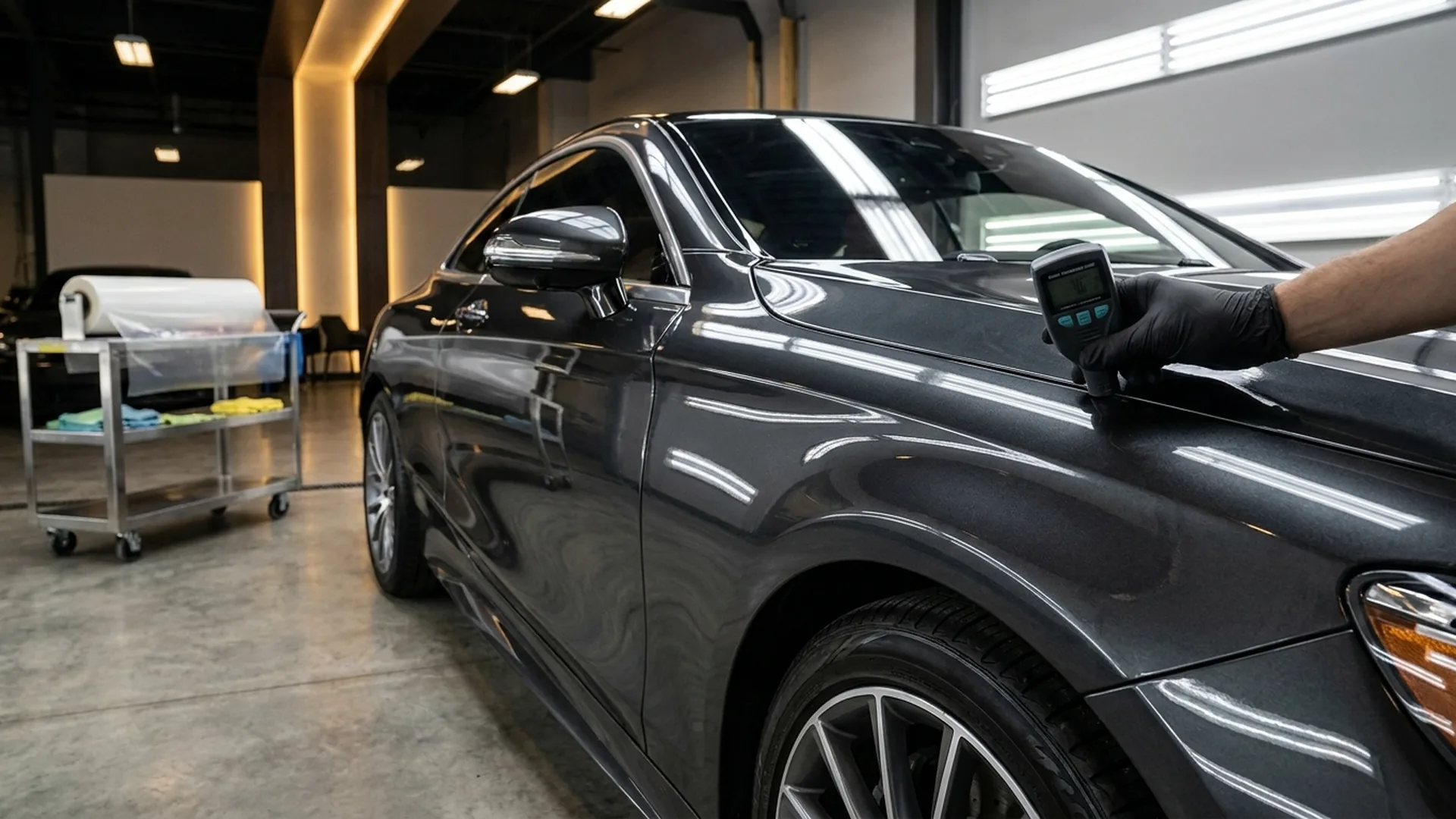
Before film: No waitThe dents were worked back from behind the panel with rods, or lifted from the front with glue tabs. Nothing was filled, nothing was sanded, nothing was sprayed, and the paint on your car is the paint that left the factory.
No coating was applied, so there is no solvent leaving a film and no crosslinking in progress. The surface being filmed or coated is the same fully-cured factory finish that was on the car before the storm. No published source states this conclusion outright — it follows from the fact that the cure has no mechanism by which to apply.
What to ask the body shop: Confirm the repair order says PDR with no refinish on the panels you want protected — and check whether any panel needed a blend or touch-up, because that spot is refinished paint.
The mixed case is the one we see most, and it is where the standard advice costs the most. Picture the car that actually arrives: a Taycan with a dimpled roof the PDR technician saved and a hood the adjuster wrote off to refinish. The roof and doors are ready immediately; the hood is not. Holding the whole car to the hood's schedule loses you the season for no technical reason — and while a stripped panel is bare is also the cheapest moment for any correction work the surrounding panels turn out to need. Which panels came off the film in the first place is a related question — which panels have to be stripped for the dent work depends on the repair method rather than on the film itself.
Paint Manufacturers Already Publish This Number. It Is Called Time to Decal
Here is the thing nobody in the detailing industry seems to cite. Paint manufacturers do publish a figure for how long to wait before applying an adhesive film to fresh clear coat. It is not called "PPF" — no paint data sheet mentions paint protection film or ceramic coating by name — but it describes precisely that operation, and it sits in the same cure table as every other milestone.
On Axalta's Cromax CC3100 Snap Dry clear coat, air drying at 75 °F: dust free in 10 to 15 minutes, ready to handle in an hour and a half to two hours, ready to deliver in fair weather at four hours. And time to decal: 72 hours. The car is deliverable at four hours and film-ready at seventy-two — eighteen times longer, from the same table.
It is product-specific, which is exactly why 3M and Gtechniq both tell you to ask the paint supplier rather than publishing one universal figure. Axalta's ChromaClear G2-4500S lists 24 to 48 hours. Its Challenger CH3050 advises applying decals "after 7 days or full cure to avoid decal blistering." So the honest range from the documents is roughly one to seven days, product depending — and none of them says thirty.
The Bake Gets the Car Out the Door. It Does Not Clear the Film
This is the part we had backwards ourselves until we read the sheets, and it is the opposite of what almost everyone assumes. Force drying in a downdraft booth — commonly around thirty minutes at 60 °C metal temperature — transforms the schedule. On that same CC3100 data sheet, the force-dry column collapses time to handle, time to polish and time to deliver into "after cool down."
Time to decal stays at 72 hours. Identical to air drying. Every other milestone accelerates and that one does not move. The pattern repeats on the G2-4500S sheet, where handle, polish and deliver all become "when cool" while time to decal holds at 24 to 48 hours.
Which reframes the question worth asking the body shop. "Was it baked?" is useful for understanding your car, and it is not an argument for filming it sooner. If a shop tells you the bake means the panel is ready for film, the data sheet for the product they sprayed disagrees with them — and that is a document you can ask to see.
Where "30 Days" Actually Comes From
Search this question and you get a figure within one sentence, repeated across installer blogs, forum threads and now AI-generated answers with the cadence of an industry standard. We went looking for the document behind it. The only manufacturer text we could find containing the figure is 3M's PPF FAQ — and it does not say what it is quoted as saying. Whether that is the origin of the rule or merely its most-cited instance, we cannot establish.
3M's paint protection film FAQ asks how long to wait before applying film to a repainted vehicle, and answers: "Follow the paint supplier's recommendations. Most installers wait at least 30 days to minimize risk." Read it carefully. 3M defers to the paint manufacturer, then reports what installers do. It is an observation about industry practice, not a specification — and for years it has been cited as though it were the latter.
The others publish nothing on the subject. XPEL's FAQ contains no fresh-paint guidance. STEK publishes no cure interval. SunTek's consumer FAQ does not address repainted paint. This is the same pattern we ran into when we looked at why the film makers hand this question back to the paint supplier for touch-up work too. The convention is not harmful and the principle underneath it is real. But convention and specification are different things, and the authority everyone is deferring to — the paint supplier — turns out to publish numbers far shorter than the convention built on top of them.
Four Film Brands, Four Different Answers on Repainted Paint
The timing question gets all the attention, and for a hail-repaired car the warranty question may matter more. There is no industry position here — the four major brands genuinely disagree, and which film your installer sells decides which answer applies to you.
| Film brand | Position on repainted panels | What that means for you |
|---|---|---|
| SunTek / LLumar (both Eastman) | Warranted only for fully cured OEM paint; warranty automatically void if installed over repainted or aftermarket painted surfaces | Permanent. No waiting period restores coverage on that panel |
| STEK | Does not void, but disclaims all liability for peeling, chipping or paint defects resulting from film removal on repainted or compromised paint | Coverage survives; removal damage is your risk |
| XPEL | No repainted-paint exclusion among the numbered exclusions in the current warranty documents | The most permissive of the four on this specific point |
| 3M | Substrate listed as OEM paint; warranty coverage excludes paint pull during the film removal process | Removal risk explicitly carved out |
"The Products are intended and warranted for use only on fully cured OEM (original equipment manufacturer) vehicle painted surfaces. This warranty is automatically void if installed over repainted, aftermarket painted or vinyl surfaces."
SunTek — paint protection film consolidated warranty (identical wording in LLumar's)
"STEK disclaims all liability for any damage, including but not limited to peeling, chipping, or other paint defects, resulting from the removal of Paint Protection Film (PPF) on vehicles with repainted, weak, deteriorated, or otherwise compromised paint surfaces."
STEK — paint protection film warranty
Neither is a cure time and neither is installation guidance. What they establish is that a repainted panel is a different commercial proposition from a factory one — which is an argument for having this conversation before the film goes on rather than after.
Ceramic Coating: Shorter, and One Manufacturer Actually Answers
The two products get quoted the same waiting period constantly and they should not be. A cured coating measured in microns rather than mils sits about a micron thick against roughly 150 to 200 microns — six to eight mil — of adhesive-backed urethane, so the physical case for a shorter wait is easy to make.
Gtechniq is the only coating maker we found publishing a direct answer: its coatings "are gas permeable and therefore do not prevent paint from out-gassing solvents," with a recommendation of at least 72 hours between painting and coating, and advice to consult the body shop. One caveat belongs with that, because we would want it flagged if the position were ours: Gtechniq publishes no permeation data, and the nearest peer-reviewed analogue — measurements of polysilazane-derived films as strong gas barriers — points the other way. Different cure route, different substrate, so it does not refute the claim. It does mean the claim is unpublished rather than demonstrated.
The rest are quieter than the internet suggests. Ceramic Pro and System X publish only their own coating's cure time, not fresh-paint guidance, and the frequently repeated "CarPro says one to seven days" traces to a 2014 forum post rather than a CarPro document. Keep two clocks separate as well, because they get muddled constantly: how soon after a repaint you can coat, and how long the coating itself then needs before the car meets weather. That second one is its own subject, and the late-August deadline a coating cure runs against is the part that bites in this city.
Why Calgary Changes the Arithmetic
Every figure above assumes the paint actually cured. PPG's cold-weather guidance says that as temperatures drop "the curing process slows down and can even stop when temperatures drop below 60°F in your shop," and warns that the result is a finish which "may eventually dry, but will exhibit reduced durability, gloss, and repairability."
Sixty Fahrenheit is 15.6 °C — and note that it is a shop temperature, not an outdoor one. That distinction is the whole point, because it means the month printed on your invoice tells you almost nothing. Hail season peaks through the summer, shops run a backlog behind every major storm, and repairs routinely finish in October, November and December, when Calgary's monthly means have fallen to around 4 °C and then well below freezing. A panel air-dried in an unheated or intermittently heated bay across that window — a body shop working overflow out of a leased unit in a northeast industrial park in November, say — may not be on the schedule its data sheet assumes at all. So the question worth asking is what temperature the panel cured at, not what month it was.
The scale of this is what makes it a Calgary article rather than a general one. The Insurance Bureau of Canada, citing CatIQ, put the 5 August 2024 Calgary hailstorm at $3.25 billion in insured damage as of February 2025 — one of the costliest insured events in Canadian history — with vehicle damage near $1 billion and auto claims making up more than half of all claims. About 70,000 of them were vehicles. Zoom out and Alberta hailstorms have caused more than $10 billion in insured damage over two decades, $5.5 billion of that in the past five years alone. A very large number of cars in this city carry at least one refinished panel, which makes "was this ever repainted?" a live question here rather than an edge case — and it is why which coverage responds when film is damaged in Alberta is worth knowing before the next storm rather than after it.
What We Would Do With Your Car
Read the repair order first, panel by panel. That splits the car into two groups on two different schedules, and there is no reason to treat them as one. If it was pure rod work that leaves your factory paint untouched, there is nothing to wait for and we will say so.
For anything refinished: get the clear coat product name from the painter, work to that data sheet rather than to a number off a blog, and ask what temperature the panel cured at. Then protect the untouched and PDR panels now and book the refinished ones behind them.
One correction on why a repaired panel is worth protecting, because the usual reason given is wrong. Refinish clear is not thinner than factory clear — PPG's own data sheet specifies 50 to 60 microns of dry film, comparable to or thicker than a typical factory layer. The genuinely vulnerable part is the blend edge, where the clear is deliberately thinned, and BASF declines to warrant it in writing: it "will not warrant the blended edges of clearcoats." That, plus the fact that you have already paid for the panel once through a deductible, is the honest case for the film that ends up carrying a refinished panel rather than merely tolerating it.
Bring the Repair Order With You
Send us the panel breakdown from your hail claim and we will tell you plainly which panels can be protected this week and which have to wait — and we will say so even when the answer books you later than you hoped. Call (587) 323-3222 or send the estimate over. 4.9 stars across 705+ Calgary reviews, 10,000+ vehicles protected.
Get a Post-Repair Protection PlanData sheet and warranty language is quoted from the manufacturers' published documents as cited below and can change without notice — check the current version before relying on it. Cure timing for any specific panel is governed by the data sheet for the clear coat your body shop actually sprayed and the conditions it cured in, not by a general article. Where those two disagree, the data sheet wins.
Ready to Protect Your Vehicle from Rock Chips?
Join 705+ Calgary drivers who trust Obsidian Auto for PPF installation
Serving Calgary and surrounding areas • Free Uber shuttle with every service
Frequently Asked Questions
Sources
External references used in this guide
- Axalta Cromax CC3100 Snap Dry Clearcoat — technical data sheet. Air dry and force dry columns both list 'Time to Decal: 72 hours', while force dry collapses time to handle, polish and deliver to 'after cool down'
- Axalta Cromax ChromaClear G2-4500S — technical data sheet. Time to decal 24–48 hours, unchanged between air dry and force dry
- Axalta Challenger CH3050 2K Overall Clearcoat — product page, application instructions. 'Applying decals best after 7 days or full cure to avoid decal blistering'
- 3M — Paint Protection Film FAQ (January 2023). 'How long to wait before applying paint protection film on a repainted vehicle? Follow the paint supplier's recommendations. Most installers wait at least 30 days to minimize risk.' Also gives 16–30 °C recommended ambient installation conditions
- 3M — Paint Protection Film warranty information card. 'Warranty coverage does not include paint pull during film removal process'
- SunTek — Paint Protection Film consolidated warranty. Products 'intended and warranted for use only on fully cured OEM ... painted surfaces'; warranty 'automatically void if installed over repainted, aftermarket painted or vinyl surfaces'. LLumar's PPF warranty carries identical language (both Eastman brands)
- STEK — Paint Protection Film (DYNO series) warranty. Disclaims all liability for peeling, chipping or other paint defects resulting from PPF removal on vehicles with repainted, weak, deteriorated or otherwise compromised paint surfaces
- XPEL — Warranty Information. Read in full for a repainted-paint exclusion; none appears among the numbered exclusions. The nearest adjacent clause excludes 'areas that have not been re-wrapped after a paint or body repair'
- PPG Refinish — Cold weather clearcoat curing tips. 'As temperatures drop, the curing process slows down and can even stop when temperatures drop below 60°F in your shop'
- PPG Deltron D8173 Premium UHS Clearcoat — technical data sheet. 50–60 micron dry film build; product 'can feel soft to the touch and may finger print up to 1 hour after bake ... finger prints or even masking tape marks will disappear'
- Gtechniq — FAQ, 'If my car has been repainted, how long do I need to wait before applying your coatings?' Coatings described as gas permeable, with a recommendation of at least 72 hours between painting and coating
- BASF Automotive Refinish — Fundamental Automobile Refinishing Concepts. 'In all cases, the entire panel must be clearcoated'; BASF 'will not warrant the blended edges of clearcoats'
- Insurance Bureau of Canada — Cost of historic Calgary hailstorm continues to rise (11 February 2025). Revised to $3.25 billion; vehicle damage near $1 billion; auto claims more than half of all claims
- Insurance Bureau of Canada — One year later, Calgary's historic hailstorm underscores urgent need for government action (5 August 2025). About 70,000 vehicle claims; Alberta hailstorms over $10 billion in two decades, $5.5 billion of it in the past five years
- Zheng et al., Materials 14(22):7000 (2021) — polysilazane-derived films measured as high oxygen-barrier layers. Cited as the nearest peer-reviewed analogue to the coating-permeability question, not as a refutation: different cure route and substrate
Ready to Protect Your Vehicle?
Get a quote from Calgary's most trusted detailing studio. We use only the best materials and back our work with industry-leading warranties.
Get A QuoteRelated Intelligence
Can You Put PPF Over Existing Rock Chips? A Calgary Guide
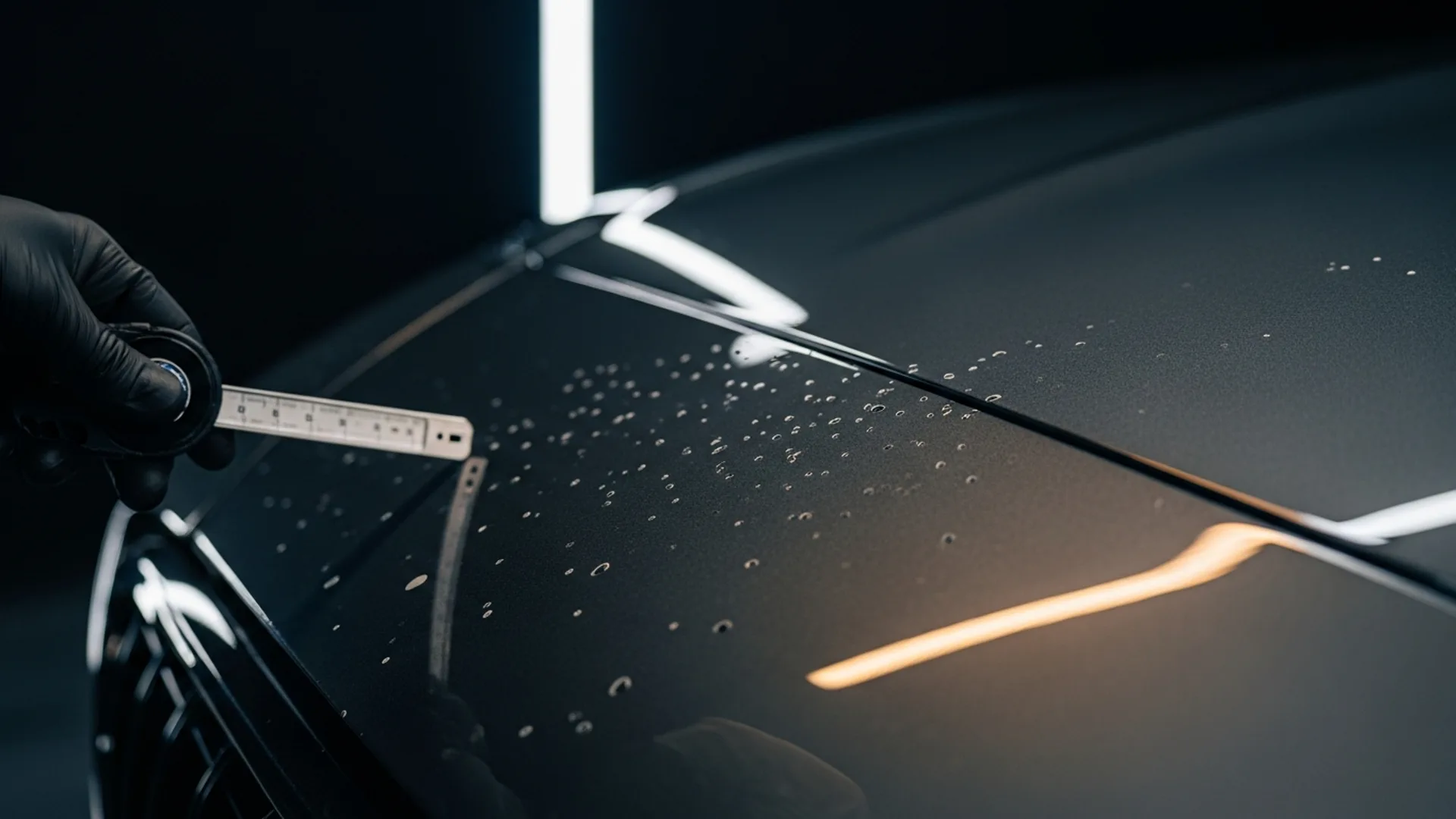
Every PPF guide assumes a car that came off the truck last week. Most Calgary film work goes on a three-year-old car with a chipped nose. The depth rule that decides whether a chip gets filmed or filled, why no manufacturer publishes the touch-up cure time everyone quotes, the 8 microns of clear coat that limit what correction is even possible, and why film can make a chip look worse.
Hail Dents Under PPF: Does the Film Come Off for PDR?
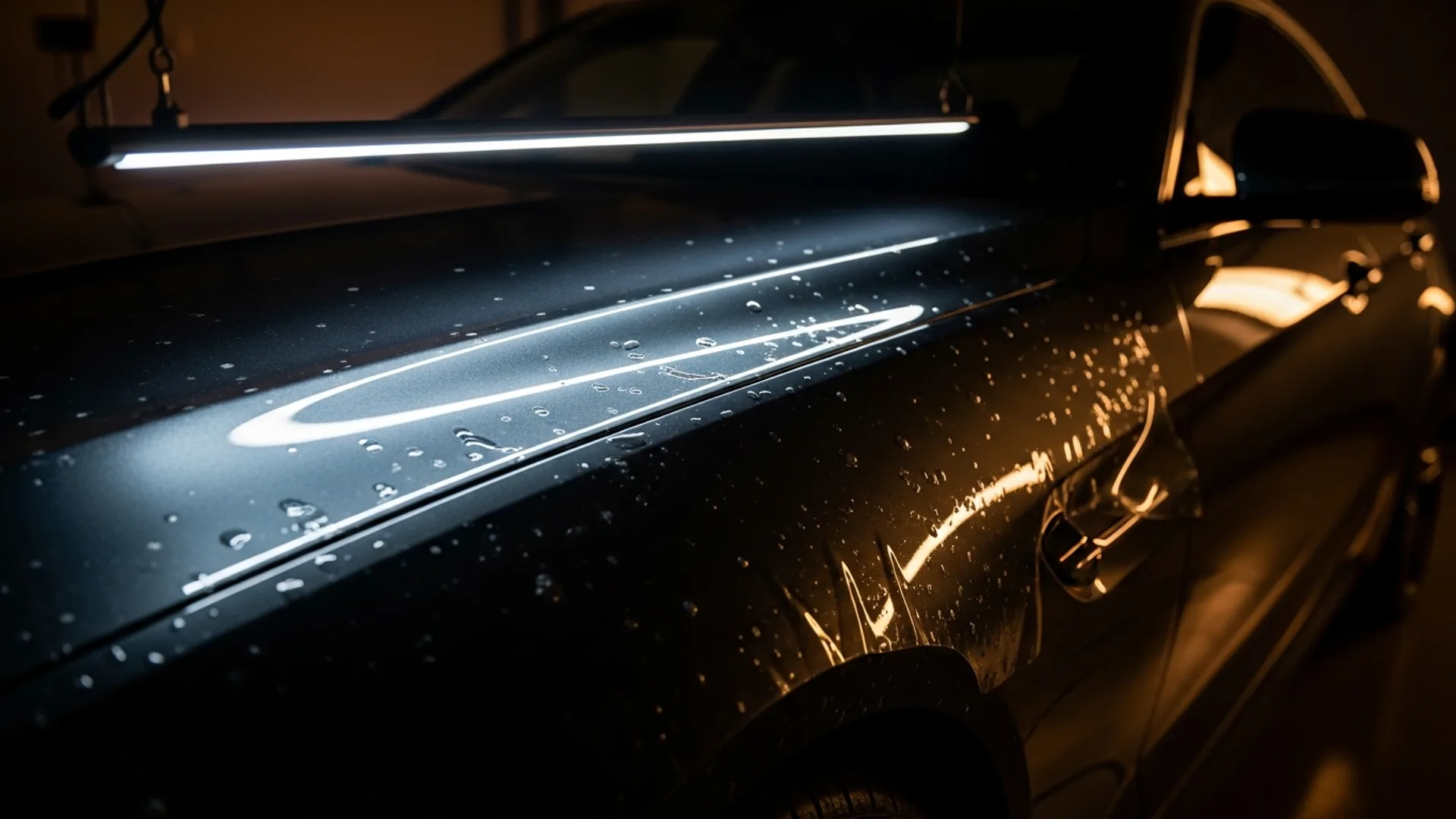
The question no page answers properly: on a wrapped car, does the film have to come off before the dents get pushed out? It depends on the PDR method, not the film — rod work from behind leaves film untouched, while glue-pull tabs grip clear coat far more predictably than film. Plus why film can never be re-laid once removed, and the line item that should be its own line on the estimate.
Why Tesla & EV Paint Chips So Easily in Calgary
New Teslas and EVs collect white rock chips within days of delivery — and it isn't bad luck. Their factory paint measures thinner and softer than German luxury marques, their flat front ends face highway gravel head-on, and Calgary's ring roads do the rest. The real paint-thickness numbers, why ceramic coating won't stop chips, and how PPF actually does.