
Windshield Rock Chips: What Alberta's Glass Endorsement Deletes
Quick answer: Alberta's approved auto policy covers a stone strike on your windshield. An approved endorsement can take it back out. SPF No. 1 deems "missiles, falling or flying objects" to be covered perils under Comprehensive, but where AB-S.E.F. No. 13(D) is attached, glass leaves Comprehensive unless the damage came from one of fourteen listed causes.
Key Takeaways
- Alberta's approved auto policy covers a stone strike on your windshield. An approved endorsement can take it back out. SPF No. 1 deems "missiles, falling or flying objects" to be covered perils under Comprehensive, but where AB-S.E.F. No. 13(D) is attached, glass leaves Comprehensive unless the damage came from one of fourteen listed causes.
- Read the fourteen and the omission is hard to miss: hail is on the list, earthquake is on the list, the forced landing of an aircraft is on the list, and the falling or flying object is not. The endorsement keeps the rarer perils and drops the one that actually breaks windshields in this province.
- The list is not bespoke. Set beside Subsection 4 of the same policy, the endorsement's fourteen causes are Specified Perils — the cheapest physical-damage tier Alberta sells — plus vandalism to windows other than the front window, plus two causes added in 2022. It quietly demotes your glass while the rest of the car stays on Comprehensive.
- Both editions are still public on alberta.ca, so the revision is visible. The superseded S.E.F. No. 13d lists twelve causes; the current AB-S.E.F. No. 13(D), footed (06/2022), lists fourteen. The two additions are a wildlife strike and another car hitting yours while it is parked. The drafters widened the list and still did not add the stone.
- The endorsement operates only on Subsection 3. Its words are "shall not be liable under Subsection 3 - Comprehensive of Section C". SPF No. 1 separately sells Subsection 1 - All Perils, and no document we read addresses how the two interact, so we are not going to tell you. It also carries a blank for item numbers, meaning on a multi-car policy it can sit on one vehicle and not another.
- We are not telling you how common this endorsement is, because nobody publishes take-up rates for it and we have not measured any. The useful instruction is narrower and free: look at your own Certificate of Automobile Insurance and see whether AB-S.E.F. No. 13(D) is named on it, and against which vehicle.
- Even with no glass limitation at all, the Deductible Clause reshapes chip damage. It provides that each occurrence "shall give rise to a separate claim" with the deductible applied to each. Three stones picked up on three separate drives are plainly three occurrences with three deductibles, which is why small glass damage is so often self-funded whatever your policy says. A hailstorm is where people assume the opposite — one event, one deductible — but the policy uses the word occurrence without ever defining it, so that is a question for the adjuster rather than something the approved wording settles.
- Alberta maintains two inspection standards for the same defect and they sit one millimetre apart. The Automotive & Light Truck manual rejects "cracks, or blemishes more than 12 mm (1/2 in) in diameter in the area swept by the wipers"; the Commercial manual rejects "a chip that is larger than 13 mm in diameter". Neither is a repair-versus-replace rule and neither is an insurance threshold.
- Calgary manufactures this exact damage. Below -15C with colder temperatures forecast, the City says it uses a sanding chip mixture it calls Pickle - 3 per cent salt, 97 per cent gravel - plus liquid calcium chloride. Separately, it applies roughly 40,000 to 50,000 tonnes of road salts a year. Those are the City's figures for what it spreads, not a measure of what is on the road at any moment, and no document publishes a rate at which windshields accumulate chips.
The short answer
Alberta's approved auto policy covers a stone strike on your windshield, and an approved endorsement can take it back out. S.P.F. No. 1 deems “missiles, falling or flying objects” to be covered perils under Comprehensive. But where AB-S.E.F. No. 13(D) is attached, glass leaves Comprehensive unless the damage was caused by one of fourteen listed causes — and a stone is not one of them, while hail is. Which means the question cannot be answered from the province. It is answered on your Certificate of Automobile Insurance.
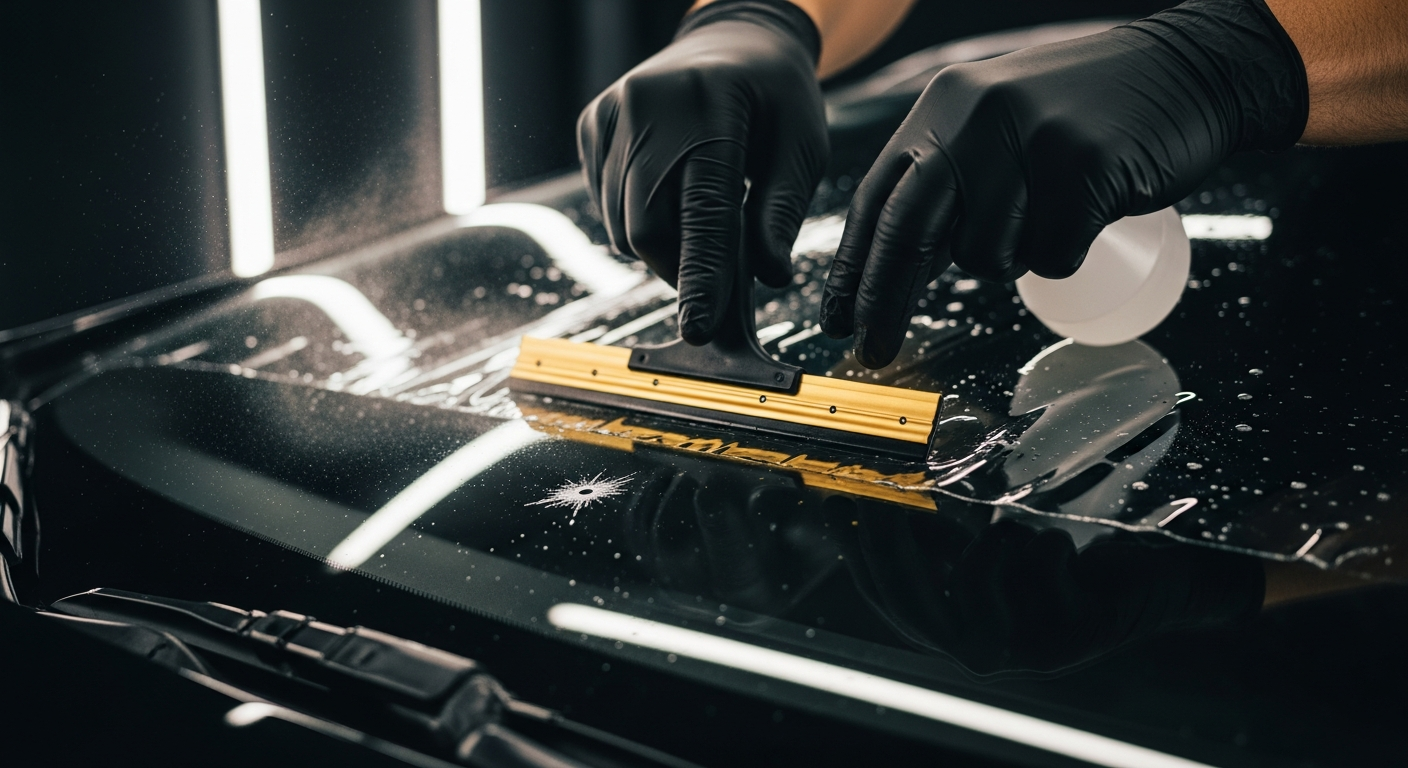
A stone comes off the truck ahead of you somewhere on Stoney Trail in February, and there is a sound like a knuckle on a window. By the time you are parked there is a star in the glass the size of a shirt button, sitting just high enough to be in your eyeline. The question every Calgary driver asks next is whether this is an insurance problem or a wallet problem, and the answers available to them are remarkably poor: American blogs about states that legislate free glass repair, brokers describing what “most policies” do, and a great deal of confident advice from people who have never opened the form.
The form is free. Alberta does not leave auto policy wording to the market. The Superintendent of Insurance approves the standard policy and every endorsement, each form is footed with that approval, and all of them are published as PDFs anybody can download. That is why this article can quote the words themselves rather than describe what policies generally say. On 14 September 2026 we read six of those documents end to end: the policy, both editions of the glass endorsement, both of the province's vehicle inspection manuals, and the Vehicle Equipment Regulation. What they describe is not a vague grey area. It is a very specific piece of drafting, and once you have seen it you cannot unsee it.
The base policy already names the thing that breaks your windshield
Comprehensive cover in Alberta is defined in Section C, Subsection 3 of the Standard Owner's Automobile Policy as cover “from any peril other than by collision with another object or by upset”. That is broad on its own, and the policy then goes further. It lists a set of causes that “shall be deemed loss or damage caused by perils for which insurance is provided under this subsection 3”, and among them sits the phrase that settles the argument: “missiles, falling or flying objects”.
A stone thrown up by a passing truck is a flying object in the plain sense of the words, and the drafters put the phrase there so that nobody would need to litigate it. This is worth stating clearly because the folklore runs the other way. The baseline position in this province is not that windshield damage is an awkward exclusion an owner has to fight about. On the approved form, with Comprehensive purchased and nothing else attached, a rock chip is inside the coverage. Everything interesting happens because of a separate document.
Fourteen listed causes, and a stone is not one of them
Alberta approves an endorsement called AB-S.E.F. No. 13(D), the Limitation of Glass Coverage Endorsement. It is one page. Its operative sentence reads: “The Insurer shall not be liable under Subsection 3 - Comprehensive of Section C - Loss of or Damage to Insured Automobile for loss or damage to glass unless such loss or damage is caused by:” — and then it enumerates. The list is closed, and it is short enough to reproduce in full:
AB-S.E.F. No. 13(D) — the complete list
- impact with a live undomesticated animal
- another automobile striking the described automobile when the described automobile is not in use or operation
- fire
- lightning
- theft or attempted theft
- windstorm
- earthquake
- hail
- explosion
- riot or civil commotion
- falling or forced landing of aircraft or parts thereof
- rising water
- the stranding, sinking, burning, derailment or collision of any conveyance in or upon which the automobile is being transported on land or water
- vandalism to windows other than the front window
Read it once for what is there and the list looks generous. Read it again for what is missing and the shape of the thing appears. Hail is covered. Earthquake is covered. The forced landing of an aircraft is covered, and so is the derailment of the train your car was riding on. The phrase the base policy went out of its way to include — missiles, falling or flying objects — is the one that does not come across. In the province where a stone off a gravel-treated highway is the ordinary way a windshield gets damaged, that is the single cause the endorsement does not carry.
One item in that list deserves separate attention, because it cuts the other way from how people usually read a vandalism clause. The fourteenth item preserves cover for “vandalism to windows other than the front window”. So where the endorsement is attached, your side glass is still protected from a vandal and your windshield, specifically, is not — even though base Comprehensive deems malicious mischief a covered peril for the whole car.
The seven clauses, quoted from the source
Select a clause to read it as the form publishes it. Three of the seven come from the policy itself. Every quotation below was read from the source itself on 14 September 2026, not from a summary of it.
Comprehensive already names the thing that breaks your windshield
"Loss or damage caused by an object, including another automobile, striking the automobile when the automobile is not in use or operation, missiles, falling or flying objects, fire, theft, explosion, earthquake, windstorm, hail, rising water, malicious mischief, riot or civil commotion shall be deemed loss or damage caused by perils for which insurance is provided under this subsection 3"
What it means. Start here, because almost every argument about Alberta windshield coverage skips it. Comprehensive is defined broadly, as cover "from any peril other than by collision with another object or by upset", and then the policy goes further and names specific things it deems to be covered perils. Among them are "missiles, falling or flying objects". A stone thrown up by the truck in front of you on Stoney Trail is a flying object in the ordinary sense of those words, and the drafters put the phrase in the policy precisely so nobody would have to argue about it. So the baseline position in Alberta is not that windshield damage is some awkward edge case. On the standard approved form, with Comprehensive purchased and nothing else attached, it is squarely inside the coverage.
Do this: Before you assume anything about your own glass, find out whether you actually carry Comprehensive. It is optional, and a policy without it was never going to respond to a stone in the first place.
Fourteen listed causes, and a stone is not one of them
"The Insurer shall not be liable under Subsection 3 - Comprehensive of Section C - Loss of or Damage to Insured Automobile for loss or damage to glass unless such loss or damage is caused by:"
What it means. This is an approved Alberta form that does one job. Where it is attached to a policy, glass comes out of Comprehensive unless the damage was caused by something on its list, and the list is closed — the endorsement says "unless such loss or damage is caused by" and then enumerates. Read the fourteen and the omission is conspicuous. Hail is there. Earthquake is there. So is the falling or forced landing of aircraft, and so is the stranding, sinking, burning, derailment or collision of a conveyance transporting your car. What is not there is the phrase the base policy went out of its way to include: missiles, falling or flying objects. The single most ordinary way a windshield gets damaged in this province is the one cause the endorsement does not carry across.
Do this: Read your Certificate of Automobile Insurance and look for AB-S.E.F. No. 13(D) by name. The endorsement also has a blank for item numbers, so on a multi-vehicle policy it can sit on one car and not another.
The list is Specified Perils wearing a different name
"caused by fire, lightning, theft or attempt thereat, windstorm, earthquake, hail, explosion, riot or civil commotion, falling or forced landing of aircraft or of parts thereof, rising water, or the stranding, sinking, burning, derailment or collision of any conveyance in or upon which the automobile is being transported on land or water"
What it means. Put the endorsement's list beside Subsection 4 of the same policy and the drafting becomes legible. Subsection 4 is the cheapest tier of physical damage cover Alberta sells, and it names eleven causes. The endorsement's fourteen are those same eleven, plus vandalism to windows other than the front window, plus the two added in 2022. The endorsement is not inventing a bespoke standard for glass; it is reusing one that already existed elsewhere in the same policy.
They revised it, added two causes, and a stone still did not make the list
"In addition, the insurer shall be liable for loss or damage caused by vandalism to windows other than the front window."
What it means. Both editions are live on the province's own site, which lets you see what changed. The superseded form lists twelve causes. The current one lists fourteen. The two additions are impact with a live undomesticated animal, and another automobile striking your car while it is not in use or operation — both of which the base Comprehensive wording already handles — the automobile strike sits in the deeming sentence, and the animal is dealt with by a definition excluding a live undomesticated animal from the words "another object". The 2022 revision brought both across so that glass keeps them too. That is the detail worth sitting with. Somebody went through this endorsement, decided its list was too narrow, widened it, and still did not add the falling or flying object. Whatever the omission is, after 2022 it is difficult to describe it as an oversight nobody had looked at.
The policy counts occurrences, not windshields
"Each occurrence causing loss or damage covered under any subsection of Section C except loss or damage caused by fire or lightning or theft of the entire automobile covered by such subsection, shall give rise to a separate claim in respect of which the Insurer's liability shall be limited to the amount of loss or damage in excess of the amount deductible, if any, stated in the applicable subsection..."
What it means. This clause matters even on a policy with no glass limitation at all, and it is the reason chip damage behaves so differently from hail. A storm is ordinarily treated as one occurrence: the whole car is damaged in a single event and a single deductible applies to it. Three stones picked up on three different drives are plainly three occurrences, and the clause says each gives rise to a separate claim with the deductible applied to each. That is arithmetic most owners never do. One caution on the storm half of this: the policy uses the word occurrence without ever defining it, so the single-event treatment is ordinary practice rather than something the wording settles. It means the economics of glass damage are driven by how the damage arrives rather than by how much of it there is, and it is why a car can accumulate real damage without any of it ever reaching the point where claiming makes sense.
Do this: Compare your Comprehensive deductible against what a single chip actually costs to deal with. For a lot of Calgary drivers the answer is that small glass damage was always going to be self-funded, endorsement or no endorsement.
The passenger standard measures blemishes, and it stops at 12 mm
"The windshield has cracks, or blemishes more than 12 mm (1/2 in) in diameter in the area swept by the wipers, excluding the area under the inside mirror and a strip 75 mm (3 in) in the upper and lower parts of the windshield."
What it means. This is the standard that applies to ordinary cars and light trucks when an Alberta inspection is required. Three things in it are worth noticing. It measures in the area swept by the wipers, so location does as much work as size. It carves out the patch under the interior mirror and a 75 mm band at the top and bottom, which is where a great many chips actually land. And it uses the word blemishes rather than chips — machine-checked, the word chip does not appear in this manual at all, so a chip is being judged under a heading that never names it. Note also item 4.1c, which rejects a windshield where "A crack through both layers exists", a reminder that the glass in front of you is two sheets with a plastic interlayer rather than one pane. That is not incidental: Alberta's Vehicle Equipment Regulation requires it at s.71(4), "A windshield must be made of laminated safety glass."
The commercial standard measures chips, and it stops at 13 mm
"c) a chip that is larger than 13 mm in diameter within the area swept by OEM windshield wipers"
What it means. Alberta's commercial manual gives the chip its own line, sets it at 13 mm, and handles cracks separately: a reject if "a crack extends through both layers of glass" or if "a crack of any length extends more than 50 mm within the area swept by OEM windshield wipers". It even prints worked examples, including a pass condition for a star chip larger than 13 mm sitting outside the wiper sweep. So the province maintains two inspection standards for the same defect on the same highways and they land one millimetre apart, one measuring blemishes and the other measuring chips. Neither number is a repair-versus-replace rule and neither is an insurance threshold. They answer a different question entirely: whether this windshield passes when somebody is required to inspect it.
Do this: If you are told a chip is "too big to repair", ask what standard that is being measured against. It is not either of these, because neither manual speaks to repairability at all.
The list is Specified Perils wearing a different name
The fourteen causes are not a bespoke standard somebody wrote to describe glass risk. Put them beside Subsection 4 of the same policy — Specified Perils, the cheapest tier of physical damage cover Alberta sells — and they line up almost exactly. Specified Perils names eleven causes. The endorsement is those same eleven, plus the vandalism carve-out, plus two more added in 2022.
That is the clearest way to describe what the endorsement actually does. It does not invent a special regime for windows. It quietly moves your glass down from Comprehensive to something very close to Specified Perils while the rest of the car stays where it was. Specified Perils is built around discrete catastrophic events rather than the ordinary attrition of driving, which is exactly why hail survives the transition and the stone does not. We should be careful not to overreach here: no document in this set explains the drafting, so this is an account of where the words came from rather than a claim about anyone's intentions.
They revised it in 2022, and the stone still did not make the list
Alberta publishes the superseded edition of this endorsement next to the current one, which makes the revision visible. The older S.E.F. No. 13d — headed “COMPREHENSIVE COVER - LIMITED GLASS (FOR ALTA., NUNAVUT, N.W.T. AND YUKON)” — lists twelve causes. The current form, footed (06/2022), lists fourteen. The two additions are impact with a live undomesticated animal, and another automobile striking your car while it is not in use or operation.
Both were already handled by the base Comprehensive wording, and the revision brought them across so that glass would keep them as well. Which is to say the list was deliberately widened. That is what makes the omission worth dwelling on. Somebody opened this endorsement, concluded its list was too narrow, widened it by two, and did not add the falling or flying object. After 2022 it is difficult to characterise the gap as something nobody had got around to looking at.
Each chip is its own claim
There is a clause in the policy that reshapes glass damage even for drivers with no glass limitation at all, and almost nobody does the arithmetic on it. The Deductible Clause provides that each occurrence “shall give rise to a separate claim in respect of which the Insurer's liability shall be limited to the amount of loss or damage in excess of the amount deductible, if any, stated in the applicable subsection”.
A storm is ordinarily treated as a single occurrence: however many panels and however much glass it damages, it happened once, and one deductible applies. The policy never defines the word occurrence, so that treatment is ordinary practice rather than something the text settles. Three stones picked up on three different drives across a winter are three occurrences, and each is a separate claim with the deductible applied to each. This is why chip damage behaves so unlike every other kind of damage a Calgary car accumulates: the economics are driven by how the damage arrives rather than by how much of it there is. For a great many owners it means small glass damage was always going to be self-funded, endorsement or no endorsement — which is a different and more useful thing to know than whether you are technically covered. The same single-event logic is why hail, the common Calgary peril the endorsement does keep on its list, sits in a completely different financial category from the gravel that hits you all winter.
Alberta's two inspection manuals disagree by one millimetre
Separately from insurance, the province publishes standards for when a windshield is bad enough to fail an inspection — and it publishes two of them, which do not agree. The Automotive & Light Truck Vehicle Inspection Manual, the one covering cars and light trucks, rejects a windshield with “cracks, or blemishes more than 12 mm (1/2 in) in diameter in the area swept by the wipers, excluding the area under the inside mirror and a strip 75 mm (3 in) in the upper and lower parts of the windshield”. The Commercial Vehicle Inspection Manual rejects “a chip that is larger than 13 mm in diameter within the area swept by OEM windshield wipers”.
| Passenger & light truck | Commercial (NSC Standard 11) | |
|---|---|---|
| What it measures | Cracks, or blemishes | Chips and cracks, separately |
| Size limit in the wiper sweep | More than 12 mm (1/2 in) | Larger than 13 mm |
| Area carve-outs | Under the mirror; 75 mm top and bottom strips | Outside the OEM wiper sweep passes |
| Crack rule | A crack through both layers | Through both layers, or over 50 mm in the sweep |
| Is it an insurance threshold? | No | No |
Two things to take from this rather than one. The obvious one is that the province maintains two standards for the same defect on the same highways, one millimetre apart, one measuring “blemishes” and the other measuring “chips” — and machine-checked, the word chip does not appear anywhere in the passenger manual. The more useful one is that both measure inside the area swept by the wipers, so where the damage sits does as much work as how big it is. A substantial chip out at the edge of the glass can pass a standard that a smaller one directly in front of the driver fails.
Neither figure is a repair-versus-replace rule, and neither is an insurance threshold. They answer only whether a windshield passes when somebody is required to inspect it, which for an ordinary registered passenger car in Alberta is not a routine annual event. It is worth being precise about this because millimetre figures travel badly. The ones published by lease-end lenders are a different domain again: as we found reading six lenders each drawing the glass line at a different millimetre, those are contractual wear-and-tear standards set by whoever financed the car, not Alberta inspection criteria, and the two sets of numbers should never be read as one scale.
Calgary manufactures this exact damage
The City is unusually open about what it puts on the road. Between 0 and -14 degrees Celsius it uses rock salt and salt brines. Below -15 degrees with colder weather forecast, it switches to what it calls Pickle — a sanding chip mixture that is 3 per cent salt and 97 per cent gravel — together with liquid calcium chloride. Separately, and across the whole season rather than that temperature band, it applies roughly 40,000 to 50,000 tonnes of road salts a year.
Ninety-seven per cent gravel is the number to sit with, and it is worth being precise about what it describes: it is the composition of the mixture described above, not a description of the road surface once that mixture is down. What it establishes is simply that Calgary's cold-weather answer to ice is to put loose stone on the road on purpose. That is the mechanism behind the endorsement's omission mattering here more than it would almost anywhere else: the cause the form declines to carry across is the cause this city generates industrially. We are not going to put a rate on it. No document publishes how quickly a windshield accumulates chips and we have not measured one.
What to actually do
Find your Certificate of Automobile Insurance, not the policy booklet, and look for AB-S.E.F. No. 13(D) or the older S.E.F. No. 13d by form number. The booklet is the standard wording everybody receives; the certificate records what was sold to you. Check it per vehicle rather than per policy, because the endorsement contains a blank reading “this endorsement applies only to the automobile(s) described under item(s) number” — on a household with a daily driver and a weekend car, the two can sit on different footings.
Two limits on what we have told you, both of which matter. The endorsement operates on Subsection 3 by its own words, and SPF No. 1 separately sells Subsection 1 - All Perils; no document we read addresses how the two interact, so we are not going to guess on your behalf. And Comprehensive is optional to begin with, so a policy that never carried it was never going to respond to a stone regardless of any endorsement. Both are questions for the party that will actually pay or decline the claim, and both are better asked before the next stone than after it.
Then, separately, decide what to do about the glass itself. If your windshield sits outside Comprehensive, the cost of the next one is entirely yours, and that changes the arithmetic on prevention far more than anything we could say about the product. That is the honest case for the film that keeps the loss from happening in the first place — it does not alter a word of what an approved endorsement says, it does not repair glass that is already chipped, and it only addresses the impact. If you want the numbers behind a modern replacement before deciding, our guide to what a HUD-and-ADAS windshield actually costs to replace sets them out. And if it is the paintwork rather than the glass you were worried about, the same policy treats the two quite differently — we covered how the same policy treats the paint rather than the glass separately, and the conclusions do not transfer.
Ready to Protect Your Vehicle from Rock Chips?
Join 705+ Calgary drivers who trust Obsidian Auto for PPF installation
Serving Calgary and surrounding areas • Free Uber shuttle with every service
Frequently Asked Questions
Sources
External references used in this guide
- Government of Alberta — Alberta Standard Owner's Automobile Policy, S.P.F. No. 1 (PDF), the current edition, every page footed "Approved form: Alberta Superintendent of Insurance - Effective: January 1, 2022". Source of the Comprehensive wording quoted here, including the deeming sentence naming "missiles, falling or flying objects"; of the Subsection 4 - Specified Perils list used to show where the endorsement's causes came from; and of the Deductible Clause providing that each occurrence "shall give rise to a separate claim". SCOPE NOTE: this is the approved standard wording. It records what the forms say, not which of them were sold on any particular policy — that is the Certificate of Automobile Insurance
- Government of Alberta — AB-S.E.F. No. 13(D), Limitation of Glass Coverage Endorsement (PDF), footed "(06/2022) APPROVED FORM - ALBERTA SUPERINTENDENT OF INSURANCE". The spine of this article and the source of the fourteen listed causes reproduced here in full, of the operative sentence limiting the Insurer's liability "under Subsection 3 - Comprehensive of Section C", and of the per-vehicle application blank "this endorsement applies only to the automobile(s) described under item(s) number". SCOPE NOTE: the endorsement addresses Subsection 3 only; SPF No. 1 separately sells Subsection 1 - All Perils, and no document read for this article addresses how the two interact
- Government of Alberta — S.E.F. No. 13d, "COMPREHENSIVE COVER - LIMITED GLASS (FOR ALTA., NUNAVUT, N.W.T. AND YUKON)" (PDF), the superseded edition, still published on alberta.ca alongside the current form. Source of the twelve-cause comparison that shows the 2022 revision added impact with a live undomesticated animal and another automobile striking the described automobile while it is not in use or operation. SCOPE NOTE: this file is a one-page image-only scan with no extractable text layer and is watermarked SAMPLE; it was read by rendering the page to an image. Where its wording differs trivially from the current form in ways typical of scanned text, this article relies on the current form
- Government of Alberta — Automotive & Light Truck Vehicle Inspection Manual, Version 1.0, December 2009 (PDF), Section 4 Glass. Source of the passenger standard quoted here, reject item 4.1b: "The windshield has cracks, or blemishes more than 12 mm (1/2 in) in diameter in the area swept by the wipers, excluding the area under the inside mirror and a strip 75 mm (3 in) in the upper and lower parts of the windshield", and of item 4.1c rejecting a windshield where "A crack through both layers exists". SCOPE NOTE: machine-verified, this manual contains zero occurrences of the word "chip" and zero occurrences of "13 mm" — the 13 mm figure belongs to the commercial manual and the two must not be merged. These are reject criteria applied when an inspection is required, not a periodic test of ordinary registered passenger cars
- Government of Alberta — Commercial Vehicle Inspection Manual, Version 2.0 (PDF), reproducing National Safety Code Standard 11, Maintenance and Periodic Inspection Standards, October 2014. Source of the commercial standard quoted here, reject item c) "a chip that is larger than 13 mm in diameter within the area swept by OEM windshield wipers", of the separate crack criteria "a crack extends through both layers of glass" and "a crack of any length extends more than 50 mm within the area swept by OEM windshield wipers", and of the printed pass and reject examples including a star chip larger than 13 mm sitting outside the wiper sweep. SCOPE NOTE: this manual governs commercial vehicles and is not the standard applied to a passenger car
- Alberta King's Printer — Vehicle Equipment Regulation, Alberta Regulation 122/2009, Office Consolidation, "With amendments up to and including Alberta Regulation 129/2025", current as of June 11, 2025. Cited here only for the glazing standards in s.71, specifically s.71(4), "A windshield must be made of laminated safety glass". SCOPE NOTE: this article takes no position on s.70, which concerns covering window glazing with transparent, translucent or opaque material — a separate question that is not about impact damage and is not addressed here
- The City of Calgary — snow, ice and salt: road salt management. Source of the only Calgary figures in this article: the City "only uses sodium chloride and calcium chloride"; between 0 and -14 degrees Celsius rock salt and salt brines are used; below -15 degrees Celsius with colder temperatures forecast "a sanding chip mixture (3% salt, 97% gravel) called Pickle and liquid Calcium Chloride is used"; and the City applies approximately 40,000 to 50,000 tonnes of road salts annually. SCOPE NOTE: this describes municipal winter practice and is not a measurement of how quickly any vehicle accumulates glass damage — no such rate is published and none is claimed here
Ready to Protect Your Vehicle?
Get a quote from Calgary's most trusted detailing studio. We use only the best materials and back our work with industry-leading warranties.
Get A QuoteRelated Intelligence
Windshield Protection Film in Calgary: Stop Rock-Chip Cracks
Windshield protection film in Calgary explained: how ExoShield-grade impact film disperses gravel rock-chip strikes on Deerfoot and Stoney Trail, what it costs from $495 against a HUD/ADAS windshield replacement, and whether it affects visibility or sensors.
Best PPF Installer Calgary: How to Choose in 2026
The complete guide to finding Calgary's best PPF installer. 10 critical criteria, red flags to avoid, and why Obsidian Auto leads with 705+ reviews.
The Complete Calgary PPF Guide: Protecting Your Car from Road Salt & Gravel (2026)
The definitive 3,000+ word guide to PPF in Calgary. Covers STEK vs 3M vs SunTek, pricing breakdowns, installation process, maintenance, and Calgary-specific protection needs.